
Navigating the Next Wave of Down-The-Hole Drilling: Strategic imperatives for 2026
Executive Overview
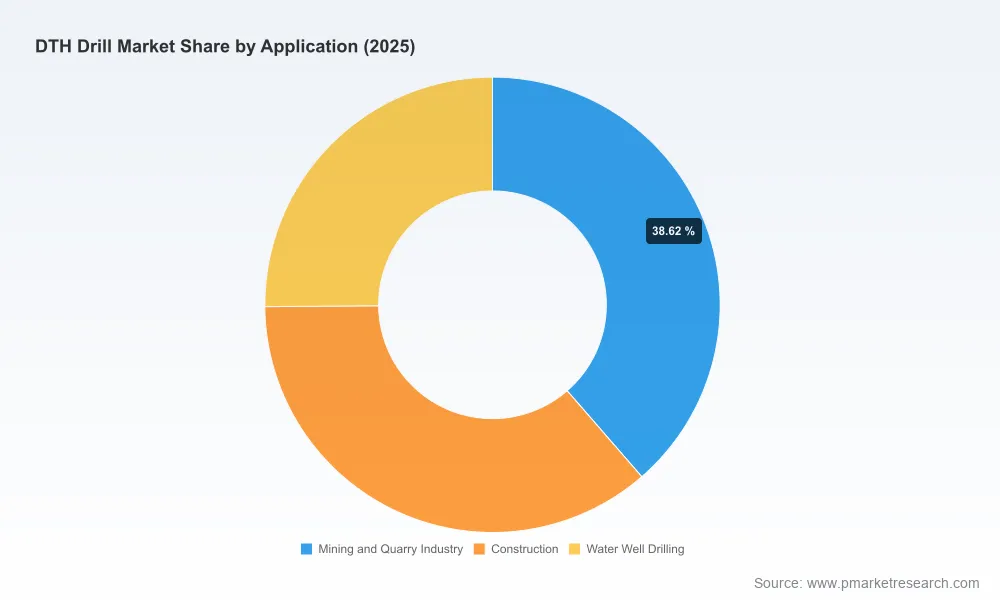
The global Down-The-Hole (DTH) drill market stands at a pivotal juncture as industrial operators recalibrate capital allocation strategies for the upcoming forecasting period. Recent baseline analysis positions the sector at approximately 1,355 million USD in the base year, with a projected trajectory extending toward 1,853 million USD by the close of the forecast horizon. This expansion is underpinned by a steady compound annual growth rate of 4.5 percent, reflecting a mature yet resilient ecosystem where efficiency gains, technological integration, and regional demand shifts converge. For executives navigating procurement cycles, fleet modernization, and long-term capacity planning, this inflection point demands more than incremental adjustments. It requires a structured understanding of how macro trends translate into actionable competitive positioning. Our latest market research synthesizes multi-year historical performance with forward-looking indicators, delivering a decision-ready framework tailored for leadership teams operating in mining, construction, and water infrastructure verticals.
Historical Momentum and Forward Trajectory
Tracing the sector’s evolution from 2020 through 2025 reveals a consistent accumulation of value, driven by sustained demand for precision rock excavation, infrastructure expansion, and resource extraction optimization. Revenue progression has moved from 1,100 million USD to 1,355 million USD over this five-year span, demonstrating steady year-over-year expansion even amid periodic supply chain constraints and shifting raw material pricing. Looking ahead to the 2026 through 2032 forecasting window, the data points toward a continuation of this upward arc, with early-period valuations climbing past 1,433 million USD before stabilizing at higher plateaus as technological maturity and regional adoption curves align. The compound growth rate of 4.5 percent does not merely reflect volume expansion; it encapsulates a broader industry transition where operators prioritize equipment that delivers measurable reductions in operational downtime, fuel intensity, and maintenance overhead. Understanding these trajectory markers enables organizations to model scenario-based procurement strategies, hedge against cyclical volatility, and align capital expenditure with verifiable productivity benchmarks.
Worldwide DTH Hammer Market
Core Market Dynamics Shaping Competitive Outcomes
Several interlocking dynamics are actively reshaping how DTH drilling technologies are evaluated, deployed, and optimized across end-use environments. First, operational efficiency has become a primary procurement criterion. Field implementations leveraging optimized hammer configurations routinely achieve penetration rates approaching 50 meters per hour, while simultaneously shortening bit change intervals by roughly a quarter and reducing air consumption per drilled meter by nearly one-fifth. These efficiency multipliers directly impact total cost of ownership, making performance consistency a decisive factor in fleet composition and vendor selection. Second, sustainability and regulatory compliance are no longer peripheral considerations. Equipment solutions engineered to lower energy draw and improve pneumatic efficiency simultaneously support corporate emissions targets and reduce operating expenditure, creating a dual incentive structure that favors integrated, efficiency-focused tool architectures. Third, the material science underpinning DTH consumables continues to evolve. The utilization of cemented carbide compounds combined with optimized head geometries enables aggressive cutting structures to perform reliably across heterogeneous rock formations, bridging the gap between exploration-grade durability and production-scale throughput. Fourth, digital integration is accelerating the transition from mechanical execution to data-informed operation. Real-time vibration analysis and performance sensing architectures now allow automated mining and infrastructure workflows to adjust parameters on the fly, maximizing productivity while minimizing unnecessary wear. These dynamics collectively redefine what constitutes value in the DTH ecosystem, shifting the conversation from unit price to lifecycle optimization, energy economics, and operational predictability.
DTH Drill Market
Competitive Architecture and Strategic Positioning
The industry landscape reflects a moderately concentrated structure, with the top three participants collectively accounting for approximately 65 percent of market share and the leading five encompassing nearly 80 percent. This concentration signals mature barriers to entry, established distribution networks, and pronounced advantages for incumbents that can sustain engineering leadership, service coverage, and technological differentiation. Within this architecture, several core enterprises define the competitive baseline. Manufacturers headquartered in Northern Europe and Oceania maintain prominent positions through diversified product portfolios spanning COP-series drill bits, hydraulic DTH systems, and digital optimization platforms tailored for hard-rock mining, quarrying, water well development, and infrastructure construction. Additional contributors from Ireland, Australia, Austria, and the United States reinforce the competitive mix with specialized hammer series, sonic-flow technologies, and configurable tooling ranging from compact diameters to large-scale production formats. A parallel ecosystem of Chinese manufacturers has expanded its footprint by offering air hammers, water hammers, button bits, and customized DTH assemblies positioned for construction, mining, and foundation applications. This multi-tier competitive field requires organizations to evaluate not only headline product capability but also regional service responsiveness, consumables availability, digital compatibility, and total cost-per-meter economics. Recent developmental milestones further illustrate how incumbents are actively shaping the next competitive cycle. Digital sensing systems and real-time performance optimization tools have been introduced to enable automated workflow integration. Catalog updates have emphasized penetration rate improvements and fuel efficiency reductions per meter, signaling a clear industry emphasis on operational cost containment. New hammer configurations and catalog expansions have broadened application coverage across mining, construction, and water well segments. Resharpening equipment introductions have reinforced circular productivity models for both DTH and top hammer applications. Fresh production-line launches have highlighted stable impact force delivery and reduced air consumption, aligning with broader sustainability and efficiency objectives. For procurement and strategy teams, mapping these trajectories against internal operational requirements becomes essential for identifying partnership structures that deliver measurable performance gains rather than isolated equipment transactions.
Report Architecture and Analytical Depth
The research publication is structured to support rigorous, scenario-aware decision-making across the 2026 onward planning horizon. The analytical framework begins with a comprehensive historical reconstruction spanning the 2020 through 2025 window, establishing baseline performance patterns and contextualizing year-over-year variance. From that foundation, the forecast model projects revenue evolution through 2032, enabling organizations to test procurement timing, capacity expansion thresholds, and market entry assumptions against credible growth pathways. The segmentation architecture dissects the market across regional distributions, product classifications, and application verticals, providing the granularity necessary to isolate high-potential deployment environments while avoiding uniform growth assumptions. Competitive profiling extends beyond static corporate summaries to incorporate recent product introductions, catalog realignments, and technology-focused initiatives, allowing readers to benchmark vendor roadmaps against internal innovation timelines. Industry context variables, including labor cost implications, regulatory influences, raw material considerations, and macro-level productivity trends, are woven into the analysis to illustrate how external pressures translate into tactical adjustments. Whether the objective is fleet rationalization, geographic expansion planning, supplier negotiation strategy, or technology adoption sequencing, the report’s modular design supports targeted extraction of relevant intelligence without requiring readers to navigate unrelated market layers.
Strategic Applications for Enterprise Decision-Making
Translating macro-level intelligence into executable strategy requires a clear line of sight between market signals and internal operational priorities. Organizations evaluating DTH drilling investments can leverage this research to address several critical decision domains. Procurement teams can calibrate replacement cycles and new equipment acquisitions by aligning anticipated efficiency improvements with total cost-per-meter modeling, reducing the risk of premature depreciation or under-optimized fleet mixes. Engineering and operations leaders can assess which technological enhancements, such as real-time performance sensing, optimized hammer configurations, or consumables with extended service intervals, deliver the most material impact on downtime reduction and throughput consistency. Market development groups can evaluate regional demand footprints and application-specific growth patterns to prioritize expansion, distributor partnerships, or localized service investments. Executive leadership can use concentration metrics and vendor roadmaps to inform negotiation positioning, supply chain diversification, and long-term supplier relationship strategies. By anchoring these decisions in structured, forward-looking analysis rather than reactive market observations, organizations can convert market growth trajectories into measurable competitive advantage.
Conclusion and Next Steps
The DTH drill market of 2026 and beyond will reward organizations that treat equipment selection, technology adoption, and supplier strategy as interconnected components of a broader operational architecture. Steady growth, converging efficiency imperatives, and increasingly sophisticated digital tooling create a landscape where incremental optimization yields compounding returns. This research equips leadership teams with the structural insight necessary to navigate those dynamics, identify high-value deployment pathways, and align capital allocation with verifiable performance outcomes. For organizations seeking the full segmentation breakdown, detailed forecast tables, competitive profiling depth, and scenario-ready analytical models, the complete market study provides the comprehensive intelligence required to advance from strategic awareness to execution-ready planning.
For detailed analysis of this topic, please visit the official page: DTH Drill Market
Lacy Lee
Senior Marketing Manager
[email protected]
PW Consulting: www.pmarketresearch.com



























Sign in to leave a comment.