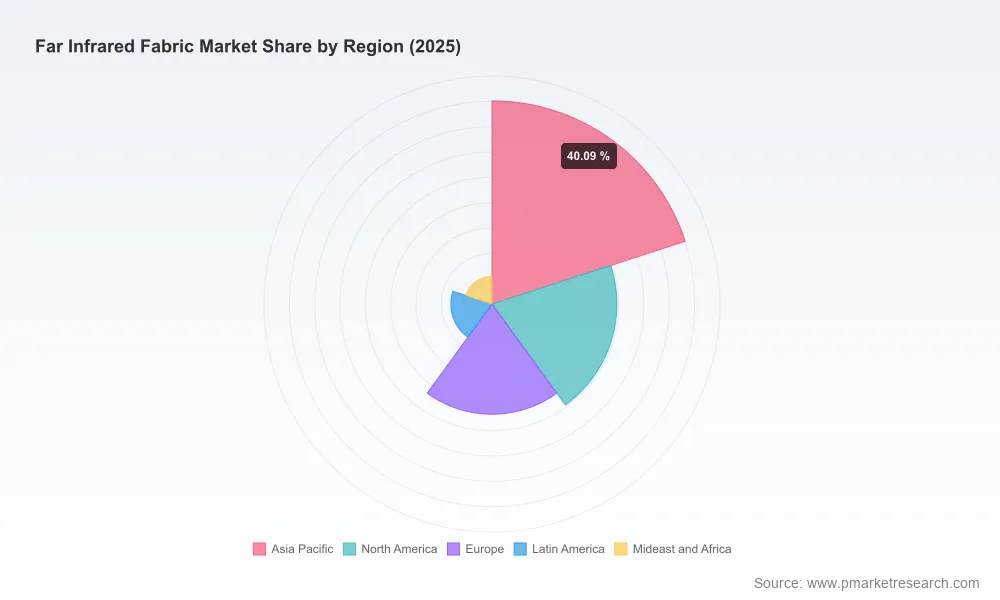

Navigating the Thermal Frontier: Why 2026 Strategic Decisions Require Precision in the Far Infrared Fabric Market
The global textile industry is witnessing a subtle but decisive shift in how performance, wellness, and thermal comfort are engineered into everyday materials. Far infrared fabric, once relegated to niche athletic sleeves or regional wellness claims, is now transitioning into a mainstream functional category with measurable commercial momentum. For executives, product leaders, and supply chain strategists operating in 2026, the question is no longer whether far infrared textiles represent a viable opportunity, but how to position portfolios, sourcing strategies, and compliance frameworks amid accelerating adoption and evolving regulatory expectations.
Our newly released Worldwide Far Infrared Fabric Market study is designed specifically for this decision window. Rather than offering a surface-level snapshot, the report delivers a structured intelligence framework that maps historical performance, forecast trajectories, segment behaviors, and competitive positioning across a global landscape. The analysis is anchored in observable market signals and built to support actionable planning through 2032. In a category where technology claims, material formulations, and consumer trust intersect, the difference between confident expansion and speculative risk often comes down to data granularity.
The Market Trajectory at a Glance
Over the historical window from 2020 to 2025, the far infrared fabric market demonstrated consistent expansion, rising from approximately 540.2 million USD to 785.4 million USD. That growth path reflects more than a temporary trend cycle; it signals a widening acceptance of infrared-functional textiles across performance apparel, therapeutic applications, and home wellness categories. Looking forward, the market is projected to continue its upward course through the 2026 to 2032 forecast period, reaching an estimated 1.35 billion USD by 2032.
The compound annual growth rate of 8.01% reinforces the strategic relevance of this space. For corporate planners, that trajectory suggests a market large enough to justify dedicated innovation budgets, yet still fragmented enough that timing, positioning, and material sourcing decisions can materially shape competitive outcomes. As categories mature, the companies that succeed will be those able to align R&D roadmaps with realistic adoption curves, rather than relying on generalized growth narratives.
What the Report Delivers for 2026 Decision-Making
Strategic advantage in this market depends on understanding not just the size of the opportunity, but its architecture. The report breaks the global landscape into practical lenses that executives can use to evaluate where to invest, where to partner, and where to defend existing positions. Instead of stopping at top-line figures, the analysis moves into the structural dynamics that shape procurement, product development, and go-to-market choices.
Key areas of operational focus include:
Worldwide Infrared Massage Therapy Bed Market
- Historical expansion patterns and forward-looking projections that support capacity planning, revenue modeling, and scenario-based forecasting
- Segment-level evaluation across fiber types, application categories, and regional demand patterns, helping teams identify where functional differentiation and price tolerance are most pronounced
- Competitive profiling of leading technology developers and textile manufacturers, with context on proprietary formulations, certification paths, and commercial partnerships
- Market concentration insights that clarify the balance between established players and emerging entrants, supporting supplier diversification and partnership strategies
- Material and manufacturing context, including how ceramic particles, mineral additives, and graphene-enhanced variants influence performance claims, durability, and cost structures
- Regulatory and claims environment considerations that affect labeling, marketing language, and product positioning across different jurisdictions
By integrating these dimensions into a single research framework, the report enables cross-functional teams to move from curiosity to execution. Product developers can benchmark technical approaches. Commercial leaders can assess where far infrared features justify premium positioning. Sourcing and strategy teams can better evaluate supplier resilience and innovation readiness.
Competition, Innovation, and the Importance of Differentiation
The competitive landscape in far infrared textiles is shaped by a mix of specialized technology providers, established fiber innovators, and manufacturers seeking to embed functional benefits into broader material portfolios. The market does not belong to a single dominant model; rather, it contains multiple viable approaches, from mineral-infused yarns to ceramic-particle composites and graphene-related enhancements. That diversity is both an opportunity and a complexity.
Worldwide Heated Fabric Market
Several high-profile contributors illustrate the breadth of current innovation. Hologenix, LLC (CELLIANT) has built a recognized infrared technology platform around natural minerals embedded into fibers and fabrics, with a regulatory footprint that includes Class 1 medical device status in multiple markets. The LYCRA Company has advanced THERMOLITE FAR INFRARED fiber, emphasizing lightweight thermal performance for legwear, socks, activewear, and outerwear, while also exploring sustainability-aligned variants. Hitek Textile Co., Ltd. focuses on SiTEX FIR yarn and related fabric constructions, using a mineral-refined polymer approach and offering OEM/ODM pathways for global brands.
Across Asia and Europe, additional players are expanding the technical palette. NUREL Synthetic Fibers produces NERIDE FIR PA6 nylon yarn with gemstone mineral additives targeting circulation, recovery, and rest applications. Sportingtex manufactures far infrared thermal fabric using ceramic nanoparticles and provides a broad SKU range spanning sportswear, medical care, bedding, and related categories. Acelon supplies medical-oriented yarns with far-infrared microelements for health care, sports, and rehabilitation use cases. FIRBEST Co., Ltd. (KODENSHI) centers on patented ceramic-particle compounding technology for functional textiles. Hyosung Corporation integrates far-infrared yarn concepts with moisture management for performance textiles. RadiciGroup contributes polyamide fabric options with infrared-emission properties, while Energy Textiles, LLC markets ceramic-particle-based textiles aimed at performance, recovery, and sleep applications.
In total, the market reflects a moderately concentrated environment, characterized by enough fragmentation to allow new entrants and specialized solutions, yet enough concentration to signal meaningful barriers in credible validation, manufacturing consistency, and regulator-facing claims. That structure matters for strategists because it shapes deal flow, partnership options, and the credibility required to scale a product beyond pilot programs.
Regulatory Context, Material Economics, and Claims Discipline
One of the most underestimated risks in far infrared textiles is not technical feasibility, but claim substantiation and compliance alignment. Infrared functional fabrics often rely on emissivity characteristics, mineral loading, and energy-recycling narratives that can be interpreted very differently across consumer markets, health-oriented categories, and regulated product classes. Companies that treat claims as a marketing afterthought often face friction later, especially when expanding into therapeutic, medical-adjacent, or retail environments with strict labeling expectations.
This is where disciplined product positioning becomes strategic. For instance, some infrared technologies have been reviewed through regulatory pathways associated with temporary increases in local circulation claims for healthy individuals, and certain solutions carry Class 1 medical device designations in select regions. At the same time, relevant markets may apply standardized emissivity testing and third-party laboratory verification to support performance statements. These dynamics influence not only marketing language, but also product development priorities, documentation practices, and partnership decisions with brands that require defensible claims.
Material economics introduce another layer of complexity. Far infrared fabrics commonly incorporate ceramic nanoparticles, mineral powders, or graphene into polyester, nylon, or other base fibers through melt-spinning or related polymerization methods. Depending on loading levels and intended use, graphene-enhanced variants can command a noticeable price premium over conventional performance fabrics. Durability considerations also matter: manufacturers and buyers alike need confidence that functional benefits persist through repeated washing and real-world use. In this context, the report's value lies in connecting technical assertions to commercial realities, so teams can evaluate whether a promising claim translates into a scalable, margin-viable product.
PW Consulting
Recent Industry Activity and What It Signals for the Near Term
Recent company-level activity points to a market that is actively refining its offering set and expanding the contexts in which infrared textiles appear. Product promotions, catalog updates, and technology launches throughout the period covered by the research indicate continued attention to customization, OEM/ODM capability, and performance narratives tied to circulation, thermal comfort, recovery, and sleep. Several players have emphasized sustainable production elements alongside functional claims, reflecting the broader expectation that performance textiles must also satisfy sourcing, environmental, and brand-value criteria.
These developments are strategically relevant because they show where the market is trying to create differentiation. Customizable FIR options, specialized legwear and sock applications, jacquard and lace constructions, and functional blends for athletic wear all suggest that product designers are moving beyond a single “infrared fabric” concept and toward category-specific solutions. For competitors and investors, that shift highlights the need to evaluate far infrared not as a uniform commodity, but as a family of technologies with different performance profiles, manufacturing requirements, and buyer expectations.
Why the Full Study Is the Next Logical Step
Executive summaries and public announcements can point to direction, but they rarely provide the level of detail needed to commit capital, restructure sourcing, or choose between competing technology paths. A market of this scale and complexity requires a careful reading of how segments interact, how concentration influences supplier power, and how technical claims map onto realizable market value. The Worldwide Far Infrared Fabric Market report is built to meet that need.
At a moment when thermal wellness, recovery-oriented apparel, and functional home textiles are all competing for attention, the companies that make informed choices will be those able to test assumptions against credible market evidence. The study gives decision-makers a way to validate growth expectations, assess segment attractiveness, and understand where competitive intensity is likely to intensify. It also supports more disciplined conversations with internal stakeholders by grounding strategy in structured data rather than fragmented news flow.
Positioning for the Rest of the Decade
The 2026 to 2032 outlook for far infrared fabric is not simply a story of rising revenue; it is a story of maturation. As adoption broadens, the market will likely reward players who can balance innovation with credibility, and opportunity with operational discipline. That means paying closer attention to formulation consistency, wash durability, test standards, claims compliance, and the economics of premium functional additives. It also means recognizing that regional demand patterns, application preferences, and fiber-type leadership will shape where different business models succeed.
Our research is intended to help organizations navigate that transition with clarity. For strategy teams, the report offers a foundation for market entry, expansion, and portfolio decisions. For product and supply chain leaders, it provides context on technology approaches and segment behavior. For commercial teams, it creates a basis for more precise positioning in a category where differentiation must be both technically credible and commercially sustainable.
The broader opportunity is real, but the details determine the outcome. With historical growth established and a multi-year expansion path ahead, far infrared fabric is entering a phase where informed strategy matters more than ever. The full study provides the depth required to move from market awareness to executable advantage.
For detailed analysis of this topic, please visit the official page: Worldwide Far Infrared Fabric Market
Lacy Lee
Senior Marketing Manager
[email protected]
PW Consulting: www.pmarketresearch.com



























Sign in to leave a comment.