
Strategic Intelligence for the 2026 Industrial Landscape: Inside the Worldwide Industrial Burden Carrier Market
The industrial sector stands at a pivotal crossroads. As organizations navigate the dual pressures of decarbonization mandates and escalating material handling demands, the Worldwide Industrial Burden Carrier Market emerges as a critical barometer of operational resilience and strategic foresight. This comprehensive market study delivers the analytical precision decision-makers require to transform raw market signals into actionable growth strategies.
Understanding the burden carrier ecosystem is no longer optional for logistics directors, manufacturing executives, and procurement leaders. These specialized industrial vehicles form the backbone of intra-facility material movement, bridging the gap between heavy machinery and human-operated workflows. The study provides a rigorous examination of market trajectories, competitive positioning, and technological shifts that will define the next seven years of industrial operations.
Market Trajectory and Growth Dynamics
The market analysis establishes a clear growth narrative rooted in historical performance and forward-looking projections. Drawing on a comprehensive dataset spanning 2020 through 2025, the research captures the sector's recovery and acceleration patterns before projecting expansion through 2032. The global burden carrier market generated approximately 420.5 million USD in revenue during 2020, climbing steadily to reach an estimated 535.4 million USD by 2025. This progression reflects sustained investment in facility modernization and the gradual replacement of aging material handling equipment across industrial zones worldwide.
The forecast period from 2026 to 2032 reveals a compelling growth arc. Market revenue is projected to advance from 552.9 million USD in 2026 to approximately 750.85 million USD by 2032, representing a compound annual growth rate of 4.95 percent. This expansion trajectory underscores the sector's resilience against macroeconomic volatility and its alignment with broader industrial automation trends. Organizations evaluating capital expenditure plans for the coming fiscal years must account for this sustained demand curve when assessing supply chain capacity and vendor partnerships.
Several structural forces converge to propel this growth. Warehouse automation initiatives continue to accelerate as labor shortages reshape operational models across manufacturing and logistics sectors. Facilities are increasingly turning to burden carriers as force multipliers, reducing manual material handling while improving throughput consistency. Simultaneously, regulatory frameworks across more than sixty countries now emphasize zero-emission mandates and indoor air-quality standards. These policies, including elements of the EU Green Deal and evolving US EPA guidelines, create a decisive preference for electric propulsion over internal combustion alternatives, fundamentally reshaping purchasing criteria for fleet managers.
Competitive Landscape and Strategic Positioning
The study provides a granular analysis of the companies shaping market dynamics, examining their product portfolios, geographic footprints, and innovation pipelines. The burden carrier sector operates with a moderately concentrated competitive structure. Market concentration analysis reveals a three-firm concentration ratio of approximately 38.45 percent and a five-firm concentration ratio of 52.12 percent, indicating that while leading players command significant share, the market retains room for specialized manufacturers and regional specialists to compete effectively.
Several established manufacturers define the category's strategic contours. Motrec International Inc., headquartered in Quebec, Canada, delivers customizable electric flatbed burden carriers with load capacities extending to 5,000 lbs, targeting heavy-duty material transport across industrial facilities and manufacturing plants. Taylor-Dunn Manufacturing Company, based in Anaheim, California, has carved a strong position with its Bigfoot series models, offering payloads up to 3,000 lbs and towing capabilities exceeding 10,000 lbs, well-suited for warehouses, railyards, airports, and confined industrial pathways.
Cushman, under Textron Specialized Vehicles in Augusta, Georgia, supplies a diversified lineup including the Titan HD, Minute Miser, and Stock Chaser models, addressing both personnel and material transport requirements in manufacturing and commercial industrial environments. Pack Mule, operating under Capacity Trucks in the United States, manufactures the heavy-duty NXG and ALPHA series electric burden carriers, emphasizing high payload and towing specifications for manufacturing plants, warehouses, and distribution centers. Johnson Industries Inc., based in Kentucky, focuses on operator safety and efficiency, producing industrial burden carrier vehicles tailored for mining and heavy industrial applications where durability and reliability remain paramount.
Additional players contribute specialized capabilities to the market. Trowin Industries in the United States provides flatbed burden carriers designed for maintenance, rescue, baggage handling, and passenger transport within industrial settings. Columbia ParCar Corp, headquartered in Reedsburg, Wisconsin, supplies the Payloader Pro and other electric burden carriers optimized for industrial material and personnel movement. Bobcat Company, based in West Fargo, North Dakota, has introduced the BBC23S-7 and BBC28S-7 electric burden carriers with carrying capacities ranging from 4,400 to 6,600 lbs and towing capabilities up to 8,800 lbs, targeting warehouse and construction facility applications. Toyota Material Handling, headquartered in Columbus, Indiana, integrates industrial burden carriers into its broader material handling portfolio, emphasizing intra-facility transport efficiency. HC Forklift America, operating in the United States, introduces lithium-ion electric burden carriers with multi-seater configurations for material, equipment, and personnel transport across manufacturing facilities, airports, and workshops.
Recent product launches and market developments illustrate the competitive intensity driving innovation. In March 2026, HC Forklift America showcased a new lithium-ion burden carrier featuring a four-seater option and enclosed cabin configuration at the ARA Show, signaling continued investment in operator comfort and battery technology. Earlier in the year, Bobcat Company expanded its 2026 lineup with the BBC28S-7 electric burden carrier, highlighting enhanced warehouse capabilities. In March 2025, Taylor-Dunn launched the Bigfoot S series, incorporating a larger operator compartment and improved ergonomics specifically calibrated for burden carrier applications. These developments reflect a broader industry shift toward operator-centric design and lithium-ion power architectures.
Segmentation Frameworks and Application Realities
The study dissects market demand across propulsion types, end-use sectors, and geographic distributions, providing the segmentation intelligence necessary for targeted product strategy and channel planning. The propulsion segment reveals a decisive tilt toward electric architectures. Electric burden carriers command the dominant share of market revenue, reflecting the cumulative impact of environmental regulations, total cost of ownership advantages, and operational suitability for indoor and controlled environments. Internal combustion models retain relevance in specific outdoor and heavy-duty applications, but their growth trajectory faces structural headwinds from decarbonization policies and shifting facility air-quality standards.
End-use sector analysis illuminates where burden carriers deliver the greatest operational value. Manufacturing applications represent the largest revenue contribution, driven by continuous production environments that require reliable intra-facility material movement and integration with automated workflows. Logistics and warehousing follows closely, reflecting the sector's reliance on burden carriers for package handling, inventory replenishment, and dock-to-storage transport. Aviation operations constitute a specialized but significant segment, where burden carriers support baggage handling, maintenance workflows, and ground support activities. Healthcare and hospitality environments also deploy these vehicles for equipment transport and facility maintenance, while other industrial applications round out the demand landscape.
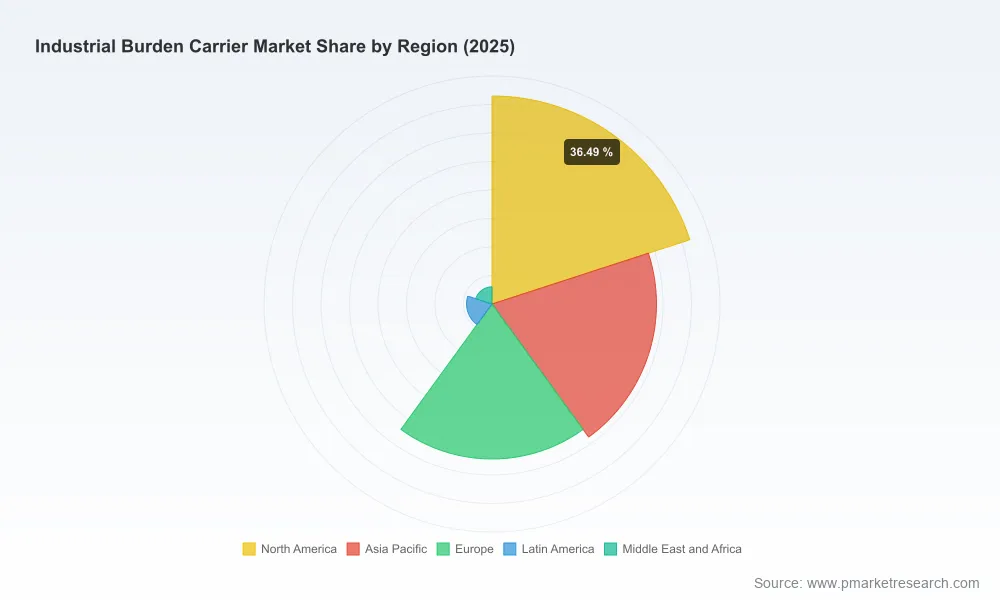
Geographic distribution analysis further contextualizes market opportunities. North America currently represents the largest revenue region, reflecting mature industrial infrastructure, sustained capital investment in facility modernization, and the presence of multiple leading manufacturers. Asia Pacific contributes the second-largest share, supported by expanding manufacturing capacity, logistics network development, and increasing adoption of electric industrial equipment. Europe maintains a substantial market presence, shaped by environmental regulations, industrial automation trends, and established manufacturing bases. Latin America and the Middle East and Africa represent smaller but growing markets, where burden carrier adoption aligns with infrastructure development and industrial capacity expansion. Detailed regional revenue breakdowns and application-specific volume data are available within the complete report, enabling precise market sizing for strategic planning.
Material Cost Pressures and Supply Chain Considerations
Strategic decision-making in 2026 requires sensitivity to input cost dynamics that directly affect burden carrier manufacturing economics and procurement timing. Global iron ore prices, particularly the benchmark for China's 62 percent Fe imported fines priced on a cost-and-freight basis, are forecast to decline from approximately 100 USD per metric ton in 2025 to roughly 90 USD per metric ton in 2026. This downward movement influences steel costs for burden carrier chassis and structural frames, potentially easing input cost pressures for manufacturers and creating favorable procurement windows for fleet buyers.
Simultaneously, steel pricing in North American markets presents a more complex picture. US Midwest hot-rolled coil steel prices are expected to operate within a range of approximately 980 to 1,060 USD per short ton during early 2026, with flat to slightly rising trends influenced by tariff structures and manufacturing activity levels. Buyers and manufacturers must navigate these divergent regional pricing dynamics when negotiating component contracts, evaluating build-vs-buy decisions, and timing capital equipment purchases to optimize total cost of ownership.
Regulatory and Operational Dynamics
The regulatory landscape continues to reshape burden carrier design requirements and operational protocols. ISO 3691-1 safety requirements and verification protocols for self-propelled industrial trucks remain the active standard governing design and operation of related equipment. While certain supplementary parts may exclude burden-carrier trucks from specific clauses, the overarching safety framework influences engineering specifications, compliance testing, and liability considerations across the industry. Manufacturers and end-users alike must maintain rigorous adherence to evolving safety standards as product lines expand and operational environments grow more complex.
Industrial UPS Market
Beyond safety regulation, the dominant market force centers on environmental compliance. Government zero-emission mandates and indoor air-quality regulations across more than sixty countries actively drive demand for electric burden carriers. The EU Green Deal and US EPA guidelines exemplify regulatory trajectories that favor electric propulsion, creating procurement incentives, carbon accounting advantages, and operational compliance benefits for facilities transitioning away from internal combustion equipment. This regulatory tailwind reinforces the electric segment's growth momentum and encourages manufacturers to prioritize lithium-ion battery integration, charging infrastructure compatibility, and emissions-free operational profiles.
Labor dynamics further compound the strategic case for burden carrier adoption. Rising warehouse automation and persistent labor shortages across manufacturing and logistics sectors increase reliance on burden carriers to improve operational efficiency and reduce manual material handling burdens. Facilities are deploying these vehicles not merely as replacements for older equipment but as integral components of labor-optimized workflows, allowing existing workforces to focus on higher-value tasks while burden carriers manage repetitive transport routes, load consolidation, and inter-zone material movement.
What the Full Study Delivers
This market study functions as a strategic instrument rather than a static data compilation. Decision-makers gain access to a structured analytical framework that maps market sizing, growth trajectories, competitive positioning, and demand segmentation into a coherent narrative for executive planning. The report examines historical performance patterns from 2020 through 2025, establishes forecast models spanning 2026 to 2032, and contextualizes those projections within the regulatory, material cost, and labor dynamics shaping the sector.
Readers will find detailed propulsion type analysis, end-use sector mapping, and regional distribution intelligence that support product portfolio strategy, channel development, and market entry evaluations. The competitive landscape section profiles leading manufacturers, their product capabilities, headquarters locations, and recent development activity, enabling benchmarking and partnership assessment. Material cost trends and regulatory developments are integrated into the analysis, ensuring that strategic recommendations account for the operational realities of procurement, compliance, and workforce optimization.
For organizations evaluating capital expenditure, fleet renewal cycles, or expansion into new industrial markets, the complete study provides the granular segmentation data, regional revenue allocations, and application-specific volume breakdowns necessary to build financially rigorous business cases. Detailed figures for each segmentation category and region are presented within the full report, enabling precise scenario modeling and investment prioritization.
PW Consulting
Conclusion: Positioning for 2026 and Beyond
The Worldwide Industrial Burden Carrier Market is evolving under the combined influence of electrification mandates, automation-driven labor optimization, and competitive innovation in electric and lithium-ion architectures. Market revenue is projected to expand steadily through 2032, supported by manufacturing, logistics, aviation, and healthcare applications that depend on reliable intra-facility material handling. Regulatory frameworks across numerous jurisdictions continue to favor electric propulsion, while material cost fluctuations and labor shortages reinforce the operational case for burden carrier deployment.
Organizations that align their procurement, fleet planning, and partnership strategies with these structural trends will be better positioned to manage total cost of ownership, maintain compliance, and sustain throughput quality as industrial operations grow more complex. The complete market study delivers the segmentation precision, competitive intelligence, and forward-looking analysis required to convert these market dynamics into informed strategic decisions. Detailed regional figures, application breakdowns, and comprehensive vendor evaluations are available in the full report, providing the depth necessary for confident executive action in 2026 and the forecast period ahead.
Hand Trucks Market
For detailed analysis of this topic, please visit the official page: Worldwide Industrial Burden Carrier Market
Lacy Lee
Senior Marketing Manager
[email protected]
PW Consulting: www.pmarketresearch.com



























Sign in to leave a comment.