
Navigating the Next Wave: Strategic Intelligence in the Worldwide Multi-PCR Detection Market
Setting the Stage for 2026 Decision-Making
The molecular diagnostics landscape is entering a decisive inflection point. As healthcare systems globally shift from reactive testing to proactive, multiplex-driven pathogen surveillance, the commercial architecture surrounding multi-PCR detection is being rewritten in real time. For executives, investors, and strategic planners, understanding this transition is no longer optional. It is a prerequisite for capital allocation, product development roadmaps, and market entry timing. Our newly released Worldwide Multi-PCR Detection Market research study delivers a structured, data-grounded view of this evolving ecosystem, translating macroeconomic trajectories into actionable intelligence tailored for 2026 planning cycles.
Between 2020 and 2025, the global market expanded from approximately USD 3,450 million to USD 5,450 million, reflecting sustained demand for simultaneous multi-target amplification across clinical, public health, and applied research settings. Forward-looking projections through 2032 indicate continued upward momentum, with an estimated compound annual growth rate of 8.5 percent and a projected revenue trajectory approaching USD 9.65 billion by the end of the forecast window. These figures are more than historical snapshots. They represent a structural shift in how diagnostic workflows are designed, reimbursed, and scaled. The study contextualizes this growth within operational realities—supply chain volatility, evolving regulatory thresholds, and reimbursement recalibrations—ensuring that strategic teams can separate short-term cyclical noise from durable market expansion.
What the Research Delivers: Actionable Frameworks, Not Just Headlines
Market research at the executive level must move beyond aggregate sizing. This study is engineered to support operational planning, competitive positioning, and scenario modeling. It maps the full value chain of multi-PCR detection, from instrument platforms and reagent architectures to software-driven data interpretation and downstream service networks. Readers will find a structured breakdown of how revenue flows across product categories, how application demand partitions across clinical and non-clinical verticals, and how regional purchasing behaviors diverge under varying healthcare funding models.
The report also integrates forward-looking demand signals tied to workflow automation, panel expansion, and point-of-care migration. Rather than presenting static tables, the analysis frames each segment through operational implications. For procurement leaders, the study highlights where reagent consumption patterns are reshaping inventory strategies. For R&D and product management teams, it maps the intersection between platform capability and clinical adoption curves. For corporate development, it identifies which application domains are experiencing the fastest panel iteration cycles and where diagnostic laboratories are standardizing multi-target workflows versus maintaining legacy single-plex approaches.
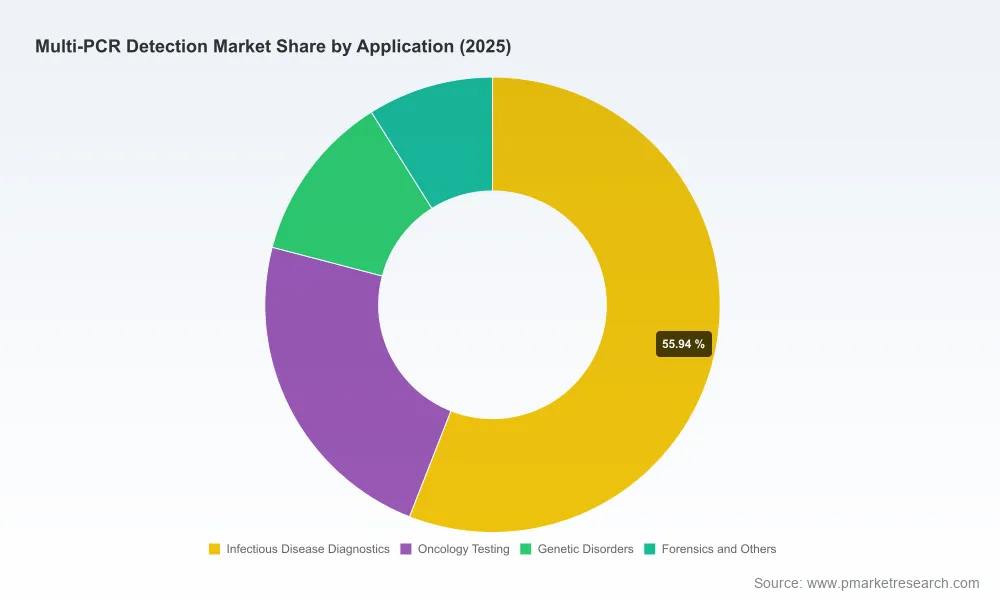
To maintain analytical integrity, the study deliberately separates high-level market architecture from granular sub-segment disclosures. Breakdowns that require detailed regional splits, application-level revenue attribution, or product-type percentage allocations are reserved for the full dataset. This design ensures that commercial teams relying on the public overview can validate strategic direction without exposing sensitive competitive intelligence prematurely, while authorized stakeholders gain access to the complete segmentation logic needed for modeling and forecasting.
Pathogen Detection Market
Competitive Landscape: Who Is Shaping the Multi-PCR Arena
The multi-PCR detection market is defined by a concentrated yet highly dynamic competitive field. The study profiles ten cornerstone players whose platform strategies, assay portfolios, and recent market moves illustrate the broader industry trajectory. Rather than treating these companies as isolated profiles, the analysis situates them within overlapping strategic vectors: automation readiness, panel breadth, regulatory cadence, and integration with laboratory information ecosystems.
QIAGEN continues to reinforce its position through modular automation and multiplex kit architecture, most recently extending its respiratory diagnostic coverage with a panel designed to detect 28 pathogens simultaneously. Roche Diagnostics has leaned into high-throughput platform reliability, securing regulatory clearance for combined SARS-CoV-2 and influenza multiplex testing on its cobas systems, a move that underscores the ongoing institutional demand for consolidated respiratory workflows. Abbott Laboratories has advanced its Alinity m ecosystem with multiplex capabilities spanning respiratory viruses and emerging pathogens, while also navigating recent regulatory milestones for specialized viral assays.
Bio-Rad Laboratories maintains differentiation through digital PCR technologies and multiplex supermix formulations that support high-specificity multi-target quantification. Thermo Fisher Scientific continues to anchor its portfolio around flexible instrumentation and TaqMan-based multiplex assay chemistry, catering to both gene expression and pathogen detection workflows. BioFire Diagnostics, operating within the bioMérieux network, has expanded the clinical utility of its FilmArray platform by broadening bacterial target coverage within pneumonia panels, reflecting the clinical push toward faster, panel-based differential diagnosis.
Cepheid, under Danaher’s portfolio, has extended its cartridge-based model into viral load monitoring use cases, reinforcing the role of integrated multi-PCR systems in chronic infection management. Hologic continues to align its Panther system and Aptima assay suite with women’s health and STI testing priorities, an area where multiplex efficiency directly influences laboratory throughput. Luminex, now part of DiaSorin, contributes a distinct multi-analyte profiling approach that complements bead-based multiplex assay designs. Meridian Bioscience rounds out the strategic field with focused cartridge-driven testing for gastrointestinal and respiratory pathogens, illustrating how niche workflow optimization can secure sustained institutional adoption.
PW Consulting
These profiles are not presented in isolation. The study compares platform economics, panel expansion patterns, and deployment models to reveal where competitive pressure is intensifying and where differentiation is becoming increasingly dependent on service integration, regulatory navigation, and laboratory workflow compatibility.
Market Dynamics Shaping Strategy in 2026
Strategic planning for multi-PCR detection cannot be decoupled from the operational forces reshaping adoption. The study integrates several structural dynamics that will influence commercial outcomes throughout the forecast period.
- Regulatory evolution: Multiplex PCR kits intended for high-risk infectious disease panels are facing heightened classification expectations, with regulatory frameworks moving toward stricter certification requirements by 2028. This creates a dual impact: longer validation cycles for new entrants, and a competitive advantage for established players with mature quality systems and existing regulatory footprints.
- Reimbursement architecture: Updated coding and payment structures for multiplex respiratory panels are influencing laboratory purchasing behavior. Reimbursement levels tied to specific multiplex codes alter the cost-benefit calculus for panel adoption, making reimbursement alignment a central consideration for product positioning and pricing strategy.
- Input cost pressures: Enzyme and reagent supply dynamics have introduced volatility into per-test economics. Rising polymerase costs and supply chain constraints are prompting laboratories and manufacturers alike to reevaluate batching strategies, inventory buffering, and alternative formulation pathways.
- Clinical-use boundaries: Distinctions between research-use-only formats and cleared diagnostic applications remain critical. Multi-PCR panels developed for exploratory research cannot be deployed in clinical diagnostics without appropriate regulatory clearance, a constraint that shapes both market entry timing and commercialization sequencing.
- Public health alignment: International prequalification standards for specific disease areas are raising sensitivity expectations for multi-target assays. This is reinforcing demand for rigorously validated panels in global health contexts and influencing procurement preferences among institutional buyers.
Together, these dynamics create a market environment where technical performance alone is insufficient. Competitive advantage increasingly depends on regulatory readiness, reimbursement alignment, supply chain resilience, and the ability to integrate multi-PCR workflows into existing laboratory operations with minimal friction.
Worldwide Medical PCR Analysis System Market
Why This Study Matters for 2026 Planning
The 2026 planning cycle requires more than directional optimism. It demands a clear view of where growth is structurally supported, where competition is consolidating, and where operational risks may erode expected returns. This study provides that view by connecting market sizing logic to the practical decisions that shape commercial outcomes. It helps executives answer questions that directly influence resource allocation: which workflow models are gaining laboratory traction, where panel expansion is accelerating adoption, how regulatory and reimbursement shifts may alter margin structures, and which competitive moves signal broader market redirection.
For organizations evaluating market entry, expansion, partnership strategy, or portfolio optimization, the report offers a disciplined framework for interpreting demand signals without relying on assumptions. It isolates the operational variables that determine whether multi-PCR adoption translates into sustainable revenue or remains constrained by workflow fit, regulatory timing, or reimbursement misalignment.
Access the Full Intelligence
This overview is designed to establish strategic context while preserving the depth that decision-makers require. Regional revenue distributions, application-level splits, product-type allocations, and detailed competitive benchmarks are maintained within the complete dataset to support precise modeling and confidential strategic planning. To explore the full segmentation architecture, forecast pathways, and proprietary market concentration analysis, access the complete Worldwide Multi-PCR Detection Market research report through our official study portal.
The multi-PCR detection market is moving quickly, but strategic clarity does not have to be reactive. With the right intelligence, organizations can align product strategy, commercial execution, and investment planning to the structural forces that will define the next phase of growth.
For detailed analysis of this topic, please visit the official page: Worldwide Multi-PCR Detection Market
Lacy Lee
Senior Marketing Manager
[email protected]
PW Consulting: www.pmarketresearch.com





























Sign in to leave a comment.