
Strategic Intelligence for the Trailer Axle Market: Navigating Growth and Disruption Through 2032
The global trailer axle market stands at a critical inflection point. As supply chains recalibrate and regulatory frameworks tighten, manufacturers and investors require more than superficial data to secure their positions. This market research study provides a comprehensive examination of the industry landscape from 2020 through the forecast period ending in 2032. For enterprise decision-makers, the value of this report lies not merely in historical tracking but in the strategic foresight required to navigate the complexities of the upcoming years. The following analysis outlines the market trajectory, competitive dynamics, and operational challenges that define this sector, offering a roadmap for informed capital allocation and product development strategies.
Market Trajectory and Velocity
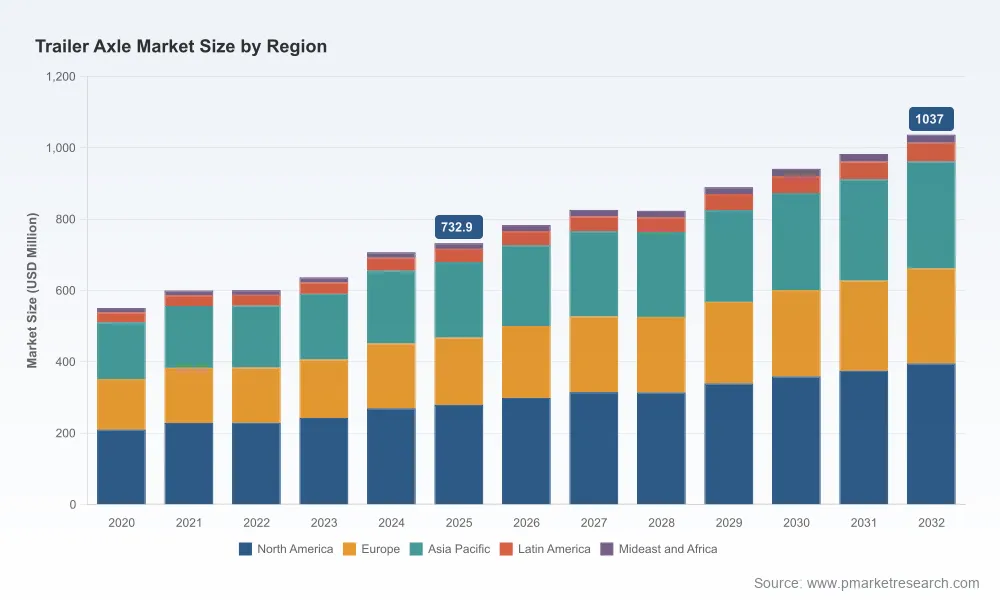
Understanding the historical momentum is essential for validating future projections. Over the historical review period from 2020 to 2025, the market demonstrated resilience and steady expansion, recovering from initial global disruptions to establish a robust baseline. The revenue generated during this phase underscores the essential nature of trailer axles in logistics, construction, and recreational transportation. Building on this foundation, the forecast period from 2026 to 2032 anticipates a sustained Compound Annual Growth Rate of 5.1 percent.
This growth trajectory implies a significant expansion in total market value over the next seven years. However, velocity alone does not guarantee success. The strategic value of this report is its ability to contextualize this growth rate against broader economic indicators. A growth rate of this magnitude suggests healthy demand, but it also attracts competition and invites regulatory scrutiny. The analysis delves into the nuances of this expansion, helping stakeholders distinguish between temporary spikes and structural changes in demand that will influence long-term planning.
Macro Environmental Drivers and Constraints
The industry is currently shaped by powerful macroeconomic and regulatory forces that dictate cost structures and product requirements. Steel prices remain a primary concern for manufacturers. Fluctuations in raw material costs directly affect manufacturing expenses and profit margins for trailer axles. In an environment where raw material availability can be unpredictable, production delays and cost overruns become tangible risks for suppliers. Our analysis incorporates these volatility factors to help companies build more resilient procurement strategies.
Simultaneously, the regulatory landscape is tightening. Strict emission regulations imposed by governments compel trailer axle manufacturers to develop advanced lightweight yet durable axles. This regulatory pressure is not merely a compliance issue but a product innovation catalyst. Manufacturers must balance the need for reduced weight to improve fuel efficiency against the durability requirements of heavy-duty transport. The report examines how these regulatory mandates are reshaping R&D priorities and forcing a shift in material composition and engineering design across the sector.
Competitive Landscape and Strategic Positioning
The market structure is moderately concentrated, with the top three companies accounting for 41.2 percent of the market share, while the top five control 48.5 percent. This concentration indicates that while dominant players hold significant influence, there remains substantial room for niche competitors and regional specialists to capture value. The competitive environment is defined by established giants and agile manufacturers leveraging automation and strategic partnerships.
Key industry participants include Dexter Axle Company, headquartered in Elkhart, Indiana. They remain a leading manufacturer of trailer axles for utility, RV, heavy-duty, marine, and specialty trailers, offering torsion, spring, and heavy-duty models with integrated brakes and components. Their broad product portfolio allows them to serve diverse segments effectively. Similarly, Lippert Components, also based in Elkhart, is a major producer of trailer axles and running gear for utility trailers, RV, and marine applications. They utilize spring and torsion designs manufactured with automation in the US, emphasizing domestic production capabilities.
On the global stage, BPW Group from Wiehl, Germany, operates as a global supplier of trailer axles, suspensions, and running gear systems. They are known for including ECO disc brake models and telematics-integrated axles for commercial trailers, positioning themselves at the forefront of technological integration. Hendrickson International, based in Somerset, Kentucky with global operations, provides TRLAXLE heavy-duty trailer axles and integrated suspension systems for flatbed, dump, and specialty trailers up to 27,000 lbs capacity. Their focus on heavy-duty specifications addresses the upper limits of load requirements. Finally, Meritor, operating as part of Dana Incorporated with various US and international facilities, supplies trailer axle spindles, assemblies, and components for commercial and heavy-duty applications, with ongoing production and aftermarket support ensuring long-term revenue streams.
Recent activity highlights the strategic nature of this landscape. In May 2026, Lippert Components announced a new supply relationship with Continental Trailers to provide US-manufactured marine trailer axles for their annual trailer production. Such strategic supply agreements illustrate how established players are securing capacity and deepening ties within specific application verticals. For competitors, these moves signal where capacity constraints might emerge and where partnerships could become necessary to maintain market access.
Segmentation and Application Nuances
While aggregate market data provides the overall picture, the true strategic opportunities lie in understanding how value is distributed across different product types and applications. The market is categorized by axle configuration, including single axle, tandem axle, and other types, as well as by application which encompasses dry van, refrigerator, flatbed, and other segments. Each segment faces unique demand drivers and operational constraints.
For instance, the divergence between single and tandem configurations reflects differing customer priorities regarding load capacity versus maneuverability. Similarly, the application split reveals where the underlying volume growth is originating. Whether driven by industrial logistics requiring robust flatbed solutions or temperature-sensitive cargo necessitating advanced refrigeration units, each segment presents distinct risk profiles. The report provides a detailed breakdown of these segments to help stakeholders identify which areas offer the highest margin potential and which require defensive positioning. Understanding the relative performance of these segments is crucial for inventory planning and capacity expansion decisions.
Commercial Vehicle Axles Market
Regional Dynamics and Global Supply Chains
Geographic exposure is another critical dimension of this research. The market activity is distributed across key regions including North America, Europe, Asia Pacific, Latin America, and the Middle East and Africa. Each region presents a unique mix of regulatory environments, logistics infrastructure maturity, and raw material availability.
North America and Europe often dictate pricing standards due to their stringent regulatory requirements and high purchasing power. However, Asia Pacific offers different growth vectors driven by infrastructure development and industrialization. Latin America and the Middle East and Africa represent emerging opportunities with distinct challenges related to supply chain logistics and economic volatility. The analysis compares these regional dynamics to assist companies in deciding where to prioritize distribution networks, manufacturing footprints, and sales efforts. Diversifying geographic risk is essential for maintaining stability in a globally interconnected market.
Trailer Axle Market
Strategic Decision Framework for 2026
Translating data into action is the ultimate goal of this research. For executives planning initiatives in 2026, the report offers several actionable insights. First, it provides the baseline metrics needed to budget for capital expenditures related to production capacity and technology upgrades. Second, it highlights the competitive moves that should trigger alerts for procurement and sales teams. Third, it outlines the regulatory horizon so that compliance can be baked into product design rather than bolted on as an afterthought.
The forecast period extending to 2032 allows for long-term scenario planning. Companies can model best-case and worst-case scenarios based on the projected growth rates and market concentration trends. This long-view approach is vital for managing investor expectations and securing financing for infrastructure improvements. By aligning internal strategy with the external market realities presented in this study, organizations can reduce uncertainty and improve their agility in responding to market shifts.
Conclusion
The trailer axle market is evolving from a commodity-driven sector to one increasingly defined by technology, regulation, and strategic supply chain relationships. The convergence of raw material volatility, emission mandates, and competitive consolidation creates a complex environment where information asymmetry can lead to significant competitive disadvantage. This market research study is designed to close that gap.
While this overview establishes the macro context and strategic imperatives, the full depth of the intelligence prepared for your team requires access to the complete dataset and detailed methodology. The report contains exhaustive segmentation data, granular regional analysis, and specific company profiles that go beyond the summary provided here. To make fully informed decisions that protect and grow your market position, we invite you to explore the complete findings. Access the full report to secure the detailed intelligence necessary for navigating the future of the trailer axle industry.
For detailed analysis of this topic, please visit the official page: Trailer Axle Market
Lacy Lee
Senior Marketing Manager
[email protected]
PW Consulting: www.pmarketresearch.com




























Sign in to leave a comment.