
The Self-Service Kiosk Market in 2026: A Strategic Inflection Point for Enterprise Decision-Makers
The global self-service kiosk industry has crossed a decisive threshold. After a measured climb from $4.18 billion in 2020 to $6.05 billion in 2025, the market is now positioned for sustained expansion, with our latest research projecting revenues to surpass $6.47 billion in 2026 and approach $10.13 billion by 2032. This trajectory reflects a compound annual growth rate of 7.68 percent across the 2026 to 2032 forecast horizon, signaling that kiosks are no longer peripheral convenience tools but core infrastructure components for enterprises navigating labor constraints, digital accessibility mandates, and rising customer expectations for frictionless transactions. For executives, procurement leaders, and technology strategists planning 2026 investments, the pressing question is no longer whether to deploy self-service terminals, but how to architect deployments that align with shifting regulatory landscapes, evolving hardware capabilities, and intensifying competitive pressures.
This research briefing serves as a strategic preview of our comprehensive Self-Service Kiosk Market study. It is designed to establish the analytical foundation that will inform enterprise roadmaps throughout 2026, mapping the convergence of macroeconomic tailwinds, compliance imperatives, and vendor evolution that will define procurement decisions in the coming quarters. The full report unpacks granular segmentation breakdowns, regional density mapping, and end-to-end cost modeling that leadership teams require to prioritize deployment sequencing, negotiate vendor partnerships, and mitigate operational risk.
A Revenue Trajectory Built on Structural Adoption Drivers
The market’s expansion is not a speculative bulge. It is anchored in persistent operational pressures that continue to accelerate self-service integration across commercial environments. Labor shortages remain a primary catalyst, with sector analyses indicating that approximately ninety-six percent of operators now rank frontline staffing cost reduction as a top priority through automation initiatives. This pressure intersects with a broader digital transformation mandate: customers increasingly expect immediate, contactless transactions, and enterprises are responding by embedding kiosks into high-traffic touchpoints where speed, consistency, and availability directly influence satisfaction and throughput.
At the same time, the hardware and software ecosystem has matured sufficiently to support more complex use cases. Kiosk platforms now routinely integrate payment processing, identity verification, digital signage, and backend transaction systems into unified deployments. This convergence reduces the friction historically associated with siloed implementations, enabling enterprises to scale self-service footprints with greater predictability. Yet scale introduces complexity. Decision-makers must weigh total cost of ownership against lifecycle performance, balance ruggedization requirements against aesthetic and branding considerations, and ensure that every installation withstands the compliance scrutiny that now governs digital transaction environments.
Kiosk Market
The revenue forecast reflects this maturation curve. Growth is expected to accelerate modestly through the late 2020s before strengthening further as deployment cycles in regulated sectors mature and as emerging use cases—particularly those involving biometric verification and integrated payment ecosystems—reach commercial inflection points. The market’s compound trajectory underscores the need for organizations to treat kiosk strategy not as a one-time capex decision but as a continuously optimized operating layer.
Regulatory and Operational Dynamics Redefining Deployment Standards
2026 introduces a regulatory environment that materially alters deployment planning. Accessibility compliance has moved from advisory consideration to enforceable baseline. The DOJ Title II Digital Rule, effective as of late April 2026, requires state and local government digital services—including kiosk-based interactions—to meet WCAG 2.1 AA accessibility standards with full transaction accessibility. This mandate extends beyond public-sector operators because private enterprises that interface with government-funded programs, public-facing civic services, or federally assisted environments must align their deployment architectures accordingly.
Parallel enforcement actions amplify this shift. HHS Section 504 accessibility rule enforcement for entities with fifteen or more employees began in 2026, directly affecting kiosk deployments across both public and private sectors. The compliance implication is clear: hardware selection, interface design, and software configuration can no longer be treated as separate workstreams. Accessibility must be engineered into the transaction flow, not retrofitted after procurement. Furthermore, emerging ADA Title II digital compliance requirements effective in 2026 introduce privacy-by-design expectations for customer transaction data, requiring that deployments incorporate data protection controls at the point of interaction rather than relying solely on backend safeguards.
Financial services deployments face an additional layer of jurisdictional complexity. As of July 1, 2026, digital financial asset kiosk operators in California must obtain licensing under the state’s Digital Financial Assets Law. For enterprises operating multi-state networks or evaluating expansion into regulated transaction categories, this creates a compliance map that must be integrated into site selection, licensing strategy, and vendor selection. The aggregate effect is that kiosk procurement in 2026 is increasingly a compliance-weighted decision, where accessibility, privacy, licensing, and transaction integrity shape total cost profiles as much as hardware pricing.
Segmentation Architecture: Where Value Is Being Captured
The market’s revenue architecture is distributed across application scenarios and commercial verticals that reflect differing operational priorities. In terms of usage functions, check-in workflows represent the largest share of transaction activity, followed by ordering and payment operations, with additional use cases supporting ancillary services and specialized workflows. This distribution signals that enterprises are prioritizing self-service touchpoints that reduce queue friction, streamline intake processes, and offload repetitive transactional work from frontline staff.
Across commercial verticals, retail environments anchor the largest proportion of total market revenue, reflecting both high transaction velocity and broad proliferation of point-of-sale integration. Hospitality follows as a significant vertical, where check-in, ordering, and guest-facing self-service functions are increasingly embedded into the brand experience. Healthcare represents a substantial and regulation-sensitive segment, where deployment decisions are shaped by accessibility requirements, privacy considerations, and the need for secure, auditable transactions. Additional verticals round out the landscape, often driven by specialized operational needs, government-facing services, or turnkey solution requirements.
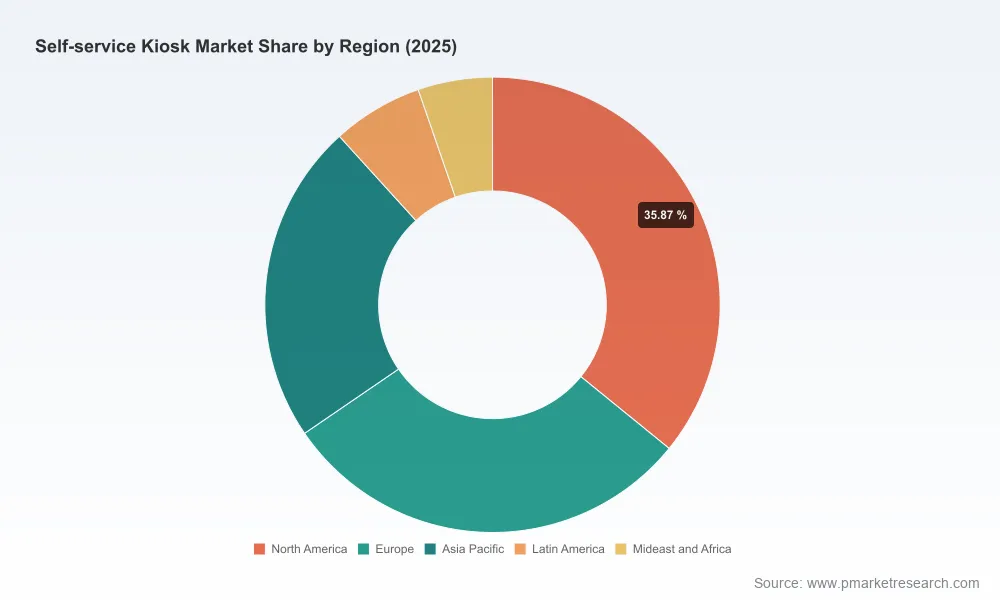
The geographic distribution similarly illustrates where deployment density and commercial momentum are concentrated. North America currently accounts for the largest share of market revenue, supported by mature retail, hospitality, and financial services ecosystems, as well as active regulatory drivers around accessibility and digital service compliance. Europe represents the second-largest regional concentration, reflecting sustained investment in self-service retail and public-facing transaction infrastructure. Asia Pacific continues to expand as a significant growth corridor, while Latin America and the Middle East and Africa represent earlier-stage but steadily developing deployment environments. These regional dynamics inform procurement strategy: organizations scaling multi-region rollouts must account for differing regulatory baselines, labor cost structures, and customer interaction norms.
Competitive Landscape: Vendors Navigating Hardware, Software, and Compliance Realities
The kiosk market is moderately concentrated, with the top three competitors accounting for approximately forty-six and a half percent of revenue and the top five representing just over fifty-eight percent. This structure reflects a landscape where established players command meaningful share through integrated hardware-software-service offerings, while specialized manufacturers compete on customization, ruggedization, accessibility compliance, and vertical-specific solutions.
KIOSK Information Systems, headquartered in Thornton, Colorado, focuses on custom self-service kiosk hardware, software, managed services, and secure deployments tailored for healthcare, government, and commercial applications. The company’s operational footprint was reinforced in late 2025 when it announced the relocation of its global headquarters and operations from Louisville to Thornton, a move that signals continued investment in regional infrastructure and service delivery capability. For enterprise buyers evaluating secure, managed deployments, this vendor profile underscores the growing importance of full-lifecycle support rather than isolated hardware supply.
Olea Kiosks, based in Cerritos, California, manufactures standard and custom self-service kiosks with emphasis on retail, hospitality, and biometric integrations. Throughout early 2026, the company has published an evolving set of insights focused on customer experience design, total cost of ownership, and biometric hardware selection. In March 2026, Olea released guidance on facial recognition kiosk hardware selection and buyer considerations, reflecting the market’s growing attention to identity-verified interactions and the technical trade-offs involved in deploying biometric capabilities. In May 2026, the company published perspectives emphasizing invisible, frictionless kiosk design and concurrently released a guide on lifecycle management and total cost of ownership. This content cadence suggests a vendor positioning strategy centered on experience design, operational economics, and the practical realities of long-term maintenance.
Meridian Kiosks, operating from North Carolina, provides end-to-end integrated self-service kiosks, digital signage, and solutions for various commercial environments. Its broader solution orientation reflects a market trend in which kiosks are increasingly deployed as part of unified customer-facing ecosystems rather than standalone terminals. Advanced Kiosks, operating across the United States, specializes in rugged, ADA-compliant self-service kiosk machines for government and turnkey solutions, positioning accessibility and durability as defining product attributes. REDYREF, also based in the United States, offers interactive touchscreen kiosks with a focus on self-service transaction and check-in systems, aligning its product narrative with high-throughput intake and transactional workflows.
The larger enterprise technology and financial technology players continue to anchor the high-transaction and high-security segments. NCR Corporation, headquartered in Atlanta, Georgia, delivers self-service kiosks integrated with POS, payments, and retail transaction solutions, reinforcing the linkage between kiosk hardware and broader transaction infrastructure. Diebold Nixdorf, also based in the United States, provides secure self-service kiosks for banking, financial services, and high-security applications, where transaction integrity, anti-fraud controls, and physical resilience are paramount. Glory Global Solutions, headquartered in the United Kingdom, specializes in self-service payment and cash-handling kiosks, reflecting continued demand for cash-compatible and hybrid payment workflows even as digital transaction volumes rise. Zebra Technologies, based in the United States, supplies rugged hardware and integrated solutions for self-service kiosk platforms, extending the market’s hardware foundation into environments that demand durable, enterprise-grade equipment.
This competitive mix has strategic implications. Enterprises deploying in regulated or high-security contexts benefit from vendors with established compliance narratives and secure deployment track records. Organizations prioritizing rapid scaling and transaction integration may gravitate toward vendors whose platforms connect tightly with POS, payment, and backend systems. Meanwhile, the growing emphasis on biometric integration and lifecycle economics suggests that procurement teams must evaluate not only upfront specifications but also long-term serviceability, component availability, software update cycles, and total cost trajectories. The full report provides vendor benchmarking detail and competitive positioning maps that enable decision-makers to match vendor capabilities to deployment priorities without overcommitting to a single architectural approach.
What the Report Delivers for 2026 Enterprise Strategy
The complete Self-Service Kiosk Market study translates market-level signals into operational intelligence. The report is structured to support procurement planning, technology roadmapping, compliance alignment, and competitive positioning. It examines deployment scenarios across the leading application categories and commercial verticals, mapping where transaction volumes, regulatory exposure, and operational economics converge.
Key report components include a detailed segmentation analysis that disaggregates revenue by region, type, and application, allowing organizations to benchmark their deployment mix against market structure and identify underpenetrated opportunity corridors. The study also explores market concentration dynamics, evaluating how share distribution influences pricing leverage, vendor negotiation strategy, and integration risk. Lifecycle cost modeling is examined in the context of recent vendor-published TCO guidance and broader operational pressures, helping enterprises compare hardware-centric procurement versus managed-service models.
Beyond segmentation and vendor mapping, the report integrates the regulatory developments shaping 2026 deployment decisions. It translates accessibility mandates, privacy-by-design expectations, and jurisdictional licensing requirements into actionable procurement considerations, including interface design requirements, transaction accessibility standards, data handling controls, and licensing workflows. The study also assesses labor-cost-driven adoption trends and evaluates how automation priorities are reshaping deployment sequencing across retail, hospitality, healthcare, and public-facing environments.
Importantly, the full report maintains the analytical discipline required for executive decision-making: it does not reduce complex market dynamics to single-number convenience. Instead, it provides the structural context—market size progression, growth trajectory, segmentation distribution, concentration metrics, vendor profiles, and regulatory overlays—needed to evaluate where self-service kiosks create measurable operational value and where deployment economics require more cautious planning.
Why This Intelligence Matters for 2026 Decisions
Enterprises planning 2026 kiosk investments face a market that is simultaneously expanding, fragmenting, and hardening around compliance requirements. The revenue trajectory suggests continued opportunity, but the value capture is uneven across segments, regions, and deployment models. Organizations that treat kiosk procurement as purely a hardware purchase risk underestimating lifecycle costs, accessibility remediation, licensing exposure, and integration complexity. Conversely, organizations that align deployment strategy with operational priorities, regulatory baselines, and vendor capability profiles can build self-service infrastructure that reduces frontline strain, improves transaction throughput, and supports scalable customer engagement.
The competitive environment reinforces this strategic discipline. With the top five competitors representing just over fifty-eight percent of market revenue, share concentration provides a degree of market stability but does not eliminate differentiation risk. Vendors are actively refining their positioning around customer experience, biometric integration, lifecycle economics, and secure deployment, which means that vendor selection is increasingly a function of deployment context rather than generic product labels. Enterprises must therefore match vendor strengths to their own operating environment, whether that environment emphasizes ruggedization, payment integration, accessibility compliance, biometric capability, or managed service continuity.
Self-service Kiosk Market
The regulatory timeline adds further urgency. Accessibility and privacy requirements are no longer future considerations; they are active deployment constraints shaping hardware selection, software configuration, and transaction design. Financial services operators, in particular, must account for evolving licensing frameworks and transaction compliance expectations. These dynamics increase the cost of late-stage remediation and reward proactive, compliance-integrated planning.
This research study is intended to equip decision-makers with the intelligence required to navigate that environment. It provides the market-level baseline, the segmentation context, the vendor mapping, and the regulatory assessment needed to build a deployment strategy that is commercially sound, operationally resilient, and strategically aligned with 2026 realities.
Moving from Insight to Execution
The self-service kiosk market is no longer a niche hardware category. It is an operational layer that intersects with labor strategy, customer experience design, compliance management, and transaction infrastructure. The revenue progression from $4.18 billion in 2020 to a projected $6.47 billion in 2026, and onward toward $10.13 billion by 2032, reflects the market’s maturation into a mainstream enterprise investment domain. Yet the strategic value of any deployment depends on how well it is matched to segment priorities, regulatory requirements, and vendor capabilities.
Our full Self-Service Kiosk Market report expands on every dimension introduced here: detailed segmentation breakdowns, regional and vertical distribution analysis, competitive positioning frameworks, regulatory impact mapping, lifecycle cost considerations, and deployment prioritization guidance. For leaders who need to move from market awareness to actionable procurement and technology planning, the complete study provides the depth required to make informed, defensible decisions.
The opportunity in 2026 is not simply to deploy kiosks, but to deploy them with strategic precision. Enterprises that ground their planning in rigorous market intelligence will be better positioned to manage compliance exposure, control total cost of ownership, select the right vendor partnerships, and capture the operational value that self-service infrastructure can deliver. The complete report offers the comprehensive intelligence needed to do exactly that, and we invite decision-makers to explore the full analysis for a detailed view of the market’s structure, trajectory, and strategic implications.
For detailed analysis of this topic, please visit the official page: Self-service Kiosk Market
Lacy Lee
Senior Marketing Manager
[email protected]
PW Consulting: www.pmarketresearch.com
























Sign in to leave a comment.