
Navigating the 2026 Landscape: Strategic Imperatives in the SME Insurance Market
The Inflection Point for Small and Medium Enterprise Coverage
The small and medium enterprise sector stands at a critical juncture. As business complexity increases, the insurance products designed to protect these vital economic engines are undergoing a profound transformation. The period from 2026 through 2032 is not merely a continuation of historical trends but represents a structural shift driven by digital integration, evolving risk profiles, and regulatory recalibration. For executives, investors, and policymakers, understanding the trajectory of this market is no longer optional; it is a strategic necessity.
Insurance Market
Our latest market research provides a comprehensive roadmap for navigating this evolving terrain. By analyzing historical performance from 2020 through 2025 and projecting forward to 2032, we offer a data-backed perspective on where capital, innovation, and risk are converging. This article serves as a strategic preview, highlighting the macro dynamics and competitive forces that will define decision-making in the coming years.
Macroeconomic Trajectory and Valuation Context
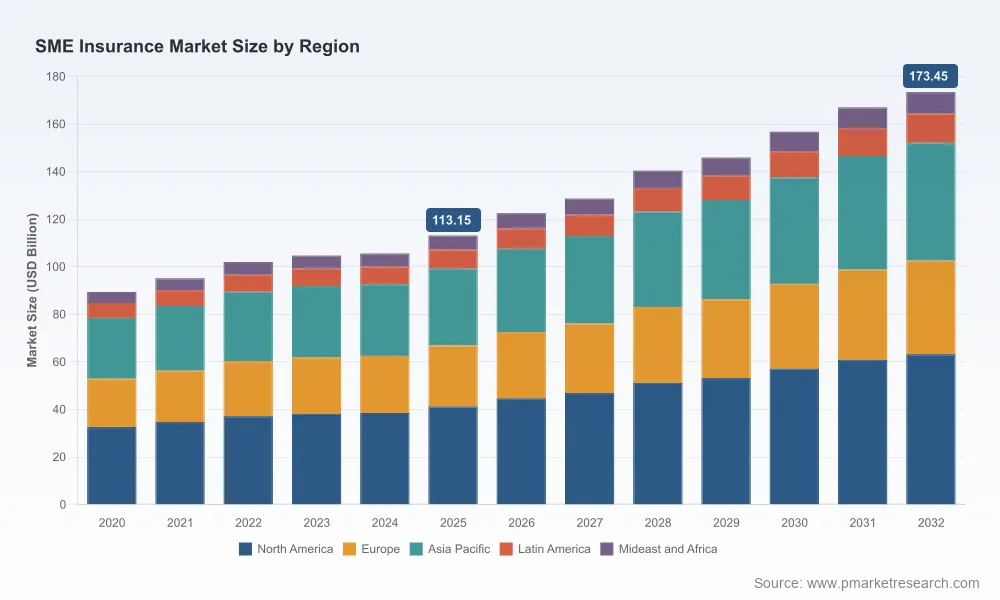
The financial scale of the SME insurance sector underscores its significance within the broader global economy. Historical data reveals a steady ascent in market valuation over the past half-decade. In 2020, the market was valued at 89.45 billion USD, growing to 95.17 billion USD in 2021 and reaching 101.99 billion USD by 2022. This upward momentum continued through 2023 and 2024, with valuations touching 104.7 billion USD and 105.6 billion USD respectively. The most recent baseline year, 2025, recorded a significant jump to 113.15 billion USD, signaling accelerated adoption and premium expansion.
Looking ahead, the forecast period from 2026 to 2032 projects continued robust growth. The market is expected to open 2026 at 122.55 billion USD, climbing to 128.68 billion USD in 2027 and surpassing 140 billion USD by 2028. By the end of the forecast window in 2032, the market valuation is projected to reach 173.45 billion USD. This trajectory implies a Compound Annual Growth Rate of 6.52 percent over the forecast period. For strategic planners, this growth rate suggests that SME insurance is outpacing many traditional insurance segments, driven by the formalization of small business sectors and the increasing necessity of risk transfer mechanisms in a volatile global environment.
Growth Drivers and Structural Shifts
Several underlying factors are propelling this expansion. The digitization of insurance distribution has lowered barriers to entry for smaller firms, allowing them to access coverage previously reserved for larger corporations. Simultaneously, the risk environment itself has changed. Small businesses are now exposed to complex liabilities ranging from data breaches to supply chain interruptions, necessitating more sophisticated coverage packages. The market is also seeing a shift in how policies are bundled, with carriers moving towards integrated solutions that address multiple risk vectors simultaneously rather than offering fragmented single-line products.
Competitive Landscape and Strategic Grouping
The market structure is characterized by a mix of established global carriers and agile insurtech platforms. Our analysis identifies key players who are defining the standards of service and product innovation. Chubb Limited, headquartered in Zürich, Switzerland, remains a dominant force with a comprehensive suite of dedicated small business insurance solutions. Their portfolio covers property, commercial packages, cyber, professional liability, and workers' compensation, specifically tailored for start-ups and community anchors. This breadth allows them to serve as a one-stop provider for scaling enterprises.
In the United States, Marsh & McLennan Companies, Inc., based in New York, focuses heavily on dedicated solutions for independents, sole-trader, and fast-growing small and medium-sized businesses. Their strength lies in their brokerage network and ability to customize coverage for diverse business models. On the technology-forward side, Simply Business, located in Boston, Massachusetts, operates as an online platform providing quotes and policies from top-rated insurers. Their model emphasizes ease of access and digital efficiency, catering to business owners who prefer self-service interfaces over traditional agent-led interactions.
The concentration of market power is notable. Our research indicates a CR3 of 31.25 percent and a CR5 of 47.8 percent. This suggests that while the top five firms hold a significant share, there remains substantial room for mid-tier and niche players to compete, particularly in specialized segments or geographic regions where local knowledge provides a competitive edge. The balance between consolidation and fragmentation will be a key dynamic to watch as the market matures through 2032.
SME Insurance Market
Product and Risk Segmentation Dynamics
Understanding where the capital is flowing within the SME insurance portfolio is essential for product strategy. Liability coverage continues to represent the largest portion of the market value. Our data shows that Small Business Liability Insurance accounts for 67.72 billion USD of the market structure. This dominance reflects the reality that legal and operational risks remain the primary concern for business owners seeking to protect their assets from lawsuits and claims.
Property Insurance follows as a significant component, valued at 28.76 billion USD. As physical assets remain critical for many SMEs, coverage against damage, theft, and natural disasters retains its importance. Health and Life Insurance for employees constitutes 16.67 billion USD, highlighting the growing focus on workforce benefits as a tool for retention and stability in tight labor markets.
From an application perspective, Cyber Risk Coverage is a standout area of focus, associated with 45.74 billion USD in market activity. As digital operations become ubiquitous, the threat of cyber incidents has moved from a niche concern to a central pillar of SME risk management. Commercial Vehicle Insurance, linked to 32.89 billion USD, remains vital for businesses reliant on logistics and transportation. Other Specialties account for 34.52 billion USD, indicating a healthy ecosystem of niche products addressing unique industry needs, from professional indemnity to specialized equipment coverage.
It is important to note that these figures represent the broader structural allocation of market value. The specific interplay between these segments varies significantly by region and business type, nuances that are critical for targeted strategy but require a deeper dive into the full dataset to fully appreciate.
Regulatory and Operational Dynamics
The operating environment for SME insurance is being reshaped by regulatory developments that impact both insurers and the insured. In the United States, the Department of Labor released an Annual Report on Self-Insured Group Health Plans in March 2026. The report estimated approximately 2.8 million ERISA-covered group health plans covering 135 million participants and beneficiaries. Notably, only 87,700 filed Form 5500 in 2023. This disparity highlights compliance challenges and data transparency issues that insurers must navigate when designing health-related products for small groups.
Furthermore, the proposed Transparency in Coverage rules, published in the Federal Register in December 2025, amend regulations under the Public Health Service Act, Employee Retirement Income Security Act, and Internal Revenue Code. These rules apply to non-grandfathered group health plans and issuers, with plan years beginning on or after January 1, 2027. For SME insurers, this means preparing for enhanced disclosure requirements that could influence product design and administrative processes.
Additionally, the Centers for Medicare and Medicaid Services proposed rule CMS-9882-P, introduced in December 2025, brings new cost-sharing information disclosure requirements for plans and issuers. Applicable for plan years beginning on or after January 1, 2027, this regulation adds another layer of compliance that market participants must integrate into their operational frameworks. These regulatory shifts suggest that the coming years will demand greater transparency and administrative rigor from providers serving the SME sector.
Innovation and Recent Market Moves
Innovation is accelerating, particularly among players seeking to differentiate through technology and community engagement. In May 2026, Simply Business launched an Insurance App for Small Businesses featuring ChatGPT integration in the U.S. This move signals a trend towards AI-driven advisory tools that can guide business owners through complex policy selection processes in real-time. Later that same month, Simply Business launched the 2026 U.S. Big Dreams Grant to support small business owners, reinforcing a brand strategy that aligns corporate success with ecosystem health. In April 2026, the company won the SMB Insurtech Solution of the Year award in the FinTech Breakthrough Awards, validating the market's recognition of digital-first approaches.
These developments illustrate a broader industry trend where user experience, technological integration, and brand purpose are becoming as important as premium pricing. Competitors are likely to respond with similar innovations, raising the bar for what constitutes a standard service offering in the SME insurance space.
Strategic Implications for 2026 Decision-Makers
For stakeholders evaluating their position in this market, the research points to several actionable imperatives. First, the growth trajectory suggests that investing in SME-focused capabilities offers a viable path to expansion. The 6.52 percent CAGR indicates sustained demand, but capturing this growth requires understanding the specific nuances of different business segments.
Second, the regulatory environment demands proactive compliance strategies. With new rules taking effect in 2027, organizations that build flexibility and transparency into their product architectures now will be better positioned to adapt without disruption. Third, the competitive landscape shows that differentiation is possible through both breadth, as seen with global carriers, and depth of technology, as seen with digital platforms. Companies must decide whether to compete on scale, specialization, or user experience, as trying to do all three simultaneously may dilute strategic focus.
Finally, the segmentation data hints at where risk perceptions are evolving. The prominence of cyber and liability coverage suggests that advisors and product developers should prioritize these areas in their conversations with SME clients. However, the specific mix that will yield the best results depends on granular factors such as industry vertical and geographic location, which are detailed in our full report.
Accessing the Full Intelligence
This overview provides a high-level map of the terrain, but profitable strategy requires precise coordinates. The figures and trends summarized here are drawn from a comprehensive analysis that includes detailed regional breakdowns, specific application splits, and deep competitive profiling. To leverage this data for your specific strategic planning, we invite you to access the full report. The complete dataset reveals the interdependencies between segments and regions that are crucial for accurate forecasting and resource allocation.
As the market moves from 122.55 billion USD in 2026 towards 173.45 billion USD in 2032, the window to establish a dominant or differentiated position is open. Understanding the mechanics of this growth is the first step toward capturing value in the SME insurance market.
For detailed analysis of this topic, please visit the official page: SME Insurance Market
Lacy Lee
Senior Marketing Manager
[email protected]
PW Consulting: www.pmarketresearch.com




























Sign in to leave a comment.