
Navigating the Tertiary Dodecyl Mercaptan Market: Strategic Intelligence for 2026 and Beyond
As industrial supply chains recalibrate and polymerization technologies advance, Tertiary Dodecyl Mercaptan (TDM) has emerged as a critical specialty chemical underpinning high-performance rubber and plastics manufacturing. For executives, procurement leaders, and R&D strategists operating in 2026, understanding the trajectory of the TDM market is no longer optional; it is a prerequisite for informed capital allocation, supply chain resilience, and competitive positioning. Our recently published market research delivers a comprehensive, forward-looking intelligence framework designed specifically to guide enterprise decision-making through 2032.
This article serves as a strategic preview of the full report. It highlights the macro-economic trajectory, regulatory and operational dynamics, competitive architecture, and analytical methodologies embedded in our research. While we share high-level market direction and structural insights here, the granular segmentation data, precise regional valuations, and actionable scenario models remain exclusively accessible through the complete publication. The intention is straightforward: equip leadership teams with the contextual depth required to ask the right questions, while directing tactical execution and precise forecasting to the full intelligence package.
The Macro Trajectory: From Baseline Recovery to Sustained Expansion
The TDM market has demonstrated a consistent upward trajectory over the past half-decade, reflecting steady demand from downstream polymer and specialty chemical sectors. Historical tracking from 2020 through 2025 reveals a market that has moved from a baseline of approximately USD 310.0 million to a 2025 valuation of USD 395.0 million. This progression underscores a market that has not merely recovered from cyclical disruptions but has structurally expanded its revenue foundation.
Looking forward, our forecasting model projects the market to reach USD 414.26 million in 2026, followed by a steady climb toward USD 584.0 million by 2032. This path corresponds to a compound annual growth rate of 5.8 percent across the 2026 to 2032 forecast window. The trajectory signals more than incremental growth; it reflects a compound effect of material substitution trends, expanding polymer capacity in key manufacturing corridors, and the continuous integration of chain transfer agents in advanced synthetic rubber and engineering plastic formulations.
For enterprise strategists, these macro figures carry clear implications. A sustained mid-single-digit CAGR in a specialty chemical segment typically indicates demand inelasticity tied to industrial output, coupled with moderate pricing power for established producers. It also suggests that capacity planning, inventory optimization, and long-term offtake agreements will increasingly differentiate market performers from laggards. The full report dissects the velocity of this expansion across different market phases, helping organizations align their investment horizons with realistic demand cadence rather than speculative peaks.
Market Architecture and the Strategic Value of Granular Segmentation
TDM demand does not flow uniformly across downstream sectors. Its application footprint spans multiple polymer systems, surface-active formulations, and specialty intermediates, each with distinct consumption patterns, purity requirements, and pricing sensitivities. Similarly, the chemical architecture of TDM products themselves varies by feedstock pathway, influencing production economics, supply reliability, and end-use suitability.
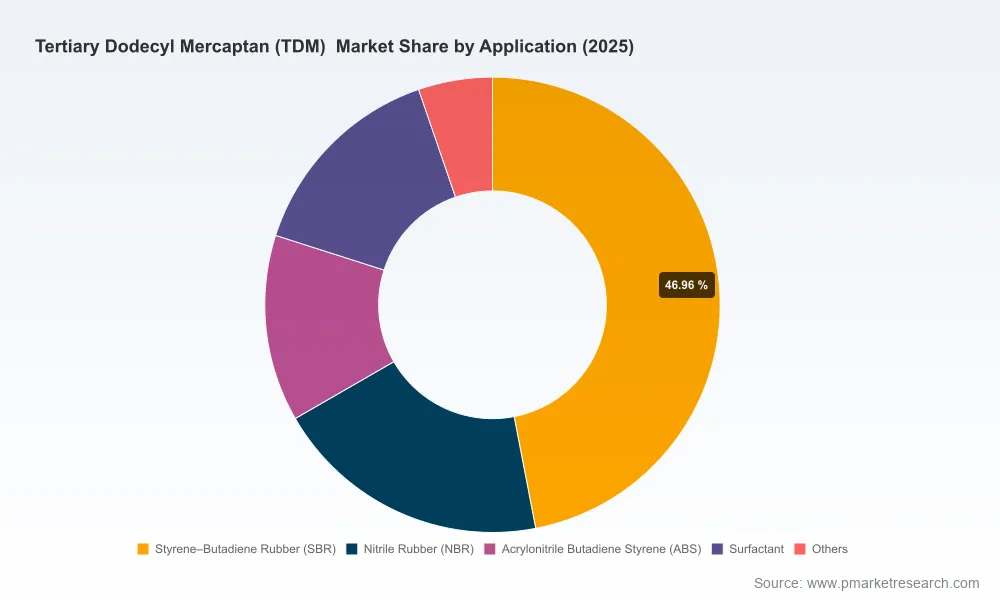
In our analysis, we examine how demand distributes across major application categories, including styrene–butadiene rubber systems, nitrile rubber formulations, acrylonitrile butadiene styrene compounds, surfactant applications, and a residual segment covering specialized industrial uses. Each of these pathways presents different growth drivers, from automotive and tire manufacturing cycles to construction material demand and industrial coatings evolution. The strategic relevance lies in recognizing that aggregate market size can mask divergent sub-sector dynamics. A formulation shift in one polymer family may accelerate TDM consumption, while another segment may face substitution pressure or capacity rationalization.
We also map the product landscape by underlying feedstock orientation, distinguishing between dodecene-based and propylene-based TDM offerings. This distinction matters for procurement strategy and supplier evaluation because it intersects with raw material availability, regional petrochemical integration, and process economics. Understanding which product architecture aligns with a given downstream requirement can materially affect total cost of ownership, qualification timelines, and supply continuity.
Crucially, the complete report provides the precise regional revenue distribution, application-level consumption figures, and type-level valuation breakdowns that executives need to build accurate S&OP models, negotiate supplier contracts, and prioritize market entry or expansion. Rather than presenting broad percentages in isolation, the publication integrates each segmentation layer with demand drivers, substitution risks, and regional manufacturing capacity considerations. This integrated view allows organizations to move from macro awareness to operationally relevant planning.
Regulatory Pressures and Operational Realities Shaping Market Dynamics
Specialty chemicals operating at the intersection of polymerization control and industrial safety are increasingly influenced by regulatory evolution. TDM is no exception. As of 2025 and into 2026, compliance frameworks across major jurisdictions are reshaping how producers handle exposure management, sulfur emission controls, and chemical registration obligations.
Tertiary Dodecyl Mercaptan (TDM) Market
In the United States, OSHA continues to regulate TDM exposure with a permissible exposure limit of 1 ppm, reinforcing workplace safety requirements throughout manufacturing, handling, and downstream incorporation. In Europe, the regulatory environment is equally consequential. The European Chemicals Agency registered over 6,000 tonnes of organosulfur compounds, including TDM, for industrial use in 2023, reflecting both the scale of industrial reliance and the scrutiny accompanying sulfur-based chemistry. REACH authorization pathways continue to apply to organosulfur compounds, with more than 300 chemicals under restriction review in Europe, creating a dynamic compliance landscape that producers and downstream users must monitor closely.
Beyond formal registration and exposure limits, environmental compliance has become a practical operational constraint. Industry market data indicates that 39 percent of global TDM producers face compliance challenges related to environmental regulations, including sulfur emission controls. This is not merely a reporting issue; it affects capital expenditure planning, plant upgrades, feedstock selection, and the relative competitiveness of producers in stricter jurisdictions versus those operating with different regulatory burdens.
For corporate decision-makers, these dynamics introduce both risk and differentiation opportunity. Companies that proactively integrate compliance costs into their sourcing models, evaluate supplier environmental performance, and anticipate regulatory shifts are better positioned to avoid disruption. The full report examines how these regulatory factors interact with regional demand, production location decisions, and the cost structures of key market participants, giving strategists a clearer view of where compliance may become a competitive lever rather than just a cost center.
Competitive Landscape: Incumbents, Differentiation, and Strategic Positioning
The TDM market is characterized by a concentrated but strategically diverse supplier base. Our report profiles the core companies shaping production, technology, and commercial positioning, enabling buyers and investors to understand not just who the players are, but how their capabilities differ in ways that matter for procurement and partnership strategy.
Chevron Phillips Chemical Company LLC, headquartered in Houston, Texas, produces TDM under the Sulfole® 120 brand, positioning it as a chain transfer agent for SBR, ABS, and broader polymer synthesis applications. The company's market presence reflects the advantage of integrated petrochemical operations and established branding in specialty polymerization chemicals. Arkema S.A., based in Colombes, France, offers heavy mercaptans including TDM with an emphasis on polymerization control in butadiene-styrene polymers and low-odor grades, highlighting the importance of product specification and downstream user experience in competitive differentiation.
In Asia, ISU Chemical Co., Ltd., headquartered in Ulsan, South Korea, manufactures high-purity TDM with a minimum purity of 98.5 percent, serving as a reaction intermediate for ABS, SBR, paints, coatings, and pharmaceutical applications. Its profile underscores how purity thresholds and application breadth can widen a supplier's addressable market beyond core rubber segments. Sanshin Chemical Industry Co., Ltd., located in Osaka, Japan, operates as a specialty chemical producer of high-purity TDM targeted at polymer emulsions and synthetic rubber applications, reinforcing the premiumization trend in certain downstream markets where consistency and technical support carry commercial weight.
Market concentration data further illustrates the structural dynamics at play. The top three producers account for approximately 65 percent of market revenue, while the top five represent around 72 percent. This concentration suggests that scale, established relationships, and production reliability remain influential in shaping purchasing decisions and pricing negotiations. At the same time, it indicates that specialized grades, regional service capabilities, and regulatory compliance excellence can still create meaningful differentiation, particularly for buyers seeking tailored solutions or supply redundancy.
T Dodecyl Mercaptan Market
Our competitive analysis goes beyond corporate descriptions. It evaluates how each player's geographic footprint, product grade strategy, and operational focus align with major demand centers and regulatory environments. This allows organizations to assess supplier resilience, potential bottlenecks, and partnership fit. The full publication provides the deeper comparative framework needed to translate competitor intelligence into procurement strategy, risk mitigation, and selective sourcing diversification.
What the Full Report Delivers: Actionable Intelligence for 2026 Decision-Making
The TDM market research is structured to support a wide range of strategic functions, from corporate development and procurement to product planning and investor communications. Rather than offering a static snapshot, the report is built around decision-useful analytics that connect market size, segmentation, competitive behavior, and regulatory context into a coherent planning tool.
Key components of the publication include a detailed historical reconstruction of market performance from 2020 through 2025, establishing a validated baseline for trend analysis. This historical layer is paired with a forecast model extending through 2032, enabling organizations to test planning assumptions against multiple growth paths. The segmentation analysis breaks down demand across regions, product types, and applications with sufficient granularity to support channel strategy, market prioritization, and supplier evaluation.
The report also integrates an assessment of market concentration and the strategic implications of a supplier base where the leading firms hold a substantial share of revenue. This is complemented by company-specific profiles that examine production positioning, product branding, purity specifications, and application focus. By linking these profiles to broader market dynamics, the research helps readers understand where scale advantages matter most and where technical differentiation or regional service capability can shift competitive outcomes.
Operational and regulatory considerations are woven throughout rather than treated as separate appendices. The analysis addresses exposure limits, chemical registration activity, sulfur emission control challenges, and the broader compliance environment, showing how these factors influence production economics and procurement risk. This integrated approach ensures that decision-makers can evaluate TDM supply not only on price and availability, but also on long-term regulatory durability and operational reliability.
For organizations planning capacity investments, entering new downstream segments, or renegotiating supply agreements in 2026, the full report provides the level of detail required to move from strategic intuition to evidence-based action. It is designed to support scenario planning, sensitivity analysis, and supplier benchmarking, all of which depend on precise segmentation values and regional market breakdowns that are presented in full within the publication.
Why This Research Matters for 2026 Strategy
The 2026 decision environment demands more than directional confidence. Specialty chemical markets are shaped by a combination of polymer demand cycles, feedstock integration, regulatory evolution, and concentrated supplier behavior. In that context, TDM represents both a functional input and a strategic variable: its availability, grade consistency, and compliance posture can affect production continuity, formulation performance, and total procurement cost.
The macro trajectory signals a market moving from recent historical expansion into a forecast period of steady, mid-single-digit growth. That direction creates a favorable backdrop for long-term planning, but it also raises the importance of precision. Companies that rely on aggregate market narratives alone may misjudge where growth is concentrated, which product architectures are most relevant to their applications, and how regulatory pressures will alter regional cost structures. The full research report is built to close those gaps.
By integrating historical validation, forward forecasting, segmentation detail, competitive profiling, and regulatory dynamics, the study offers a single reference point for cross-functional alignment. Procurement teams can use it to structure sourcing strategies around grade specifications, regional supply reliability, and compliance risk. Strategy and corporate development teams can use it to evaluate market entry timing, partnership opportunities, and investment priorities. R&D and formulation leaders can use it to understand how downstream demand trends and supplier capabilities intersect with performance requirements.
Accessing the Complete Intelligence Package
This article has outlined the strategic rationale, market direction, competitive structure, and decision-support framework behind our TDM market research. It has deliberately focused on high-level trajectory and structural insight to demonstrate analytical rigor while preserving the detailed segmentation data, regional breakdowns, and quantified application valuations for the full publication. Those detailed figures are essential for building accurate forecasts, constructing sourcing models, and comparing market opportunities with precision.
For executives and analysts who need to translate market direction into concrete 2026 plans, the complete report provides the granularity required to act with confidence. We invite you to access the full research on our website, where the complete dataset, segmentation tables, and competitive analysis are available for immediate strategic use. In a market defined by steady growth, concentrated supply, and evolving regulatory demands, deeper intelligence is not simply informational; it is a practical advantage.
For detailed analysis of this topic, please visit the official page: Tertiary Dodecyl Mercaptan (TDM) Market
Lacy Lee
Senior Marketing Manager
[email protected]
PW Consulting: www.pmarketresearch.com

























Sign in to leave a comment.