
# The Virtual Reality in Medical Education and Training Market: A Strategic Primer for 2026
Executive Overview
The integration of Virtual Reality into medical education and training is no longer an experimental novelty; it has become a critical infrastructure component for modern healthcare systems. As we approach 2026, the sector is defined by a convergence of technological maturity, regulatory clarity, and compelling economic efficiency. For enterprise leaders, investors, and academic administrators, the question has shifted from whether to adopt immersive technologies to how to deploy them strategically at scale.
Our latest market research report provides a comprehensive framework for understanding this transition. By analyzing historical performance from 2020 through 2025 and projecting growth trajectories out to 2032, this study offers the data-driven intelligence necessary to navigate a landscape characterized by rapid innovation and consolidation. Understanding the magnitude of this shift is essential for stakeholder alignment and long-term operational planning.
PW Consulting Health Care Research Center
Market Scale and Trajectory
The financial magnitude of the Virtual Reality in Medical Education and Training market underscores its strategic importance. Tracking the evolution from 2020 to the present day reveals a consistent upward trajectory that defies broader economic headwinds. In 2020, the market was valued at approximately 400.28 million USD. By 2025, this figure had surged to 1150.0 million USD, reflecting a compound growth pattern that signals robust institutional adoption.
Looking forward, the forecast period from 2026 to 2032 suggests continued expansion driven by deeper curriculum integration and broader hardware accessibility. The projected compound annual growth rate stands at 23.5 percent, indicating that the sector will significantly outpace many traditional healthcare education segments. By 2032, the industry is expected to reach substantial valuation milestones that will restructure how training budgets are allocated globally.
This growth is not merely linear; it represents a structural shift in how medical competence is developed and assessed. The acceleration observed between 2023 and 2024, where market value jumped from 706.24 million USD to 934.82 million USD, highlights the tipping point where VR moved from pilot programs to standardized operational tools. Stakeholders entering 2026 must recognize this momentum as a baseline expectation rather than an outlier.
Competitive Landscape and Enterprise Dynamics
The competitive environment is populated by specialized innovators who are differentiating through content depth, hardware integration, and assessment analytics. Several key companies are defining the operational standards for immersive training. Osso VR provides an immersive procedural-skills platform focused on surgical education with objective assessment and analytics. SimX offers the largest library of VR medical simulation cases for nursing, EMS, military, and physician training, featuring multiplayer capabilities. FundamentalVR delivers haptic-enabled VR surgical simulation platforms for procedural training and skills development.
Other significant players include Oxford Medical Simulation, which emphasizes clinical decision-making and soft skills across medicine and nursing, and CAE Healthcare, which integrates VR-based solutions with physical simulation for comprehensive education. Medical Realities specializes in VR surgical training content, while ImmersiveTouch provides platforms for medical education and surgical planning. These organizations are not just competing on technology but are actively shaping the ecosystem through partnerships and curriculum integration.
- Strategic Partnerships: Recent activity shows increased consolidation. SimX formed a strategic partnership with Elevate Healthcare in April 2025 to combine VR simulation platforms with simulation center management expertise, signaling a move toward holistic training solutions.
- Curriculum Integration: Adoption is moving beyond individual tools. In October 2025, the University of Virginia incorporated the Vantari VR high-fidelity training platform into their anesthesiology residency and fellowship curriculum, setting a precedent for academic integration.
- Product Expansion: Competitors are broadening portfolios. zSpace expanded its health science portfolio in October 2025 with new immersive applications for anatomy and ECG training, demonstrating continued innovation in adjacent educational tech.
Industry Dynamics and Regulatory Context
The operational environment for VR in medical training is being shaped by regulatory oversight, hardware economics, and standards evolution. The FDA maintains dedicated oversight for AR/VR medical devices, issuing multiple 510(k) clearances in 2025 for neurology and radiology applications, including systems from Medivis, Brainlab, Augmedics, and Surgical Theater. This regulatory activity provides a measure of legitimacy and safety assurance that encourages institutional procurement.
Hardware cost dynamics are also pivotal. The average selling price of high-quality standalone VR headsets suitable for medical simulation fell to under 500 USD by 2025, with enterprise configurations ranging from 700 to 900 USD. This reduction in barrier-to-entry costs allows hospitals and schools to scale deployments more aggressively. Furthermore, the INACSL Healthcare Simulation Standards of Best Practice were revised in 2025, including updated facilitation methods applicable to VR-based training, ensuring that pedagogical rigor keeps pace with technology.
Cost efficiency remains a primary driver for adoption. Sector analysis indicates that VR simulations can cost between 2 to 15 USD per session compared to 28 to 395 USD for traditional simulations. These long-term operational savings justify the initial hardware investment, altering the total cost of ownership models that administrators rely on for budgeting decisions.
Report Scope and Strategic Value
This market research report is designed to serve as a decision-support tool for senior leadership. It moves beyond surface-level trends to provide actionable intelligence on market architecture and competitive positioning. The analysis covers the historical period from 2020 to 2025 and extends the forecast horizon through 2032, allowing for both retrospective analysis and forward-looking strategic planning.
Educational and Training Software Market
- Segmentation Analysis: The report details market splits across key components including Hardware, Software, and Services, as well as end-user categories such as Medical Schools, Hospitals and Clinics, and Research Institutes. Understanding these splits is crucial for targeting specific revenue streams.
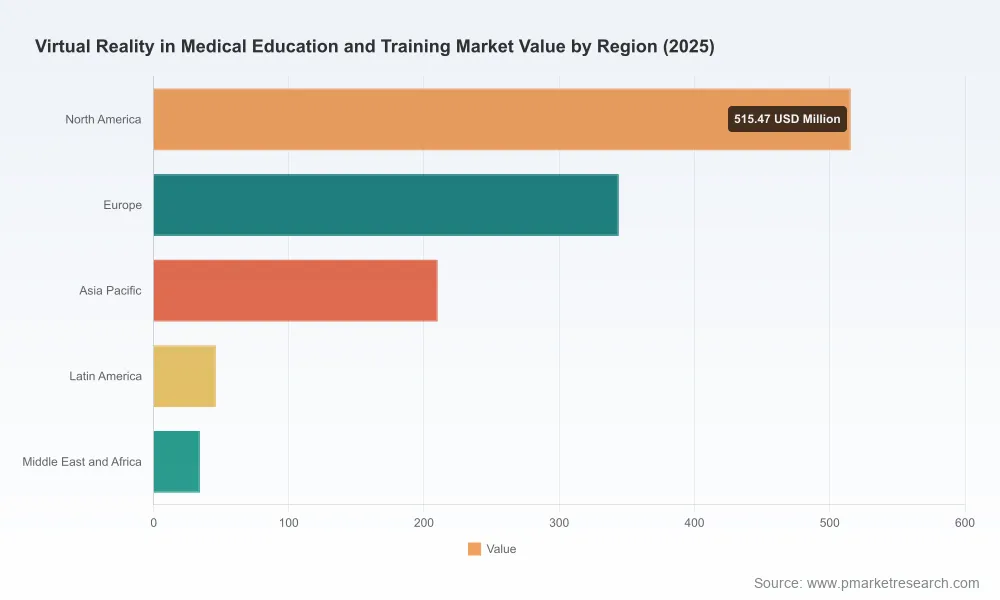
- Regional Insights: Geographic performance is analyzed across North America, Europe, Asia Pacific, Latin America, and the Middle East and Africa, providing context for global expansion strategies and regional risk assessment.
- Concentration Metrics: Market concentration data is provided to help stakeholders understand competitive density and potential barriers to entry within the current landscape.
For decision-makers in 2026, this report offers the granularity required to validate investment thesis and optimize resource allocation. Whether evaluating a partnership opportunity, assessing competitive threats, or planning internal deployment roadmaps, the data contained herein supports evidence-based decision-making.
Conclusion
The Virtual Reality in Medical Education and Training market is positioned for sustained growth and transformative impact on healthcare delivery systems. The combination of favorable economic metrics, regulatory support, and proven cost efficiencies creates a compelling case for accelerated adoption. However, navigating this landscape requires precise intelligence regarding segment performance and competitive moves.
Virtual Training Market
To access the complete dataset, detailed segmentation breakdowns, and full company profiles, stakeholders are encouraged to consult the full report. Ensuring your organization has the most accurate and up-to-date intelligence is the first step toward securing a competitive advantage in this evolving sector.
For detailed analysis of this topic, please visit the official page: Virtual Reality in Medical Education and Training Market
Lacy Lee
Senior Marketing Manager
[email protected]
PW Consulting: www.pmarketresearch.com




























Sign in to leave a comment.