
Strategic Horizons in Water Treatment Equipment: Navigating the 2026 to 2032 Market Landscape
Executive Overview
The global water treatment equipment sector stands at a critical inflection point. Between 2020 and 2025, the market expanded from 41.5 billion USD to 66.0 billion USD, reflecting a compound trajectory shaped by regulatory pressure, infrastructure renewal, and technological maturation. Looking ahead to 2032, the market is projected to reach nearly 99.4 billion USD, sustaining a forecast CAGR of 6.2 percent across the 2026 to 2032 evaluation window. These figures are not merely historical summaries; they are strategic signals that speak to capital allocation, risk exposure, and competitive positioning for enterprises operating across municipal, industrial, and commercial water value chains.
For decision-makers entering 2026, the question is no longer whether the water treatment equipment market is growing, but how to align investment, product strategy, and partnership models with the forces reshaping demand, supply, and compliance. This article previews the strategic architecture of our latest Water Treatment Equipment Market research, outlining the analytical depth, competitive intelligence, and operational frameworks that practitioners can leverage to convert macro growth into defensible advantage.
The Growth Story Behind the Numbers
The historical arc from 2020 through 2025 reveals a sector that has proven resilient amid macroeconomic volatility. Revenue climbed from 41.5 billion USD in 2020 to 46.58 billion USD in 2021, then continued upward through 49.5 billion USD in 2022, 52.97 billion USD in 2023, and 59.02 billion USD in 2024. By 2025, the base year for this study, the market reached 66.0 billion USD. This progression underscores an accelerating pace of adoption, driven by aging infrastructure, tightening effluent standards, and rising corporate focus on water stewardship.
The forward outlook reinforces this momentum. The market is expected to move from 68.92 billion USD in 2026 to 73.78 billion USD in 2027, 76.82 billion USD in 2028, and 82.94 billion USD in 2029. By 2030, the trajectory approaches 85.63 billion USD, before accelerating toward 97.05 billion USD in 2031 and 99.4 billion USD in 2032. This sustained expansion is anchored by a forecast CAGR of 6.2 percent, a rate that signals more than cyclical recovery. It reflects structural demand embedded in long-lived infrastructure programs, evolving regulatory architectures, and the gradual digitization of water management.
Strategically, this growth narrative matters because it clarifies where longer-term value creation is likely to concentrate. Markets expanding at this pace tend to reward companies that can combine capital-efficient deployment models with differentiated technology and compliance-ready service ecosystems. They also penalize players that rely on commodity positioning without clear operational differentiation. The underlying data, when unpacked by segment, application, and region, reveals where such differentiation is most attainable and where margin pressure is most likely to intensify.
Dynamics Reshaping Demand and Investment
Several interlocking forces are reshaping how water treatment equipment is specified, financed, and operated in 2026 and beyond. Regulatory pressure remains a dominant catalyst. In April 2025, the US Environmental Protection Agency implemented stringent water conservation regulations mandating the use of smart technologies in water management. This shift moves compliance from a static checklist toward a continuously monitored operational discipline, increasing demand for equipment that integrates sensing, control, and data-driven optimization.
Financing environments are also evolving. The US EPA's Clean Water and Drinking Water State Revolving Funds support financing for wastewater and drinking water infrastructure upgrades, creating viable pathways for municipalities and industrial operators to modernize treatment assets. Crucially, energy efficiency practices in plants can enable 15 to 30 percent savings in operating costs, which strengthens the business case for equipment that reduces lifecycle energy intensity rather than simply meeting baseline performance thresholds.
Energy consumption itself is a strategic consideration. Water and wastewater treatment accounts for approximately 3 percent of total energy use in the US, with municipal plants representing the largest energy consumers and often accounting for 30 to 40 percent of total energy consumed. This concentration makes efficiency a board-level issue, not merely an engineering concern. Equipment decisions that lower pumping loads, optimize disinfection dosing, or improve membrane performance can have outsized effects on total cost of ownership.
Macro infrastructure needs further reinforce the investment backdrop. The US EPA's national needs assessment identifies 625 billion USD in funding required for clean water infrastructure improvements over the next 20 years, including treatment needs of 55.3 billion USD. While this figure spans the full capital spectrum, it frames a multi-year opportunity for equipment suppliers, system integrators, and service providers positioned to deliver scalable, compliant, and energy-aware solutions.
The strategic implication is clear: the market is increasingly rewarding solutions that couple performance reliability with measurable efficiency gains, regulatory readiness, and operational visibility. Companies that can articulate and quantify these value drivers are better positioned to secure project approvals, negotiate favorable contracts, and build repeat engagement across procurement cycles.
Value Creation Across Equipment Categories
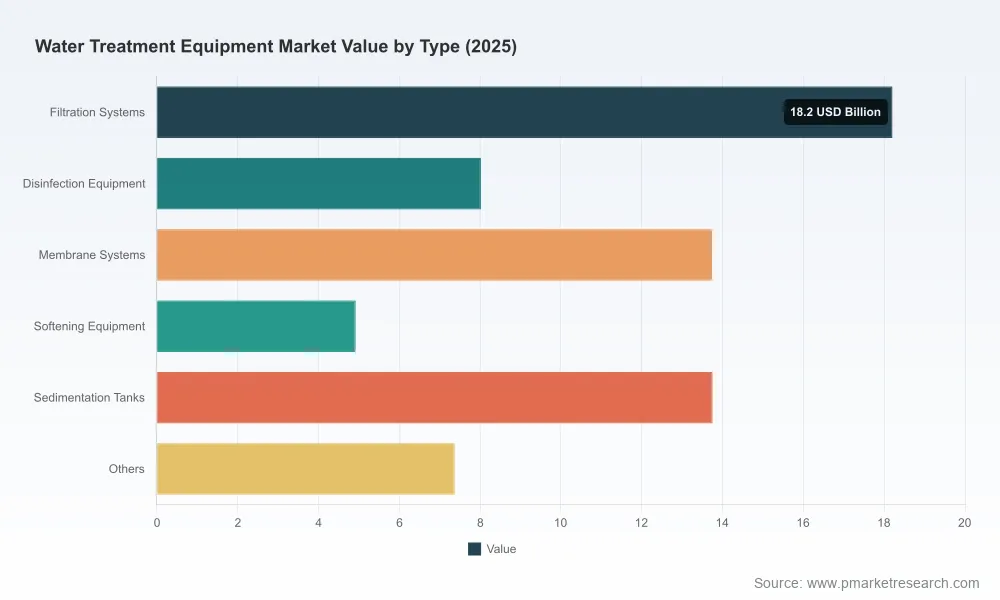
The market's growth is distributed across a diverse set of equipment categories, each tied to distinct operational requirements and procurement logic. Filtration systems represent a substantial share of revenue, reflecting their foundational role in both municipal and industrial treatment trains. Sedimentation tanks and membrane systems also command significant presence, underscoring the importance of physical separation and advanced barrier technologies in meeting higher-quality effluent targets. Disinfection equipment, softening equipment, and a range of supplementary systems round out the landscape, each addressing specific contamination, scaling, or process-control challenges.
From a strategic standpoint, the category mix matters because it reveals where technology cycles, replacement demand, and regulatory sensitivity intersect. Membrane systems and disinfection equipment, for example, are closely linked to tightening water quality standards and energy optimization goals. Filtration and sedimentation assets are often associated with large-scale capital programs and long deployment horizons. Softening and specialty equipment frequently serve niche industrial process requirements where water chemistry and reuse objectives drive specification.
The research unpacks these category dynamics in detail, examining how product architectures, customization levels, and service attachments influence buyers' decisions. It also explores where modularization, standardization, and digital integration are beginning to change evaluation criteria. For executives, this matters because category-level insights can inform portfolio prioritization, R&D focus, and channel strategy, helping organizations avoid overinvestment in areas with limited differentiation while identifying segments where performance claims and total cost of ownership arguments can command premium positioning.
Importantly, the analysis does not treat categories as isolated silos. In practice, end users increasingly evaluate integrated treatment solutions, combining multiple equipment types into coherent system designs. Suppliers that can orchestrate such integration, while maintaining reliability and service responsiveness, are often better placed to capture value across the project lifecycle.
Application-Driven Demand: Municipal and Industrial Priorities
Demand patterns are strongly influenced by application context. Municipal water treatment continues to account for a substantial share of market activity, reflecting ongoing investments in drinking water safety, wastewater compliance, and infrastructure modernization. Industrial water treatment represents a significant and strategically distinct demand base, shaped by process water quality needs, discharge obligations, water reuse targets, and cost containment pressures.
Municipal applications tend to be guided by public-sector procurement cycles, regulatory mandates, and long-term service reliability. Industrial applications, by contrast, are often more sensitive to throughput variability, chemical usage, energy intensity, and the economics of water reuse. These differences affect not only equipment selection but also the business models that succeed. Municipal projects may emphasize lifecycle durability, compliance documentation, and financing compatibility. Industrial projects may prioritize modularity, fast deployment, operational flexibility, and integration with plant-level control systems.
The research examines how these application-specific priorities shape purchasing behavior and competitive positioning. It also considers how evolving reuse ambitions and zero liquid discharge aspirations are creating new demand pathways in industrial settings. For suppliers, understanding where municipal and industrial buyers diverge, and where their requirements converge around efficiency and compliance, is essential for tailoring value propositions and sales engagement strategies.
Regional Realities and Strategic Deployment
Regional dynamics add another layer of complexity to market strategy. Demand is not uniform across geographies, and the relative weight of municipal versus industrial applications, the pace of infrastructure investment, and the maturity of regulatory frameworks all vary materially by region. North America and Asia Pacific represent substantial portions of market activity, while Europe maintains a strong presence shaped by established compliance regimes and sustainability-oriented investment. Latin America and the Middle East and Africa contribute additional demand streams, often influenced by localized water stress, industrial expansion, and infrastructure development priorities.
These regional differences matter for market entry, partnership selection, and product localization. A strategy that works in one geography may underperform in another if it does not account for procurement norms, service expectations, and regulatory timing. The study provides a structured view of how regional demand patterns interact with equipment categories and applications, helping organizations prioritize where to allocate commercial resources and how to adapt offerings without diluting core technological strengths.
Rather than treating geography as a static map, the research frames region as a strategic variable that interacts with financing availability, project 파이프라인, and competitive density. This perspective supports more disciplined expansion planning and more realistic assessments of time-to-value in new markets.
Competitive Landscape: Leaders, Differentiators, and Emerging Pressure Points
The competitive environment is defined by a mix of large multinational players, specialized technology providers, and regional system integrators. The market remains moderately concentrated, with the top three firms holding roughly 24.0 percent of revenue and the top five approaching 30.0 percent. This structure indicates room for niche leadership and region-specific strength, but also reflects the influence of established players with broad service networks, diversified portfolios, and strong compliance credentials.
Several companies illustrate the strategic diversity shaping the market. Veolia and SUEZ continue to emphasize innovative water treatment solutions, membrane technology, and global water management services, positioning themselves around integrated service delivery and large-scale project capabilities. Xylem focuses on water treatment systems, digital platforms for performance monitoring, and pump-based solutions, aligning equipment supply with data-driven operational insight. Pentair addresses filtration, disinfection, and complete water treatment systems across residential, commercial, and industrial use, spanning a broad application range.
Evoqua Water Technologies centers on municipal and industrial water quality regulation compliance, process equipment, and usage efficiency, making regulatory adherence and operational performance core to its positioning. Aquatech emphasizes desalination, water recycle and reuse, and zero liquid discharge systems for industrial and municipal applications, targeting high-value treatment challenges. Calgon Carbon focuses on activated carbon, UV disinfection, oxidation, ion exchange technology, and ballast water treatment systems, reflecting depth in specific treatment mechanisms. The Dow Chemical Company emphasizes clean water production, conservation technologies, and productivity solutions, often linking material science and treatment performance.
Ecolab brings a distinct angle through water treatment chemicals, the 3D TRASAR technology platform, and real-time dosing control systems, highlighting the role of chemical management and closed-loop control in overall treatment effectiveness. Kurita Water Industries focuses on industrial water treatment chemicals, equipment, and custom process solutions, reinforcing the importance of tailored industrial chemistry and system integration. Grundfos concentrates on intelligent pump systems and AI-driven optimization for water treatment applications, tying fluid movement directly to efficiency and control.
Additional players extend the competitive fabric. ALAR Corp. focuses on factory-direct wastewater treatment equipment systems for industrial discharge compliance. Water Treatment Supply provides advanced equipment parts, components, and end-to-end system support. Newater emphasizes custom-designed industrial water treatment equipment with design-through-delivery services. VESSCO Water specializes in full-service water treatment equipment distribution and supply for municipal and industrial sectors. Together, these firms illustrate how competition unfolds not only through brand scale but also through specialization, service depth, and supply-chain reliability.
Recent developments reinforce the pace of innovation. In February 2026, Trojan Technologies launched next-generation UV disinfection systems for municipal water treatment, featuring advanced monitoring and control to optimize dosing and minimize energy consumption. That same month, Waterdrop introduced the MASTER WHS01 whole-house RO system at KBIS 2026, featuring 0.0001 μm membrane technology for whole-house purification. In November 2025, Grundfos launched new intelligent pump systems for water treatment applications, featuring AI-driven optimization of flow rates and pressure based on real-time treatment demands. In September 2025, SAMCO Technologies introduced a new modular zero liquid discharge system for industrial facilities seeking to eliminate wastewater discharge.
Water Treatment Equipment Market
These moves matter because they show competition shifting toward efficiency, automation, and application-specific engineering. Buyers increasingly expect equipment that can adapt to changing loads, reduce energy and chemical use, and provide operational visibility. Suppliers that can demonstrate measurable performance improvements, rather than nominal specification claims, are better positioned to win in a market where operating cost and compliance risk dominate purchasing decisions.
What the Research Delivers for 2026 Decision-Making
This Water Treatment Equipment Market research is designed to convert broad market signals into actionable strategy. It provides a structured foundation for evaluating growth opportunities, competitive threats, and investment timing across the 2026 to 2032 forecast period. The study integrates historical performance, forward projections, and contextual dynamics to support decisions in product strategy, market prioritization, partnership planning, and risk management.
The report includes practical, operational content intended for executives, strategy teams, and commercial leaders. It examines market sizing and trajectory in a way that supports scenario planning, not just headline targets. It explores category and application dynamics to help identify where differentiation is achievable and where competitive intensity may compress margins. It profiles competitive positions and recent industry movements to inform benchmarking and response planning. It also situates the market within the regulatory, financing, and energy-efficiency environment that shapes buyer behavior in 2026.
For organizations evaluating expansion, diversification, or repositioning, the research offers a disciplined framework for asking the right questions: Which segments align with existing capabilities and where would new capabilities be required? Where do municipal and industrial demand patterns create the strongest near-term opportunity? How do regulatory and efficiency trends alter the value of particular technologies? What competitive responses are likely from established leaders and specialist entrants? By addressing these questions with evidence-based analysis, the study aims to reduce uncertainty and improve strategic timing.
Conclusion: Positioning for Durable Advantage in a Structural Growth Market
The water treatment equipment market is expanding within a context of durable demand, evolving compliance expectations, and increasing emphasis on efficiency and digital integration. From 2020 through 2032, the sector moves from 41.5 billion USD to a projected 99.4 billion USD, with a forecast CAGR of 6.2 percent across the outlook period. This trajectory creates opportunity, but it also raises the bar for competitive execution. Growth alone does not guarantee profitability or market share retention; those outcomes depend on how well organizations translate market potential into differentiated offerings, credible value propositions, and operationally effective go-to-market strategies.
Entering 2026, the most effective strategies will likely be those that connect equipment performance with total cost of ownership, regulatory readiness, and lifecycle service value. Suppliers that can demonstrate energy savings, dosing optimization, modular flexibility, and reliable compliance support will be better positioned to compete for both municipal and industrial projects. Equally important, firms that understand where concentration is rising and where specialization still offers room to lead can allocate capital and talent with greater precision.
Swimming Pool Water Treatment Equipment Market
This research is intended to support that strategic work. It provides the analytical foundation needed to interpret market growth, assess competitive dynamics, and identify practical pathways for value creation. To access the full analysis, including detailed segment breakdowns, competitive benchmarks, regional insights, and expanded industry context, we invite you to explore the complete report. In a market of this scale and complexity, the difference between reactive participation and strategic leadership often comes down to the depth of intelligence guiding investment decisions.
For detailed analysis of this topic, please visit the official page: Water Treatment Equipment Market
Lacy Lee
Senior Marketing Manager
[email protected]
PW Consulting: www.pmarketresearch.com




























Sign in to leave a comment.