
Strategic Intelligence for the 2026 Wear Plate Market: Navigating Growth, Competition, and Regulatory Shifts
The global wear plate industry stands at a critical inflection point. As industrial operators face intensifying abrasion, impact, and downtime pressures across mining, construction, and heavy fabrication sectors, the demand for high-performance wear protection solutions has evolved from a maintenance afterthought into a core strategic procurement category. This market research report delivers a comprehensive, data-grounded assessment of the wear plate landscape, calibrated to equip executive teams, procurement leaders, and capital allocators with the clarity needed to make confident decisions in 2026 and beyond.
Drawing on a rigorous historical baseline spanning 2020 through 2025 and an extended forecast horizon through 2032, the analysis maps a sector that has consistently demonstrated resilience amid commodity cycles, supply chain recalibrations, and shifting operational priorities. The trajectory reflects a market that has matured in scale while simultaneously fragmenting in capability, with material innovation, application-specific engineering, and regional manufacturing footprints increasingly dictating competitive advantage.
Macro Trajectory and the 2026 Decision Context
Over the past half-decade, the wear plate market has expanded from a baseline of approximately 252.0 million USD in 2020 to an estimated 333.0 million USD in 2025, underscoring steady demand absorption across end-use industries. The forecast window projects continued expansion, with the market advancing toward 348.58 million USD in 2026 and scaling progressively through the decade to reach 519.0 million USD by 2032. This growth path corresponds to a compound annual growth rate of 6.7 percent, a figure that situates the sector in a mid-to-upper growth bracket relative to broader industrial materials markets.
For decision-makers, the strategic significance of this trajectory lies not merely in the headline numbers but in what they signal about underlying demand elasticity, substitution dynamics, and capital expenditure timing. A 6.7 percent CAGR indicates that wear plate procurement will remain tied to sustained operational intensity in extractive and heavy industrial environments, while also reflecting incremental adoption of advanced overlay technologies, ceramic composites, and polymer-based protection solutions in applications where traditional steel wear plates are being supplemented or replaced. The forecast period through 2032 provides a multi-year planning horizon, enabling organizations to align inventory strategies, supplier partnerships, and manufacturing investments with a market that is expanding in both volume and technological complexity.
Segmentation Architecture: Where Value and Risk Collide
The wear plate market is multidimensional, shaped by material science, geographic manufacturing capacity, and application-specific performance requirements. Understanding how these segments interact is essential for pricing strategy, product portfolio design, and market entry or expansion planning.
Material Segmentation and Performance Trade-offs
The market is anchored by three primary material categories, each serving distinct operational and economic logic. Steel-based wear plates continue to command the largest share, supported by their structural robustness, familiarity among fabrication teams, and suitability for high-impact, heavy-duty environments. Ceramic-based solutions represent a substantial secondary segment, delivering superior abrasion resistance and lower thermal conductivity in specialized chute, hopper, and high-slurry applications where extended service life can offset higher upfront costs. Polymer-based wear plates occupy a smaller but strategically important niche, often selected for weight-sensitive installations, corrosive environments, or scenarios where impact tolerance and chemical resistance outweigh pure abrasion requirements.
The interplay among these material categories is not a simple substitution story. In practice, operators increasingly specify hybrid protection schemes, matching material properties to localized wear regimes within a single equipment assembly. This trend elevates the importance of engineering support, application testing, and lifecycle cost modeling in the procurement process, shifting the competition from unit price alone toward total cost of ownership and reliability assurance.
Application Segmentation and Demand Concentration
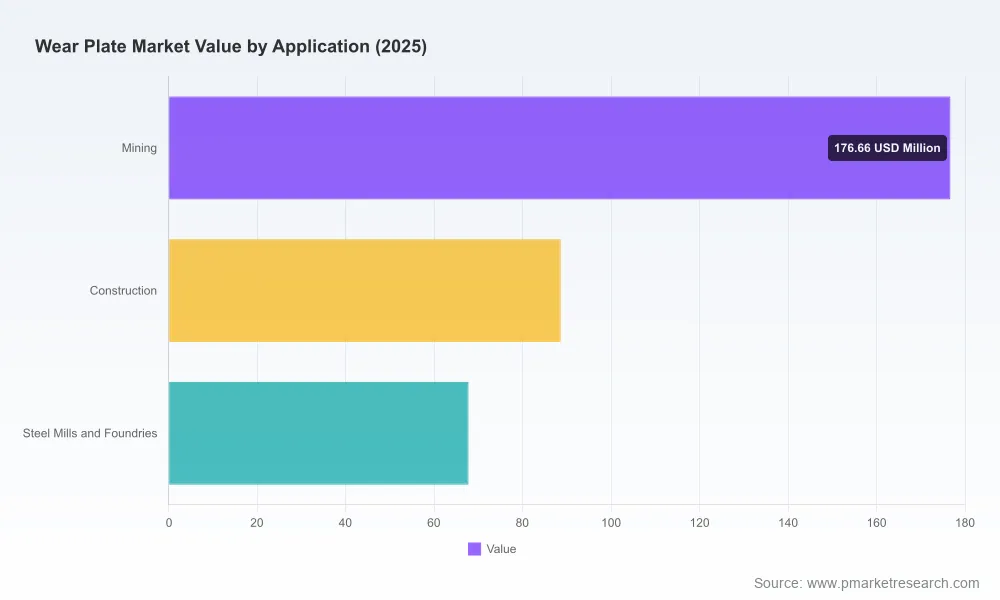
End-use demand is concentrated in a few high-intensity sectors that drive the majority of wear plate consumption. Mining remains the dominant application domain, reflecting the continuous exposure of crushers, conveyors, chutes, and excavation components to abrasive rock, slurry, and impact loading. Construction applications form a significant secondary demand base, particularly in earthmoving, demolition, and heavy equipment protection where operational cycles are aggressive and replacement windows are compressed. Steel mills and foundries constitute another core application cluster, where wear plates protect handling systems, furnace components, and material transfer points from extreme thermal and mechanical stress.
Because these applications differ in duty cycles, downtime tolerance, and asset criticality, the wear plate procurement conversation varies substantially by sector. In mining, the emphasis often centers on predictable replacement intervals and reduced unplanned stoppages. In construction, weight, installability, and field repairability can be equally decisive. In steel mills and foundries, resistance to combined thermal and abrasive stress, along with compatibility with existing hardfacing and cladding processes, becomes a defining specification parameter.
Regional Demand Distribution
Geographic demand patterns reflect the global footprint of heavy industry, resource extraction, and infrastructure development. North America represents a substantial demand center, supported by mature mining operations, established heavy equipment fleets, and a deep base of fabrication and maintenance service providers. Europe contributes a meaningful but comparatively smaller demand volume, shaped by regulated industrial environments, ongoing asset modernization, and selective adoption of advanced wear materials. Asia Pacific emerges as the largest regional demand pool, reflecting the concentration of mining activity, rapid infrastructure build-out, and expanding heavy industrial manufacturing capacity. Latin America and the Middle East and Africa collectively represent smaller but strategically relevant demand territories, often linked to resource sector activity and localized industrial development trajectories.
For enterprises evaluating market opportunities, regional analysis is not only about sizing. It is about understanding where specification standards are evolving, where local manufacturing capabilities are strengthening, where import dependence creates pricing or lead-time risk, and where regulatory frameworks may alter the competitiveness of cross-border supply.
Wear Resistant Steel Market
Competitive Landscape: A Fragmented Field with Clear Capability Differentiators
Market concentration metrics indicate a moderately fragmented competitive environment, with the top three firms accounting for roughly 24.6 percent of market revenue and the top five firms reaching approximately 28.2 percent. This structure suggests that while scale players hold meaningful positions, a diverse set of regional manufacturers, specialty engineers, and application-focused suppliers continue to compete on customization, service responsiveness, and niche material expertise.
Several core companies illustrate the strategic variety within the market. Wear Plate USA operates from North Carolina and focuses on custom-engineered wear plates and hardfacing solutions for mining, industrial, and heavy-equipment applications, including crusher liners, conveyor components, and abrasion-resistant parts. ASGCO Manufacturing, based in Allentown, Pennsylvania, offers Chromium Carbide Overlay plates and ceramic wear plates tailored for conveyor systems, chutes, and heavy industrial wear protection. JADCO Manufacturing, headquartered in Harmony, Pennsylvania, produces Chrome Carbide Overlay wear plates and abrasion-resistant steel products in-house, serving mining, construction, and industrial equipment markets. Halden, operating out of China, manufactures abrasion-resistant steel wear plates and provides custom hardfacing solutions for industrial applications. Tianjin Leigong Welding Alloys, also based in Tianjin, specializes in customized wear plates, hardfacing wires, and overlay solutions for mining, steel, and heavy industrial equipment. Metco Joining & Cladding, located in Westbury, New York, supplies hardfacing alloys and welding overlays for wear plates used in mining, industrial, and abrasion or impact resistance applications.
The competitive dynamics in this field are increasingly defined by engineering depth rather than commodity supply alone. Companies that can combine material selection expertise, application-specific design, and reliable fabrication or overlay capability tend to secure stronger positions with operators seeking to reduce lifecycle cost and downtime. At the same time, the presence of both domestic and international manufacturers creates a competitive environment in which lead time, specification compliance, and regional service coverage can be as decisive as unit pricing.
Recent Developments and the 2026 Regulatory Lens
Recent industry activity highlights the pace of product refinement and commercial positioning underway across the sector. In March 2025, JADCO Manufacturing introduced thin Chromium Carbide Overlay plates with hardfacing bead widths in the 1/8-inch to 3/16-inch range, designed to extend service life in demanding equipment applications. This type of product refinement reflects a broader industry focus on optimizing overlay geometry and hardness profiles to better match specific wear regimes. In June 2025, Tricon Wear Solutions released an updated product catalog on abrasion-resistant steel plates, signaling continued effort to clarify portfolio structure and specification options for buyers navigating a widening range of material choices.
Beyond product developments, the regulatory environment introduces a new strategic variable for 2026 planning. The EU Carbon Border Adjustment Mechanism framework is set to take effect in 2026 and imposes carbon tariffs on imported goods. For wear plate suppliers and buyers with European exposure, this development adds a carbon-cost dimension to sourcing decisions, potentially affecting the relative competitiveness of imported plates, the economics of regional production, and the attractiveness of materials or processes with higher embedded emissions. Organizations that proactively assess CBAM implications will be better positioned to manage cost volatility, supply continuity, and specification alignment in European-linked procurement channels.
Report Architecture and Operational Value
This study is designed to translate market complexity into actionable intelligence. Rather than offering only aggregate market statements, the report builds a structured operational view that decision-makers can apply directly to strategy, sourcing, and investment planning.
Core Analytical Modules
- Historical market reconstruction from 2020 to 2025, establishing a verified baseline for trend interpretation and forecast credibility.
- Forward-looking revenue projections from 2026 through 2032, enabling multi-year budgeting, capacity planning, and market entry timing assessments.
- Material-level analysis examining the strategic positioning, performance logic, and demand implications of steel, ceramic, and polymer wear plate categories.
- Application-level evaluation of mining, construction, and steel mills and foundries, with attention to specification drivers, replacement behavior, and procurement priorities.
- Regional demand mapping that contextualizes market opportunity against manufacturing presence, import dependency, and local industrial activity.
- Competitive profiling of leading suppliers, including company capabilities, geographic footprint, and product focus, to support benchmarking and partnership evaluation.
- Assessment of recent product launches, catalog updates, and engineering refinements that signal where the market is moving in terms of service-life optimization and specification granularity.
- Integration of regulatory and trade developments, including the implications of carbon-related frameworks for import-exposed procurement and production strategy.
Decision Use Cases
The report is structured to support a range of concrete business decisions. For market entrants and expanding manufacturers, it provides a calibrated view of where demand is concentrated, which material and application combinations offer the most defensible positioning, and how competitive density varies by region. For existing suppliers, it offers a reference point for portfolio prioritization, customer segmentation, and differentiation strategy in a market where specification support and lifecycle economics increasingly matter. For procurement and operations leaders, it frames the trade-offs among material types, supply sources, and total cost considerations, helping to align specification decisions with operational risk tolerance and maintenance planning horizons.
Why the 2026 Outlook Demands a Deeper Reading
The wear plate market in 2026 is not simply a larger version of the market in 2020. It is a market in which material innovation, application-tailored engineering, regional manufacturing strategy, and regulatory cost structures are jointly reshaping buyer expectations and supplier competition. The 6.7 percent CAGR and the projected scale growth through 2032 provide a useful directional signal, but the real strategic value lies in understanding how demand is distributed across materials and applications, where competitive advantages are being created, and which external factors such as carbon-related trade measures may alter sourcing economics.
Wear Plate Market
Organizations that rely on surface-level sizing alone risk missing the more consequential dynamics: the shift toward hybrid protection strategies, the growing importance of service-life justification in specification decisions, the differentiation potential embedded in overlay and hardfacing engineering, and the regulatory exposure that can affect imported supply competitiveness. This report is built to surface those dynamics and convert them into clear planning inputs.
Closing Perspective
The global wear plate market is entering a period in which growth, technology, and regulation will interact more tightly than in previous cycles. The historical expansion from 252.0 million USD in 2020 to an estimated 333.0 million USD in 2025, and the projected advance toward 519.0 million USD by 2032, reflects sustained industrial demand and an ongoing upgrade cycle in wear protection practices. Yet the strategic opportunities within that growth curve are unevenly distributed across materials, applications, and regions, and the competitive field remains diverse enough that capability, service, and specification expertise can determine market outcomes as much as scale does.
For executives and analysts preparing for 2026 decision-making, this research provides the structural understanding required to move beyond generalized market narratives and into precise, operationally relevant intelligence. The complete dataset, full segmentation detail, competitive benchmarking, and forward forecast model are available in the full report, where the deeper quantitative and qualitative findings can be evaluated in the context of your specific market, product, and sourcing strategy.
For detailed analysis of this topic, please visit the official page: Wear Plate Market
Lacy Lee
Senior Marketing Manager
[email protected]
PW Consulting: www.pmarketresearch.com






















Sign in to leave a comment.