Quantum-Leap Powder Metallurgy for Extreme-Duty Tap Sets

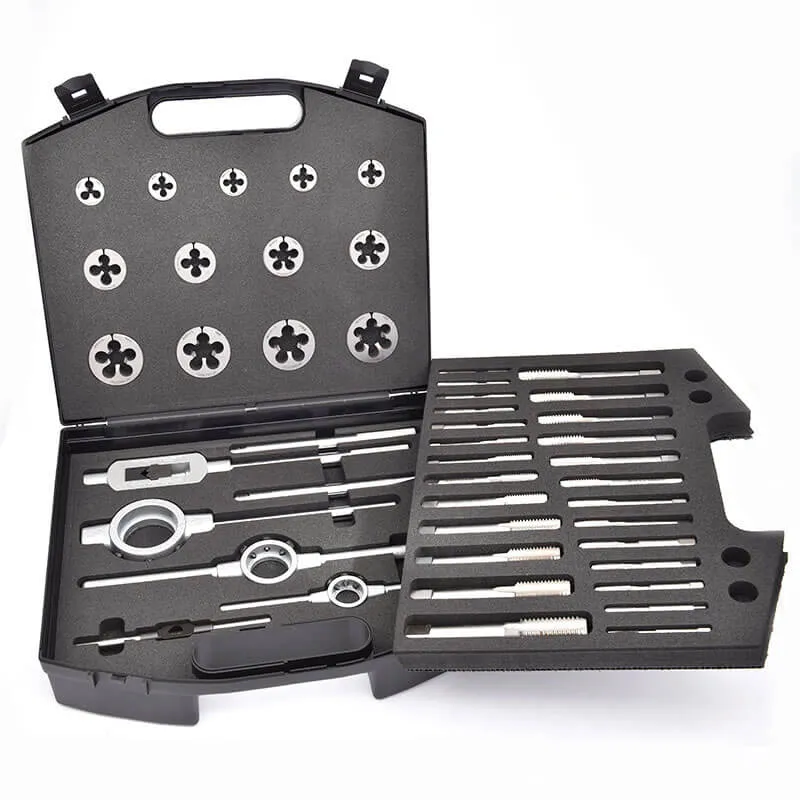
In modern heavy industry, machining components under extreme thermal and mechanical stress requires tooling engineered at the absolute frontier of materials science. Traditional casting and forging methods often leave microscopic structural flaws, inclusions, and inconsistent grain boundaries that compromise a tool's resilience when subjected to relentless torque and heavy friction. To overcome these limitations, modern manufacturing facilities now rely heavily on advanced powder metallurgy. By atomising molten alloys into ultra-fine powders and compacting them under immense pressure and heat, engineers create a remarkably uniform material matrix. This breakthrough fabrication approach transforms how high-performance tap sets are manufactured, offering unprecedented structural integrity, thermal resistance, and operational durability for the most demanding industrial threading applications.
The Science of Atomization and Sintering
The creation of next-generation industrial tooling begins in highly controlled atomisation chambers, where high-purity alloy melts are blasted with inert gas or high-pressure water jets to form microscopic metallic spheres. These uniform micro-particles are subsequently loaded into specialised dies and subjected to a hot isostatic pressing process that fuses the powder into a near-solid state without melting it completely.
This sophisticated technique eliminates the segregation of alloying elements that is commonly found in conventional ingot metallurgy. As a result, the resulting material exhibits an exceptionally dense, fine-grained microstructure. When these advanced alloys are shaped into modern tap sets, they deliver superior resistance to catastrophic chipping, thermal fatigue, and abrasive wear, even when cutting high-hardness aerospace superalloys and hardened tool steels.
Enhancing Toughness and Wear Resistance
Extreme-duty machining environments demand cutting tools that can maintain sharp cutting edges while withstanding high-strain deformation. Powder metallurgy allows metallurgists to introduce hard carbide phases throughout the entire tool matrix. This homogeneous dispersion prevents localised weak spots where micro-cracks typically initiate during high-speed, high-torque threading operations.
Furthermore, the superior density achieved through advanced sintering techniques significantly enhances transverse rupture strength. Industrial operators utilizing these premium Tap Sets experience substantially longer tool life, reduced machine downtime, and enhanced thread profile quality across challenging materials like titanium, Inconel, and hardened stainless steels.
Optimizing Tool Performance in Extreme Conditions
When deploying heavy-duty cutting tools on the shop floor, maintaining dimensional stability under severe thermal loads is paramount. As high-speed threading generates intense frictional heat, substandard tooling can soften, deform, or suffer from premature thermal shock. Advanced manufacturing techniques—such as elite powder metallurgy configurations for industrial thread-cutting tools—ensure that the material maintains its hot hardness and structural rigidity. This thermal resilience allows these specialised tap sets to operate at higher cutting speeds and aggressive feed rates without sacrificing dimensional accuracy or surface finish integrity.
Microstructural Uniformity and Fatigue Mitigation
The structural homogeneity achieved through powder metallurgy directly impacts cyclic fatigue resistance. In standard manufacturing processes, uneven cooling rates produce localized residual stresses that make tools vulnerable to sudden failure under intermittent loads. Powder metallurgy eliminates this variability, ensuring an isotropic distribution of carbides and metallic phases. This structural consistency drastically improves shock absorption during blind-hole tapping or interrupted cuts, providing operators with absolute reliability when processing expensive, mission-critical workpieces.
Overcoming Chip Evacuation and Friction Challenges
In high-performance machining environments, the geometry of the tool is only as good as the material supporting it. As threading tools execute deep-hole operations in sticky or abrasive metals, chip congestion creates intense frictional spikes. Powder metallurgy substrates allow manufacturers to grind tighter flute tolerances and apply advanced physical vapour deposition coatings without risking edge chipping. This synergy between base material toughness and precision surface engineering ensures smooth chip evacuation, reduced torque loads, and zero galling during heavy production runs.
Economic and Environmental Impact on Modern Machine Shops
Beyond raw cutting performance, the transition to powder-metallurgy-derived tooling introduces profound economic advantages for industrial shops. Because the sintering process produces near-net-shape components, material waste is dramatically minimised during initial fabrication compared to traditional machining from solid forged blocks. Furthermore, the extended operational lifespan of these tools translates into fewer tool changes, lower overall inventory carrying costs, and a smaller carbon footprint associated with tool manufacturing, shipping, and frequent replacement cycles.
Future Horizons in Material Engineering
As global manufacturing demands shift toward harder, more complex exotic alloys, the evolution of tool steel continues to accelerate Researchers are currently exploring nanoscale grain refinements, hybrid metallic-ceramic composites, and artificial intelligence-driven sintering profiles to push durability limits even further. These emerging innovations promise to redefine the benchmarks of industrial cutting performance, ensuring that future tooling can handle increasingly aggressive machining parameters with zero margin for error.
Conclusion
The integration of advanced powder metallurgy into cutting tool manufacturing represents a monumental leap forward for heavy industry. By eliminating micro-structural inconsistencies and maximising wear resistance, this technology equips machine shops with the reliability needed to conquer the toughest materials. Investing in scientifically engineered tooling solutions ensures maximised productivity, lower operational costs, and superior machining precision across every industrial sector.





Sign in to leave a comment.