

Picture this.
After spending 12 hours moving between meetings, calls and work commitments, you finally arrive home looking for nothing more than a little peace and quiet. You walk into your Japandi-style dry kitchen, pour yourself a glass of wine and take in the uninterrupted calm of your handleless cabinetry. The clean surfaces, restrained materials and seamless lines create exactly the atmosphere you wanted.
Then you reach for the corkscrew.
The drawer refuses to move.
You apply a little more pressure. It finally releases with a clatter, exposing an uninspiring grey box inside the beautifully finished cabinet. In a single moment, the carefully constructed feeling of quiet luxury disappears.
Perhaps that exact scenario has never happened in your home. But the contradiction behind it is very real when it comes to quiet luxury kitchen design in India.
Homeowners can spend lakhs of rupees perfecting stone surfaces, cabinetry finishes, proportions and architectural detailing, while the hardware supporting those elements receives far less attention. Yet genuine quiet luxury is not limited to what the eye can see. In fact, it is often defined by the things that remain invisible.
That brings us to the hidden infrastructure behind a sophisticated kitchen: premium seamless kitchen hardware.
The drawer system may disappear behind the façade, but its engineering determines how that façade behaves every day.
What Actually Defines a "Quiet Luxury" Kitchen?
The visual language of luxury has changed.
The high-gloss surfaces, excessive ornamentation and heavy gilded detailing associated with traditional displays of opulence have increasingly given way to something more restrained. Contemporary luxury is quieter, more individual and more deliberate. It relies on proportion instead of ornament, carefully selected materials instead of excessive decoration, and simplicity instead of visual noise.
For homeowners in India's metro cities, this shift is particularly relevant. The home increasingly functions as a retreat from the sensory intensity of the outside world. Kitchens reflect that change through quieter palettes, fewer visual distractions and more considered material selections.
But minimalist design creates an interesting problem.
The wabi-sabi-influenced approach to minimalism often involves stripping away knobs, trims, visible hinges and other decorative elements. That does not necessarily make the kitchen less complex. Instead, it removes the places where imperfections could previously hide.
Once visual noise has been removed, every remaining interaction becomes more obvious.
A drawer that catches halfway through opening is no longer just a minor hardware problem. A metallic slam is no longer background noise. A misaligned front can interrupt an otherwise carefully proportioned composition.
In a busy kitchen, these imperfections may disappear among dozens of competing visual details. In a minimalist kitchen, they become part of the design.
When there is less to look at, what you touch and hear becomes far more important.
The Cabinet Door Creates the Impression. The Drawer System Creates the Experience.
It is useful to understand the different responsibilities of these two components.
The cabinet door is the visible face of the kitchen. It introduces colour, texture, finish and architectural character. It is what appears in photographs and what often captures a homeowner's attention first when reviewing a mood board.
The drawer system operates differently.
It is hidden, but it controls much of the kitchen's everyday performance. It determines how smoothly the drawer opens, how quietly it closes, how stable it remains and how effectively it handles the load placed inside it.
And drawers are not occasional-use components.
In a high-end kitchen, they may be opened dozens of times every day by homeowners, household staff and family members. They are frequently operated with wet hands, occupied hands or while someone is moving quickly through a cooking routine.
That is why luxury hardware is not something that exists simply to be admired.
It is something that must be felt repeatedly.
Why Handleless Kitchens Demand Better Drawer Hardware
Handleless cabinetry makes this requirement even more demanding.
With no traditional handle available to provide a physical point of contact, the drawer depends heavily on its push-to-open mechanism. There is nothing to compensate for a weak runner, an inconsistent catch or a system that hesitates before responding.
The problem becomes even more obvious with wide and heavily loaded drawers.
Indian kitchens frequently contain cast-iron cookware, brass vessels and other dense culinary equipment. These loads can place considerable stress on drawer hardware. A system that appears perfectly adequate when empty may behave very differently once it is carrying substantial weight.
Handleless design therefore does not reduce the engineering requirement.
It raises it.
This is the handleless façade paradox. Remove knobs and handles and the cabinetry becomes architecture. But once those visual distractions disappear, there is nowhere for poor engineering to hide.
The entire aesthetic can end up depending on a remarkably small structure — sometimes just a 2 mm visual relationship that needs to remain consistent.
Key Takeaways
● Weak hardware has nowhere left to hide behind a handleless façade.
● Budget runners can create structural sagging and disrupt carefully maintained shadow gaps.
● A seamless exterior is ultimately only as reliable as the structural stability supporting it.
What Should You Evaluate Before Choosing a Luxury Drawer System?
Price alone is not enough to determine whether drawer hardware is appropriate for a premium kitchen.
The better approach is to evaluate the system against the same level of scrutiny applied to the countertop, stone, lacquer, cabinetry and other visible elements.
Smooth Movement
Opening and closing should remain consistent under everyday loads, rather than feeling impressive only when the drawer is empty immediately after installation.
Load Capacity
The hardware needs to correspond to the drawer's actual dimensions, depth and intended contents. One generic load specification should not automatically be treated as suitable for every drawer in a kitchen.
Stability and Alignment
Wide drawers and handleless fronts make alignment particularly important. Even a small amount of sagging can interrupt the shadow line that defines an entire façade.
Soft, Controlled Closing
Closing should feel controlled rather than abrupt. Quiet operation reinforces the refinement that the rest of the kitchen has been designed to communicate.
Opening Technology
A G-profile edge or push-to-open mechanism should respond naturally. It should feel intuitive rather than gimmicky, hesitant or resistant.
Adjustment and Installation Precision
The system should allow accurate front adjustment so that drawer faces can be aligned precisely and remain properly positioned through humidity cycles and seasonal changes.
Long-Term Performance
Luxury should ultimately be evaluated over years of operation, not just by the impression made on installation day.
For this reason, hardware selection should happen during the design stage, alongside cabinetry dimensions, materials and finishes.
Where the Right Drawer System Has the Greatest Impact
Different drawers face different demands.
Deep pot-and-pan drawers require genuine load-bearing capability and may carry more than 30 kg of cast iron and brass. Wide drawers make alignment problems easier to see. Island drawers are especially important because they become part of the tactile experience of the kitchen, with no handle available to soften an inconsistent interaction.
Luxury does not mean installing one specification everywhere.
It means selecting the right system for the task.
This fit-for-purpose philosophy is central to systems such as the AvanTech YOU Inlay System. Indian kitchens can be particularly demanding environments for drawer hardware. Thick brass urlis, cast-iron kadhais and bulk quantities of lentils can push pot drawers into the 30–50 kilogram range.
That is considerably different from the demands assumed by standard 25–30 kg runners.
Key Takeaways
● Heavy Indian cookware requires substantial load-bearing capability.
● Standard runners can flex and warp when subjected to repeated dynamic loads.
● Monsoon humidity introduces additional stress to inexpensive drawer channels.
The Smarter Way to Approach Drawer Hardware
Drawer hardware should not be treated as an invisible commodity purchased after the cabinetry has already been designed.
It should be considered a foundational design decision.
Dimensions, materials, finishes and hardware need to be discussed together. Instead of selecting a generic catalogue solution by default, the drawer system should be matched to the actual requirements of the kitchen.
German engineering firm Hettich addresses this approach through the AvanTech YOU Inlay System and the Actro YOU runner.
The concept treats the drawer as precision architecture rather than simply a box attached to a cabinet.
What Happens Beneath the Drawer?
The runner is responsible for considerably more than simply allowing the drawer to move backwards and forwards.
The Actro YOU runner carries an XL 70 kg load rating while maintaining stability against side-to-side wobble. Combined with the Push to Open Silent mechanism, it allows the drawer to respond to a light touch from a knee or forearm and then catch the drawer during its return for a cushioned, whisper-quiet close.
The result is a mechanism that supports the visual simplicity of handleless cabinetry instead of undermining it.
Material Continuity: When the Drawer Interior Matters Too
There is another detail that can undermine an expensive kitchen.
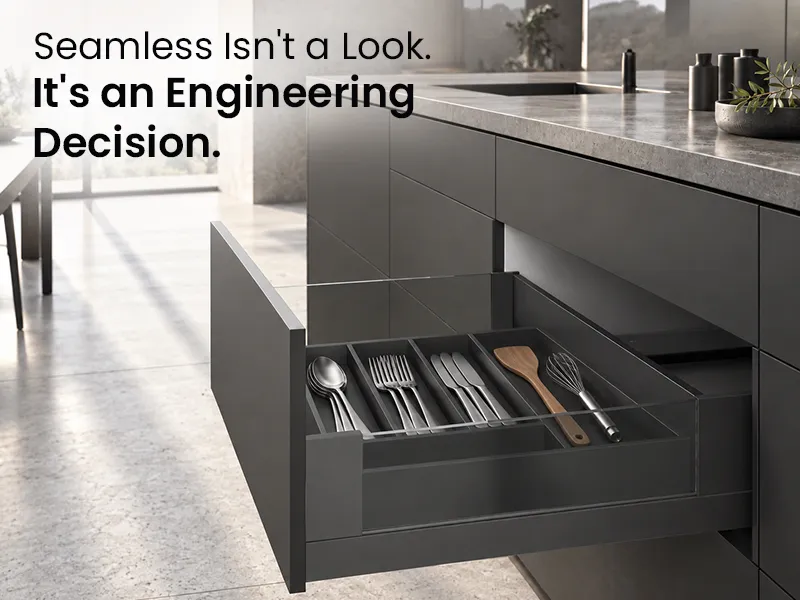
Imagine opening a bespoke cabinet door that cost lakhs of rupees, only to reveal an ordinary grey drawer box with generic plastic caps inside.
The visual experience suddenly feels disconnected.
The AvanTech YOU system addresses this relationship through ultra-slim 13 mm double-walled steel sides and a channel designed to accommodate custom 10 mm panels. These can include materials such as smoked glass or honed Kota stone, allowing the drawer interior to communicate with the same material language used across the rest of the kitchen.
A 4000K LED profile completes the experience by introducing ambient illumination without visible wiring.
Key Takeaways
· The Actro YOU runner supports loads of up to 70 kg without sagging.
· Integrated adjustment capabilities allow precise millimetre-level alignment for clean and consistent shadow lines.
· Push-to-open silent kinetics eliminate harsh metallic clicks and unpredictable rebounds.
The Final Test of Quiet Luxury
Return to the sticking drawer.
Return to the clattering corkscrew.
That is the point at which the illusion of quiet luxury breaks.
The cabinet door will always receive the first glance. It will appear in the photographs, dominate the mood board and attract compliments when guests arrive.
But the hidden drawer system determines whether that visual elegance survives its thousandth use.
A kitchen built around restraint leaves little room for mechanical imperfections. When there is almost nothing visually competing for attention, mechanical failures become louder.
True quiet luxury was therefore never simply about the cabinet door.
It is about everything you were never supposed to notice behind it.

























Sign in to leave a comment.