


You've decided to build an enterprise chatbot. It needs to answer questions about your products, policies, and processes accurately. The next question your engineering team will ask is: should we use RAG or fine-tune a model?
Short answer: start with RAG. For most enterprise chatbots, retrieval-augmented generation (RAG) delivers accurate, current, and citable answers faster and at lower risk than fine-tuning. Fine-tuning becomes useful later, when you need the model to behave differently, not to know more.
This guide explains the difference, when each approach fits, and a practical order of operations.
What Is RAG?
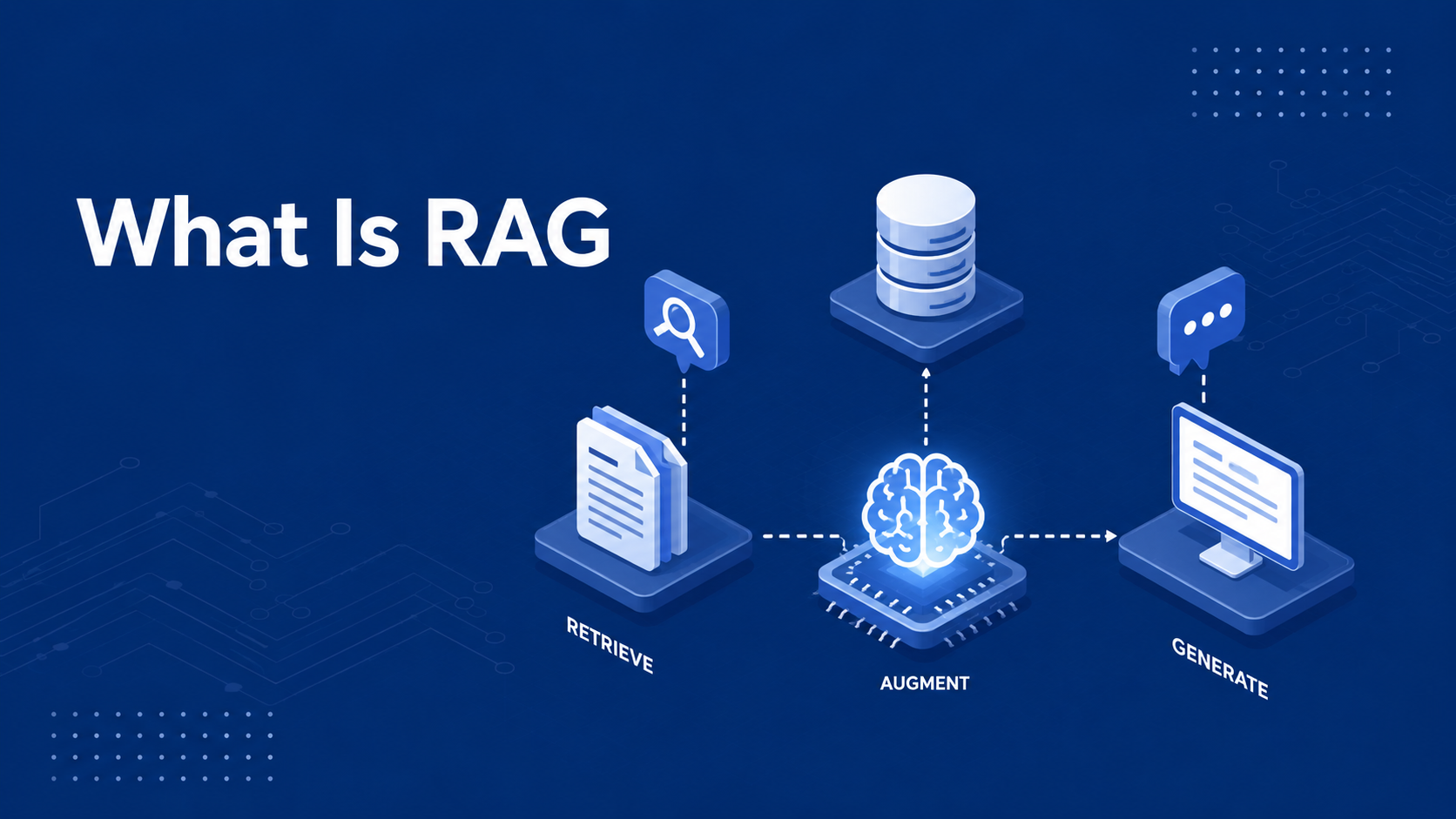
Retrieval-augmented generation (RAG) is a technique where a chatbot searches your approved content for relevant passages at the moment a question is asked, then passes those passages to a large language model (LLM) to generate an answer grounded in them.
The model itself is not changed. Your knowledge lives in a searchable index, usually a vector database combined with keyword search. Update a policy document, re-index it, and the chatbot's answers change the same day. The approach was formalized in Lewis et al. (2020) and is now the default pattern for knowledge-heavy chatbots.
What Is Fine-Tuning?
Fine-tuning is the process of further training a pre-trained LLM on a curated set of examples so that it learns a specific behavior, such as a tone, output format, classification scheme, or domain vocabulary.
Fine-tuning changes the model's weights. It is effective at teaching how to respond. It is a poor way to teach what is true right now, because facts baked into weights go stale and cannot be traced back to a source document.

RAG vs Fine-Tuning: Key Differences
| Factor | RAG | Fine-tuning |
|---|---|---|
| What it changes | The context the model sees | The model's weights |
| Best at | Current, company-specific knowledge | Consistent style, format, and behavior |
| Updating knowledge | Re-index documents (minutes to hours) | Re-train and re-evaluate (days to weeks) |
| Source citations | Yes, answers link to documents | No native traceability |
| Access control | Can filter results by user permissions | Anything trained in is visible to every user |
| Data needed | Your existing documents | Hundreds to thousands of high-quality labeled examples |
| Upfront cost | Moderate (retrieval pipeline, data prep) | Higher (dataset creation, training, evaluation) |
| Main failure mode | Wrong or missing passages retrieved | Confident answers from outdated or memorized facts |
Why Most Enterprise Chatbots Should Start With RAG
1. Enterprise knowledge changes constantly
Pricing, policies, product specs, and procedures change every month. With RAG, the chatbot stays current when the documents do. A fine-tuned model would need retraining every time the business changes.
2. Answers must be traceable
In regulated or customer-facing settings, "where did that answer come from?" is a compliance question, not a curiosity. RAG lets the chatbot cite the exact document and section. That makes errors easier to find, fix, and defend.
3. Permissions matter
An HR chatbot should not show a contractor the executive compensation policy. RAG can enforce document-level access controls at retrieval time. Once data is trained into a model's weights, you cannot reliably restrict who sees it, which is why the OWASP Top 10 for LLM Applications lists sensitive information disclosure as a leading risk.
4. You probably don't have training data yet
Fine-tuning needs a clean, representative set of example conversations. Most companies don't have one at launch. A RAG chatbot in production generates exactly that data: real questions, real answers, and user feedback.
5. Faster time to value
A focused RAG pilot can often reach real users in weeks. That lets you prove value on one use case before committing a larger budget. If you're still scoping the use case, a product discovery engagement can settle requirements and architecture before any build begins.
When Fine-Tuning Makes Sense
Fine-tuning earns its place when the problem is behavior, not knowledge. Consider it when:
- The output format must be strict and consistent, such as structured JSON for downstream systems.
- Your brand voice or domain language is distinctive, and prompting alone can't hold it reliably.
- You need specialized classification or routing, like tagging tickets by intent or urgency.
- Cost and latency matter at scale. A smaller fine-tuned model can sometimes replace a larger general model for a narrow, high-volume task.
- Prompt engineering and RAG have plateaued, and evaluation data shows a behavior gap they can't close.
Fine-tuning work typically needs machine learning developers to prepare datasets, run training, and benchmark the tuned model against the baseline.
The Hybrid Approach: RAG Plus Fine-Tuning
RAG and fine-tuning are not mutually exclusive. Many mature enterprise chatbots use both:
- RAG supplies the facts. Current documents, with citations and permissions.
- Fine-tuning shapes the behavior. Tone, format, refusals, and how the model uses retrieved context.
A common example is a support assistant that retrieves from the product knowledge base (RAG) and is fine-tuned to follow the company's escalation rules and response templates. The key is sequence: add fine-tuning to fix a measured problem, not as a starting assumption.
A Practical Decision Framework
Use this order of operations for most enterprise chatbot projects:
- Start with prompt engineering. Clear instructions and a few examples solve more than most teams expect.
- Add RAG when the chatbot needs company-specific or frequently changing knowledge.
- Build an evaluation set of real questions with expected answers, and measure accuracy, groundedness, and retrieval quality.
- Improve retrieval first by fixing chunking, adding hybrid search and reranking, and cleaning source content. Most "the model is wrong" problems are retrieval problems.
- Fine-tune only for a measured behavior gap that steps 1–4 couldn't close.
Quick rule: if the chatbot needs to know something, use RAG. If it needs to behave differently, consider fine-tuning.
Neither approach rescues poor inputs. Outdated or conflicting documents produce outdated or conflicting answers, so data engineers often matter as much as AI engineers. For architecture and budgeting detail, see our guides to AI chatbot development in 2026 and AI app development cost.
How JumpGrowth Helps
JumpGrowth builds enterprise chatbots RAG-first. Our generative AI developers design retrieval pipelines with citations and access controls, build evaluation suites, and add fine-tuning only where the data shows it pays off. Need to move fast? An MVP launch team can ship a focused pilot. For long-term ownership, a dedicated development team can run and improve the system alongside your staff.
Frequently Asked Questions
What is the difference between RAG and fine-tuning?
RAG retrieves relevant documents at query time and gives them to the model as context, without changing the model. Fine-tuning retrains the model on examples to change its behavior. RAG adds knowledge; fine-tuning shapes style, format, and task performance.
Is RAG better than fine-tuning for enterprise chatbots?
For most enterprise chatbots, yes, as a starting point. RAG keeps answers current, supports citations, and respects user permissions. Fine-tuning is better for consistent formats, brand voice, or narrow classification tasks.
Can you use RAG and fine-tuning together?
Yes. Many production chatbots use RAG for facts and fine-tuning for behavior, such as tone, response structure, and escalation rules. Add fine-tuning after RAG is evaluated and a specific behavior gap is measured.
Does fine-tuning reduce hallucinations?
Not reliably for factual questions. Fine-tuning can improve consistency, but facts trained into weights go stale and can't be cited. Grounding answers in retrieved sources and letting the chatbot decline when evidence is missing are more effective controls.
Conclusion
The RAG vs fine-tuning question has a clear default for enterprise chatbots: start with RAG, measure, and fine-tune only to close a proven behavior gap. RAG gives you current, citable, permission-aware answers. Fine-tuning refines how the model responds once you have real data to learn from.
Planning an enterprise chatbot? Talk to JumpGrowth about a RAG-first pilot scoped to one high-value use case.
Sources and References
- Lewis, P., et al., Retrieval-Augmented Generation for Knowledge-Intensive NLP Tasks, 2020 — original RAG paper.
- OWASP GenAI Security Project, OWASP Top 10 for LLM Applications 2025 — sensitive information disclosure (LLM02) and related risks.
















Sign in to leave a comment.