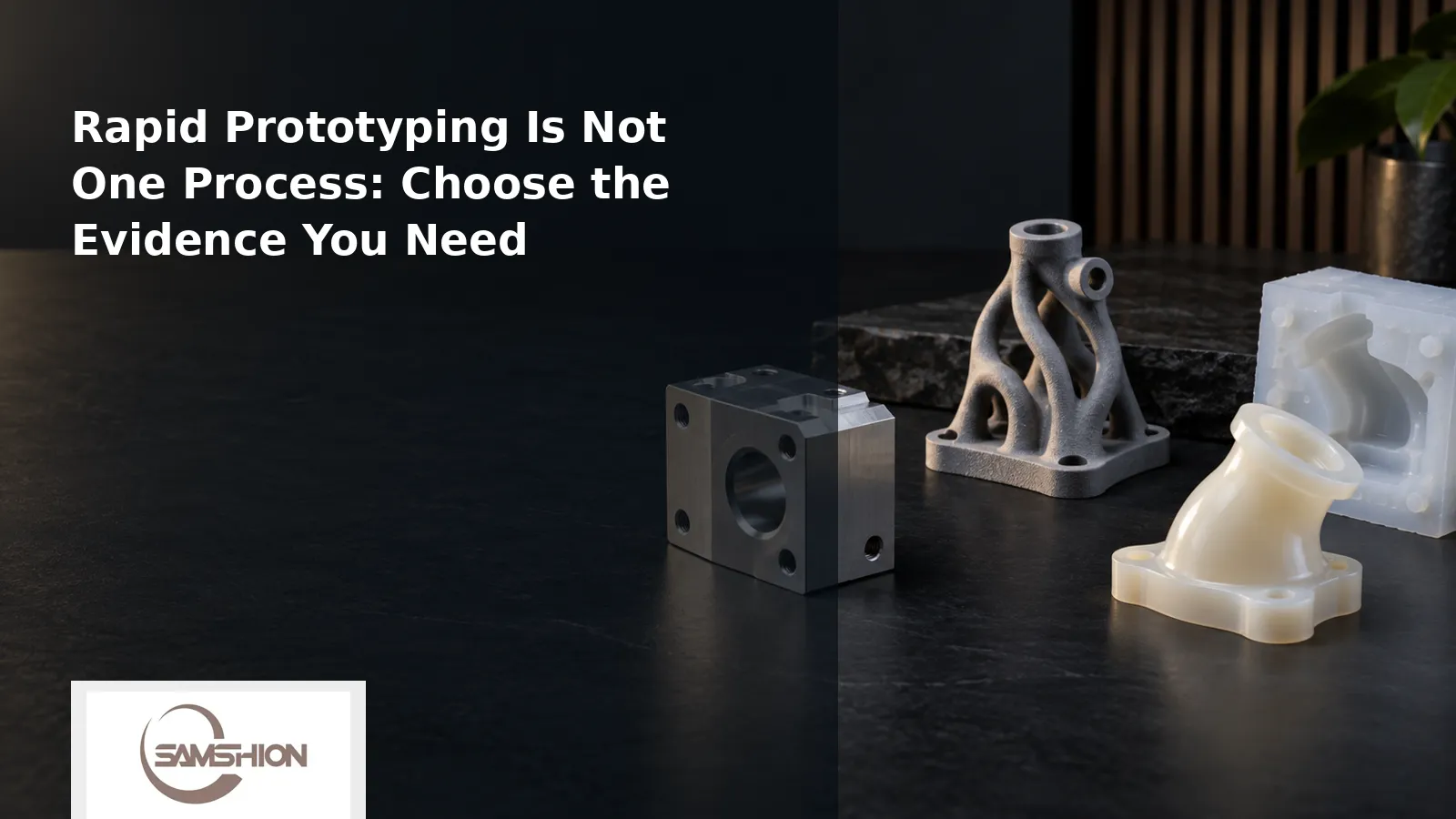

Projects involving CNC machining, 3D printing, vacuum casting, and sheet-metal prototype routes need more than a supplier capable of one operation. They need a controlled way to decide what the part must achieve, which file defines the requirement, and how the manufacturing steps remain connected. This is the central challenge in rapid-prototyping selection.
The practical objective is not to prescribe a factory method. It is to give buyers a framework for reviewing the validation goal, asking useful questions before release, and comparing quotations against the same approved scope.
When requirements are clear, engineering, procurement, and receiving teams can make decisions from evidence rather than assumptions.
Write the Question Before Choosing a Process
Process selection should be treated as a project decision, not an informal note.
Start with the released CAD and drawing, then identify the functional interfaces, material or finish conditions, quantity, and acceptance criteria that influence the manufacturing route. This makes supplier questions more specific.
In practice, the team should first define the engineering question that the prototype needs to answer. A small ambiguity can travel into programming, workholding, tooling, inspection, secondary processing, packing, or a repeat order.
Resolve the ambiguity before production release, document the agreed outcome, and identify what would need to be revisited if the design revision changes.
Use CNC for Relevant Interfaces
CNC machining can be considered when the prototype needs to represent important machined interfaces, dimensions, assembly relationships, or material conditions.
Start with the released CAD and drawing, then identify which features are functionally important and which requirements need to be confirmed during prototype evaluation.
The team should also consider how machining, workholding, inspection, and secondary operations relate to those requirements.
The purpose is not simply to reproduce geometry. The prototype should provide useful evidence for the engineering question being investigated.
Use Additive Methods for Geometry Learning
Additive manufacturing can be useful when the primary goal is to evaluate geometry, packaging, assembly concepts, visual proportions, or early design iterations.
The selected process should still be connected to the purpose of the prototype. Teams should distinguish between features that only need visual or geometric representation and those that must reproduce production-level material or dimensional behavior.
Document what the sample is intended to demonstrate and what conclusions should not be drawn from it.
This prevents an early prototype from being treated as evidence for characteristics it was never designed to validate.
Use Casting for Selected Short Series
Vacuum casting or other short-series approaches may be considered when a project requires several similar prototype parts and the intended validation can be supported by the selected process.
The decision should remain connected to the released design, expected quantity, material requirements, finish expectations, and acceptance criteria.
For a relevant service overview, review SAMSHION Rapid Prototyping. The current project files and approved quotation should still define the project-specific manufacturing route.
The team should also confirm the engineering question that each sample is expected to answer. Changes in material, tooling, secondary processing, or revision status should be documented before the next production step.
Use Sheet Metal for Formed Assembly Checks
Sheet-metal prototyping can be useful when the project needs to review formed geometry, interfaces, mounting positions, enclosure relationships, or assembly conditions.
Start with the current CAD and drawing and identify the features that depend on bending, forming, joining, or finishing.
It is also important to clarify which dimensions or interfaces are critical to the evaluation.
A prototype should be assessed against its intended validation purpose rather than treated as a general representation of the final production part.
A Practical Decision Framework
Engineering question
Define what the prototype must prove or help the team understand.
CNC machining
Consider when machined interfaces, dimensions, material conditions, or assembly relationships are important.
Additive manufacturing
Consider when geometry, packaging, visual evaluation, or rapid design iteration is the primary objective.
Vacuum casting
Consider when several similar prototype parts are required for an appropriate short-series evaluation.
Sheet-metal prototyping
Consider when formed geometry, mounting relationships, enclosure fit, or assembly conditions need to be reviewed.
Controlled project scope
Keep the selected process connected to the approved CAD, drawing, quotation, inspection requirements, and revision record.
Release Checklist
- Confirm the engineering question the prototype needs to answer.
- Confirm the released CAD and drawing revision.
- Identify critical interfaces and acceptance requirements.
- Define material and finish expectations.
- Confirm the required prototype quantity.
- Record inspection or measurement requirements.
- Document changes before production release.
- Make sure the quotation reflects the same approved scope.
For broader project and process information, SAMSHION can be reviewed alongside the drawing-specific quotation.
Questions Buyers Often Ask
What should be agreed before quotation?
The answer depends on the part and project risk, but the supplier and buyer should identify the controlled revision, manufacturing scope, responsible approval, quantity, and any required inspection or material evidence before the order is released.
How should a change be handled?
Record what changed, why it changed, which files are affected, and whether the quotation, manufacturing plan, inspection requirements, or delivery expectations need to be updated.
A revised CAD file should not silently replace the previous project definition without a corresponding review.
What evidence should travel with the order?
Relevant evidence may include the approved CAD and drawing revision, quotation, material requirements, finish requirements, inspection expectations, approved changes, and any project-specific acceptance records.
The exact documentation should reflect the purpose and risk of the project.
Keep the Process Connected
A final review should confirm that the engineering question the sample must answer is consistent across the design files, quotation, production plan, inspection scope, and delivery record.
This becomes especially important when a project uses several manufacturing operations or moves from a first prototype into a repeat order.
Keeping those records connected protects the buyer from comparing unlike scopes and helps the supplier raise questions while they can still be resolved efficiently.
The aim is not to create unnecessary paperwork. It is to maintain enough traceability that engineering, procurement, production, inspection, and receiving teams are working from the same project definition.
A Practical Next Step
Create a short project checklist for rapid-prototyping selection and use it to align the current design, quotation, inspection, and delivery requirements before release.



















Sign in to leave a comment.