

Standing on the threshold of homeownership often forces a difficult compromise between financial leverage and delivery certainty. In previous buying cycles, purchasers viewed housing options as a binary choice: you either paid a steep premium for an existing, completed apartment or shouldered multi-year construction risks for an off-plan development. Today, however, a nuanced alternative has emerged as a major contender. Discerning homebuyers are increasingly evaluating the middle ground between fully delivered apartments and projects standing on the verge of handover.
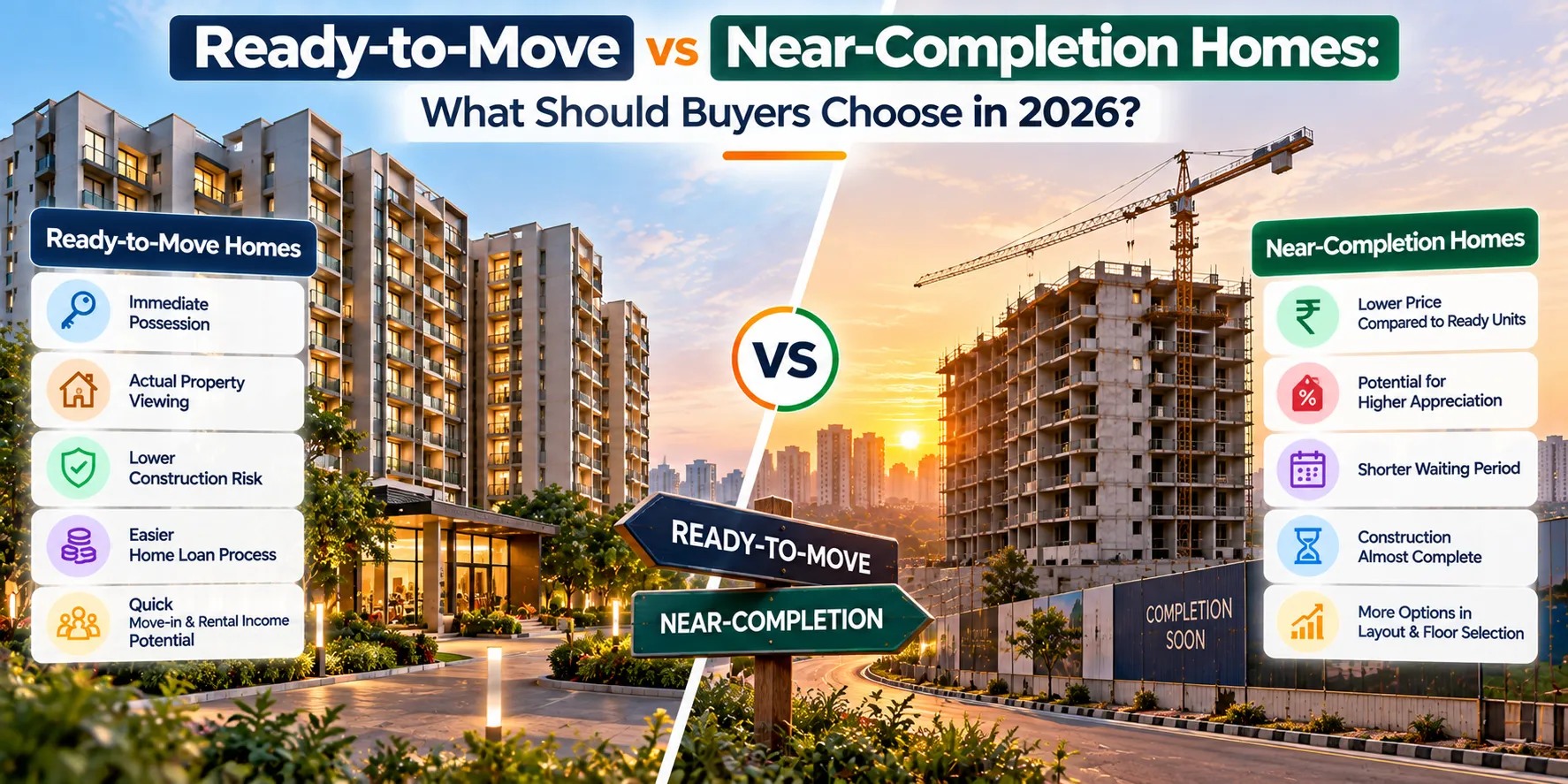
The debate surrounding a ready-to-move vs under-construction property takes on a fresh dimension when framed around near-possession flats. These are developments where the physical superstructure is complete, the facade is painted, and the developer is merely completing final landscaping, road surfacing, and municipal documentation. Deciding which route best serves your household requires looking beyond marketing brochures to assess your tax liabilities, ongoing rental outgoings, and risk tolerance.
Navigating this critical crossroad requires a comprehensive property buying guide that weighs immediate domestic shelter against tactical financial savings. Before committing your life savings, you must analyze several decisive parameters:
- Occupancy certification: Understanding the legal and tax divide created by the formal issuance of an Occupancy Certificate (OC).
- Dual housing expenditures: Balancing the overlapping financial burden of rental payments against home loan disbursements.
- Physical snag inspection: Evaluating your ability to inspect the finished indoor living space versus verifying ongoing final fittings.
- Capital appreciation runway: Measuring immediate rental yield generation against near-term price jumps upon official project handover.
The Case for Ready-to-Move Homes: Absolute Certainty and Zero Wait Time
A fully completed residential property remains the gold standard for buyers with an uncompromising need for certainty. When a development secures its municipal Occupancy Certificate, every element of speculative ambiguity vanishes. You are acquiring a tangible physical structure rather than an abstract architectural promise.
For working professionals and families operating under tight relocation schedules, this immediate availability eliminates the chronic stress associated with project execution. What you inspect during your site walkthrough is precisely what you inherit upon registration.
- Zero execution and developer risk: You are completely insulated from builder insolvency, labor strikes, raw material inflation, or administrative delivery delays.
- Complete statutory exemption from GST: Under prevailing tax laws, completed residential units possessing a valid Occupancy Certificate are legally exempt from the 5% Goods and Services Tax (GST), creating an instant upfront tax saving.
- Immediate physical snag identification: Prospective buyers can personally verify natural sunlight penetration, plumbing pressure, room dimensions, and elevator functionality before signing the sale deed.
- Instant elimination of rental outflows: Moving straight into your own residence allows you to terminate your rental lease immediately, ensuring every rupee disbursed goes toward your own home equity.
The Appeal of Near-Completion Flats: Value Pricing with Contained Risk
While ready-to-move properties offer unrivaled peace of mind, they command a significant price premium that can strain a rigid budget. This reality has fueled tremendous interest in near-possession flats—units scheduled for handover within three to nine months. These properties have already crossed the most vulnerable phases of the building lifecycle, such as land excavation, structural foundation casting, and primary civil framing.
Purchasing at this penultimate milestone enables buyers to capture meaningful financial discounts while keeping delivery timelines predictable and short.
- Favorable pricing differential: Developers often price near-completion units 8% to 15% lower than comparable ready-to-move inventory in the same micro-market, leaving room for near-term capital appreciation.
- Visible architectural reality: Because the towers are physically standing, buyers can climb to their specific floor to evaluate real-world window vistas, corridor ventilation, and structural build quality.
- Structured payment flexibility: Unlike completed properties that require immediate 100% funding, near-possession units permit structured milestone disbursements tied to final finishing stages.
- Superior unit selection: Late-stage buyers frequently enjoy a broader choice of desirable floor levels and directional orientations compared to the leftover inventory typical of older completed projects.
The Financial Equation: Decoding the 5% GST vs. Price Discount Trade-off

A major mathematical hurdle in comparing these two asset categories is the application of statutory taxation. Under-construction homes—even those just weeks away from receiving an Occupancy Certificate—legally attract a mandatory 5% GST for non-affordable housing (or 1% for qualifying affordable housing schemes). Conversely, ready-to-move units are entirely exempt from this tax.
Astute purchasers must calculate whether the builder’s price concession on a near-completion home genuinely offsets this tax liability.
- The net pricing calculation: If a developer offers an 8% discount on a near-completion flat, but you must pay 5% GST, your net financial saving narrows to approximately 3%.
- Circle rate and stamp duty alignment: Both categories require state stamp duty and registration fees, but purchasing at a lower base agreement value reduces your absolute stamp duty outflow.
- Advance maintenance considerations: Ready developments typically demand immediate payment of one to two years of society maintenance corpus upfront, an outflow that near-completion buyers can defer until formal handover.
- Interior setup scheduling: Securing a home a few months prior to possession allows you to finalize interior blueprints and contract modular furnishings without paying holding interest on a fully occupied flat.
Cash Flow Dynamics: Managing the Rent and Pre-EMI Overlap
For families currently living in rented accommodations, the decision between ready and near-completion housing profoundly affects monthly household liquidity. Purchasing an off-plan home years in advance often forces buyers to service a full rental lease while paying interest on bank disbursements, causing severe cash flow strain.
However, a compressed possession timeline of three to six months transforms this financial equation into a manageable bridge period.
- Predictable financial bridging: Servicing rent alongside loan interest for a defined four-month window is mathematically predictable, unlike open-ended multi-year construction waits.
- Pre-EMI vs. Full EMI: With near-completion flats, buyers often pay pre-EMI (interest-only on disbursed amounts) until the final tranche is released at possession, easing short-term monthly obligations.
- Rental lease alignment: Buyers can coordinate with current landlords to extend existing rental agreements by a few months, avoiding the chaos of mid-year emergency relocations.
- Contingency reserves: Maintaining an emergency buffer covering at least six months of overlapping rent and loan repayments ensures that minor administrative delays do not threaten household solvency.
Scrutinizing Developer Execution and Regulatory Records
Evaluating new residential projects nearing delivery requires rigorous due diligence. The final 10% of a development—encompassing permanent electrical substation energization, municipal water connection approvals, and fire safety clearances—can occasionally encounter administrative friction.
Verifying the legal status of the development through public regulatory portals ensures your anticipated moving date remains firm.
- State RERA milestone tracking: Cross-check the officially registered completion deadline on the state RERA portal against the marketing promises made by the sales team.
- Fire NOC and environmental clearances: Inquire whether the developer has submitted applications for mandatory fire safety no-objection certificates and environmental compliance clearances.
- Subcontractor and finishing activity: During physical site visits, verify active labor presence dedicated to interior plastering, elevator installation, and external paving.
- Escrow account transparency: Confirm that buyer payments remain routed through legally mandated RERA escrow accounts to guarantee funds are dedicated solely to project completion.
Comprehensive Decision Matrix
The following analytical matrix summarizes the primary operational and financial trade-offs between both residential options:
| Evaluation Criteria | Ready-to-Move Homes | Near-Completion Flats (3–9 Months) |
|---|---|---|
| Possession Timeline | Immediate (within 15–30 days) | Short wait (90–270 days) |
| GST Liability | 0% (Fully exempt with OC) | 5% (Standard) / 1% (Affordable) |
| Purchase Price Point | Premium market pricing | 8% to 15% discount on base rate |
| Execution Risk | Zero structural or handover risk | Minimal; structural work completed |
| Inspection Capability | Full inspection of finished unit | Inspection of structure & layout only |
| Initial Cash Flow Outflow | Full EMI begins immediately | Staggered disbursements / Pre-EMI |
| Immediate Rental Income | Available from Day One | Deferred until formal handover |
Strategic Guidance: Matching Your Profile to the Right Choice
Choosing between these property types ultimately comes down to your personal living arrangements, financial flexibility, and risk tolerance. There is no universally superior choice; success lies in selecting the vehicle that matches your immediate life stage.
- Choose a Ready-to-Move Home if: You face a strict, non-negotiable relocation deadline, your current rental expenditures are excessively high, you refuse to take on administrative risks, or you want immediate rental income from day one.
- Choose a Near-Completion Flat if: You have temporary housing flexibility, your primary goal is maximizing square footage on a fixed budget, you want to capture immediate equity appreciation upon project delivery, and you prefer customizing interior finishes before moving in.
Conclusion
The residential real estate sector in 2026 offers sophisticated opportunities for buyers who evaluate their options with analytical discipline. While the traditional debate of a ready-to-move vs under-construction property once forced a stark choice between excessive price tags and multi-year construction uncertainty, near-possession flats provide a compelling middle path. By securing an apartment with a verified, compressed possession timeline, you can capture attractive pricing discounts without risking prolonged delivery delays.
Conversely, paying a defined premium for a ready home remains an unbeatable investment in immediate certainty, completely bypassing construction variables and statutory GST burdens. By carefully evaluating total acquisition costs, auditing RERA disclosures, and stress-testing your monthly cash flow against overlapping expenses, you transform an emotional purchase into a sound financial decision. Ultimately, selecting the home that harmonizes with your family's personal timeline guarantees a rewarding living experience and lasting wealth creation for decades to come.






















Sign in to leave a comment.