

Property development requires significant capital at every stage, from land acquisition and construction to infrastructure development and project completion. For growing property developers, securing sufficient funding can be challenging, particularly when traditional financing options involve strict lending requirements, high collateral demands, or lengthy approval processes.
Real estate tokenization is emerging as an alternative approach to structuring property-related financing. By using blockchain technology to represent eligible ownership interests, debt instruments, or other financial rights as digital tokens, developers can create new ways to organize investment opportunities and connect with potential investors.
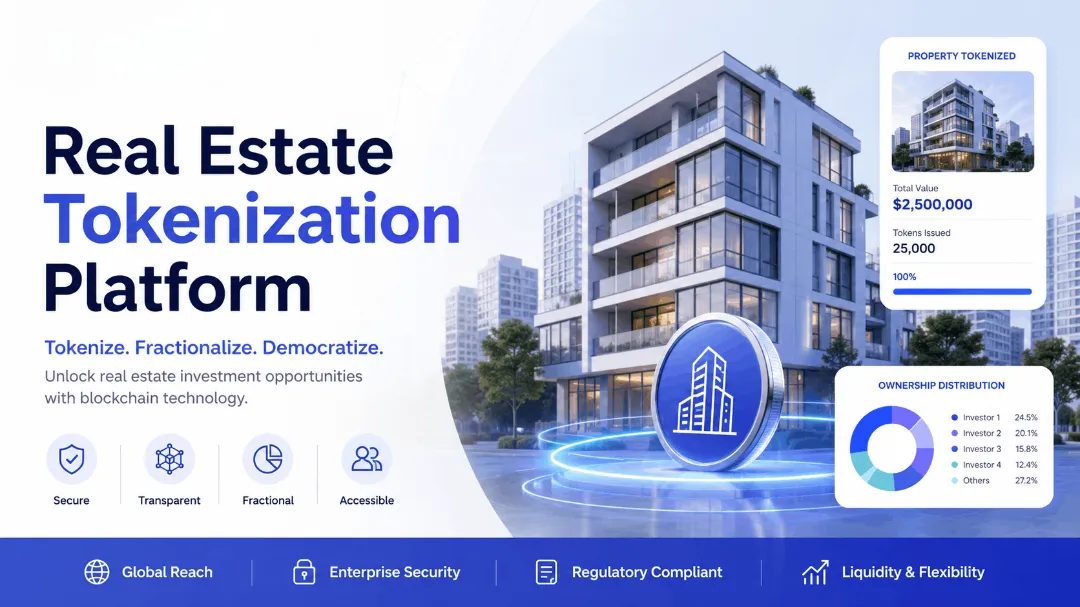
A Real Estate Tokenization Platform can help developers manage digital asset issuance, investor onboarding, ownership records, and investment distributions within a structured digital environment. When supported by appropriate legal frameworks and financial arrangements, this approach can help property businesses explore additional capital sources while improving investment administration.
What Is Real Estate Tokenization?
Real estate tokenization is the process of representing eligible property ownership interests or property-related financial rights as digital tokens on a blockchain.
Rather than requiring investors to acquire an entire property directly, a tokenization structure may allow them to participate in a legally defined investment through smaller units. The exact rights attached to these tokens depend on the underlying legal agreements, ownership structure, and applicable regulations.
For property developers, tokenization can support several financing models:
- Equity tokenization: Represents eligible ownership interests in a property-holding company or special purpose vehicle (SPV).
- Debt tokenization: Digitally represents qualifying debt instruments used to finance development activities.
- Revenue tokenization: Represents contractual rights to specified property-related revenue streams, where legally permitted.
- Fund tokenization: Digitally represents interests in a real estate investment fund that finances multiple properties or development projects.
Each model serves a different purpose. Developers must determine which structure aligns with their funding requirements, investor expectations, risk profile, and legal obligations.
Why Growing Property Developers Need New Funding Strategies
Expanding a property development business often requires more capital than a single project can generate internally. Developers may need to finance several projects simultaneously while managing construction costs, land payments, labor expenses, and market uncertainty.
Traditional funding methods remain important, but they may not always provide the flexibility a growing business needs.
Challenges with conventional financing
Limited access to bank financing: Smaller or newer developers may struggle to meet lending criteria, particularly without an extensive project history or sufficient collateral.
High capital requirements: Purchasing land, obtaining approvals, and beginning construction can require substantial upfront investment before a project generates revenue.
Long funding cycles: Loan approvals, financial reviews, and negotiations with lenders may delay project timelines.
Concentration of financial risk: Relying on a limited number of lenders or investors can leave a development business vulnerable if a funding source becomes unavailable.
Expansion constraints: Developers seeking to enter new markets or undertake larger projects may need additional capital beyond their existing borrowing capacity.
Real estate tokenization may help developers explore alternative ways to structure financing, diversify potential investor participation, and organize investment administration. However, it does not eliminate funding risk or guarantee access to capital.
How Real Estate Tokenization Creates New Funding Opportunities
Tokenization can change how developers structure and administer investment opportunities. Its value depends on the underlying asset, legal arrangements, investor demand, and the quality of the platform supporting the project.
Accessing a broader investor base
Traditional property investments can involve substantial minimum investment amounts, limiting participation to investors with considerable available capital.
A tokenized structure may divide eligible investment interests into smaller units, potentially making participation accessible to a broader range of qualified investors. Developers can establish investment terms that suit the project's financial objectives and applicable investor eligibility requirements.
Digital distribution can also support investor engagement across different markets, subject to securities laws, offering restrictions, and local compliance requirements.
Supporting project-specific fundraising
Developers can structure tokenization around individual projects rather than relying exclusively on company-wide financing.
For example, a developer planning a residential community could establish an SPV to hold the relevant property or project interests. Eligible investors could then participate through a legally compliant offering associated with that SPV.
This structure can help separate project finances, define investor rights, and clarify how funds are allocated. The legal documentation must specify how the investment works and what happens if the project is delayed or fails to meet its objectives.
Exploring equity-based funding
Real Estate Equity Tokenization allows developers to explore digital representations of eligible equity interests in property-owning entities.
Depending on the structure, investors may receive specified ownership rights, voting rights, or participation in potential returns. Developers may be able to raise capital without relying entirely on conventional loans.
Equity funding does not generally create the same repayment obligations as debt, but it can involve sharing ownership, economic benefits, or decision-making rights. Developers should assess these trade-offs before selecting an equity-based model.
Structuring debt-based investment opportunities
Real Estate Debt Tokenization can support digital issuance and administration of qualifying debt instruments used to finance property development.
A project may raise funds under defined repayment terms, including an interest rate, maturity date, and repayment conditions. Smart contracts can assist with recording obligations and automating certain payment processes when properly integrated.
Debt financing allows developers to raise capital without necessarily diluting equity ownership. However, the developer remains responsible for meeting the contractual repayment obligations, even if project revenue is lower than expected.
Improving investment administration
Managing numerous investors can create significant administrative work, especially as a development company expands.
A well-designed tokenization platform can centralize investor records, token allocations, transaction histories, compliance checks, and distribution schedules. Smart contracts may automate approved processes, reducing repetitive manual work.
These capabilities can improve operational efficiency, although they do not replace accounting controls, legal oversight, independent audits, or accurate property records.
How Property Developers Can Use Tokenization in Different Projects
The funding model should reflect the project's financial needs rather than applying the same structure to every property.
Residential development
Developers can explore tokenized equity or debt structures to finance apartment buildings, housing communities, and residential projects. Funding terms can be linked to a specific property-holding entity and defined project milestones.
Commercial property development
Office buildings, retail centers, and mixed-use developments may require substantial upfront investment. Tokenization can support structured fundraising through eligible equity interests, debt instruments, or property investment funds.
Industrial and logistics assets
Warehouses, distribution centers, and industrial facilities can involve long development cycles and large capital commitments. Tokenized financing may provide an additional structure for investors seeking exposure to these assets.
Multi-property portfolios
Established developers can explore fund tokenization to finance several assets under a coordinated investment structure. This may help organize portfolio-level participation rather than raising capital independently for every property.
The Role of a Real Estate Tokenization Platform
A Real Estate Tokenization Platform provides the technology infrastructure required to issue and manage digital investment interests. For developers, the platform should support the complete investment lifecycle rather than simply generate tokens.
Important capabilities include:
Digital asset issuance: Create tokens representing clearly defined legal and economic rights associated with the property or investment vehicle.
Investor onboarding: Collect investor information, verify identities, and apply Know Your Customer (KYC) and Anti-Money Laundering (AML) procedures.
Smart contract management: Encode approved rules for token issuance, transfers, eligibility restrictions, and distributions.
Ownership and transaction records: Maintain traceable records of token allocations and transactions, alongside the authoritative legal ownership records.
Payment and distribution management: Support the administration of proceeds, interest, or other distributions according to the investment agreements.
Compliance controls: Apply transfer restrictions, investor eligibility rules, reporting requirements, and other controls appropriate to the offering.
Security infrastructure: Use appropriate access controls, secure key management, smart contract testing, and monitoring to reduce technology-related risks.
Selecting the right platform requires evaluating its technical capabilities, legal integration, scalability, reporting functions, and ability to support the intended investment model.
Steps to Launch a Tokenized Property Funding Model
Developers should establish a clear financial and legal framework before launching a tokenized funding initiative.
Step 1: Define the funding objective
Determine how much capital the project requires, when the funds are needed, and how they will be used. The funding objective should include development costs, contingency reserves, expected cash flows, and potential delays.
Step 2: Select the appropriate tokenization structure
Evaluate equity, debt, revenue-linked rights, or fund-based structures. The decision should reflect the developer's financing objectives, expected repayment capacity, willingness to share ownership, and investor rights.
Step 3: Establish the legal framework
Identify the asset-owning entity, document the relationship between the property and the digital tokens, and determine the applicable securities, property, tax, and offering requirements.
Token ownership should not be presented as direct property ownership unless the legal structure genuinely provides that right.
Step 4: Choose the technology platform
Assess whether a ready-made or custom Real Estate Tokenization Platform best suits the project's requirements. Consider smart contract functionality, investor management, integrations, security, and ongoing maintenance.
Step 5: Prepare investor documentation
Provide clear information about the project, funding purpose, financial assumptions, fees, investment duration, potential returns, risks, and exit provisions. Investors should understand exactly which rights they acquire.
Step 6: Conduct investor onboarding and fundraising
Implement required identity checks, eligibility screening, and subscription procedures. Fundraising should proceed only under the applicable legal permissions and offering requirements.
Step 7: Manage the investment throughout the project
Track the use of funds, construction progress, financial performance, and contractual obligations. Provide appropriate reporting to investors and administer distributions according to the agreed terms.
Traditional Property Financing vs. Tokenization
| Factor | Traditional financing | Tokenized financing |
|---|---|---|
| Capital sources | Banks, private lenders, equity partners | Potentially eligible investors through structured digital offerings |
| Investment structure | Loans, direct equity, joint ventures | Digitally represented equity, debt, or other eligible financial rights |
| Investor administration | Often handled through separate systems | May be consolidated through a digital platform |
| Recordkeeping | Legal documents and financial systems | Blockchain records alongside authoritative legal records |
| Payment processes | Manual or conventional automated systems | May use smart contracts for approved processes |
| Liquidity | Depends on the agreement and available buyers | Secondary transfers may be possible if legally permitted and buyers are available |
| Main considerations | Lending terms, collateral, repayment, dilution | Compliance, technology security, investor demand, legal enforceability |
Tokenization is not automatically cheaper, faster, or more liquid than traditional financing. Actual outcomes depend on the project's structure, platform costs, regulatory requirements, and market conditions. Developers may also combine tokenization with bank loans or conventional equity funding.
Challenges Developers Should Consider
Although tokenization creates additional financing possibilities, it introduces risks that developers must evaluate carefully.
Regulatory compliance: Digital tokens may qualify as securities or other regulated financial products. Developers must assess applicable laws, offering requirements, investor restrictions, and cross-border obligations.
Investor confidence: Investors need reliable property valuations, transparent financial information, clear legal rights, and credible project management.
Technology security: Smart contract vulnerabilities, compromised wallets, and cybersecurity incidents can create financial and operational losses.
Market liquidity: Creating tokens does not guarantee that investors can resell them. Secondary trading depends on applicable laws, platform availability, transfer restrictions, and buyer demand.
Project execution: Construction delays, cost overruns, planning issues, and market downturns can affect project performance regardless of the funding method.
Implementation costs: Platform development, legal structuring, compliance, audits, and ongoing administration can create substantial expenses. Developers should compare these costs with the capital they realistically expect to raise.
A practical approach is to begin with a clearly defined project, establish its legal and financial structure, and assess investor demand before committing to a large-scale implementation.
The Future of Real Estate Tokenization for Growing Developers
As blockchain infrastructure and digital investment services evolve, real estate tokenization may become an increasingly relevant component of property financing strategies.
Developers could use integrated platforms to coordinate fundraising, investor verification, asset records, payment administration, and financial reporting. Standardized processes may also make it easier to manage multiple offerings across different property types.
Another potential development is the integration of tokenized property investments with broader real-world asset (RWA) infrastructure. This could support connections between property-related financial products and digital asset management systems, subject to legal and operational requirements.
For smaller and mid-sized developers, the key opportunity is not simply converting property interests into tokens. It is identifying whether a well-structured digital offering can improve access to suitable investors, complement existing funding arrangements, and support long-term business growth.
Adoption will depend on regulatory clarity, institutional confidence, platform reliability, investor protection, and evidence that the model offers practical benefits over existing alternatives.
Conclusion
Real estate tokenization offers growing property developers another way to approach project financing. By digitally representing eligible equity interests, debt instruments, or other contractual financial rights, developers can explore new fundraising structures and more organized investor administration.
A successful strategy requires more than blockchain technology. It depends on a viable property project, an appropriate legal structure, transparent investor documentation, reliable platform infrastructure, and a realistic assessment of costs and risks.
For developers planning to expand their portfolios, a carefully designed tokenization model can complement traditional funding methods and create additional pathways for raising project capital. The most effective approach is to align the technology with clear business objectives and investor needs.
Frequently Asked Questions
1. How can real estate tokenization help property developers raise funds?
It can enable developers to structure eligible equity, debt, or other property-related financial interests as digital tokens and offer them to qualified investors through compliant investment arrangements.
2. Is real estate tokenization suitable for small and mid-sized developers?
It may be suitable when a developer has a clearly defined project, a viable funding requirement, an appropriate legal structure, and sufficient investor demand. Implementation costs and compliance obligations should be assessed first.
3. Can tokenization replace traditional property loans?
Not necessarily. Tokenization can complement bank loans, private credit, and equity financing. The most appropriate combination depends on the developer's cash flow, financing costs, risk tolerance, and project requirements.
4. What is required to launch a real estate tokenization platform?
A project typically requires a legally defined asset or investment interest, appropriate offering documentation, smart contracts, investor onboarding and compliance procedures, secure transaction infrastructure, and ongoing reporting and administration.
5. Does tokenized real estate guarantee liquidity for investors?
No. Tokenization can facilitate digital transfers, but liquidity depends on legal permissions, market demand, available trading infrastructure, and restrictions attached to the investment.


















Sign in to leave a comment.