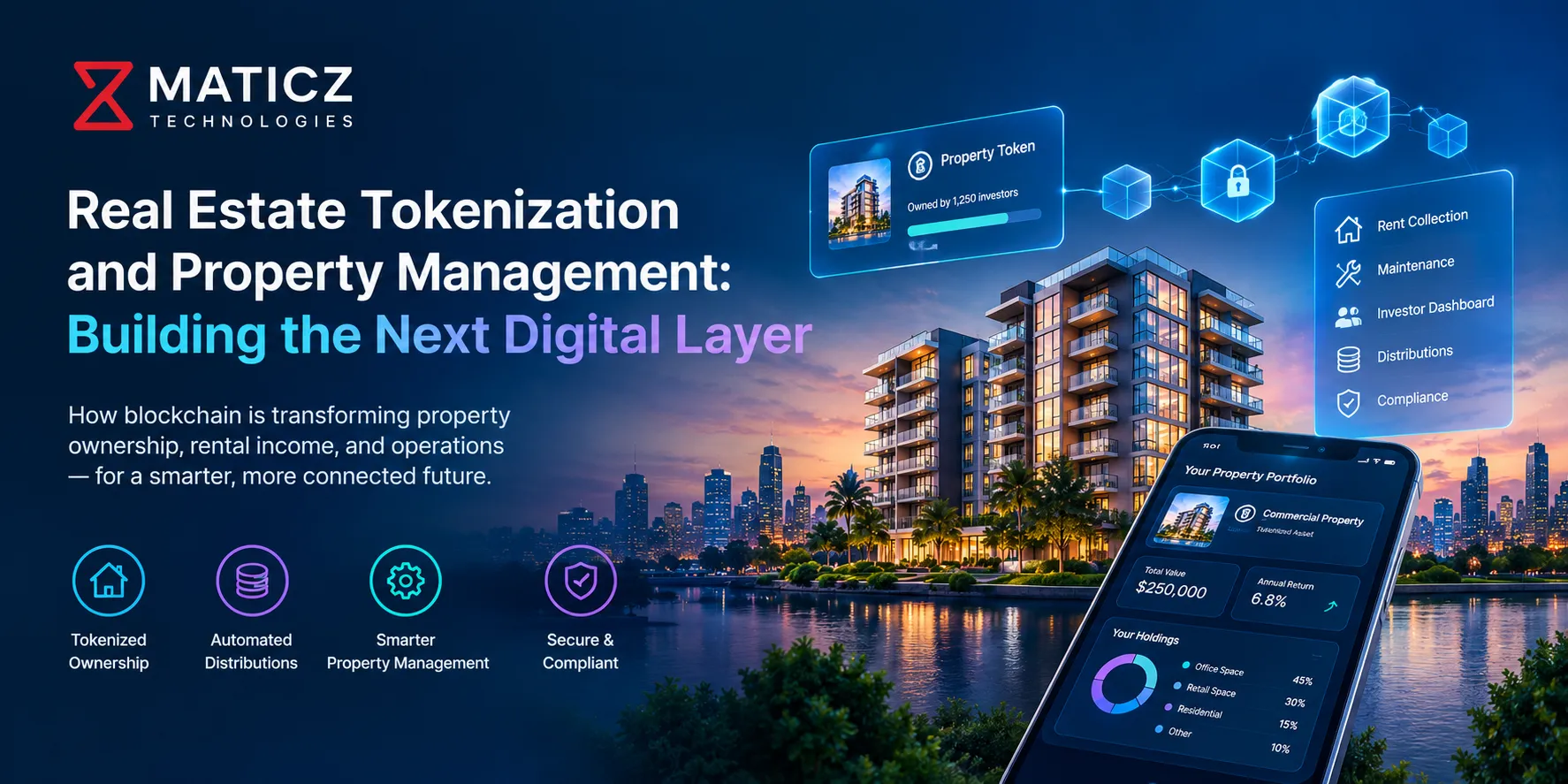

Real estate is becoming increasingly data-driven. Property valuation, tenant analytics, investment decisions, portfolio management, and operational planning are all being influenced by artificial intelligence. At the same time, blockchain is introducing new ways to represent property ownership and investment interests through tokenization.
Bringing these technologies together creates a new possibility: AI-powered real estate tokenization.
Instead of using blockchain only to create digital representations of property ownership, businesses can combine tokenization with AI to analyze property data, support valuation, monitor asset performance, automate selected workflows, and provide investors with more dynamic insights.
The opportunity is particularly relevant as real estate companies move toward technology-enabled operating models. PwC's 2026 research shows that AI is increasingly being used across real estate for data analytics, leasing, investment decisions, pricing, and operational efficiency.
What Is AI-Powered Real Estate Tokenization?
Real estate tokenization involves representing ownership or economic interests associated with property through blockchain-based tokens.
AI-powered tokenization adds an intelligence layer to this infrastructure.
AI can analyze property data, market conditions, rental performance, comparable properties, occupancy, expenses, and other variables to generate insights that can support valuation and asset management.
Blockchain, meanwhile, can provide the infrastructure for token ownership, transfers, compliance rules, transaction records, and programmable financial processes.
The result is a technology stack where:
AI analyzes the asset.
Blockchain records and manages digital ownership.
Smart contracts automate predefined processes.
This does not mean AI independently determines the legal value of a property or that blockchain automatically establishes land ownership. Instead, the technologies can work alongside traditional valuation, legal, financial, and property-management systems.
Why Combine AI With Real Estate Tokenization?
Tokenization can make ownership and investment interests digitally manageable, but it does not automatically solve the operational challenges associated with real estate.
A tokenized property still needs to be valued, monitored, maintained, leased, financed, and managed.
AI can help analyze the large volumes of data generated by these activities.
For example, an AI system could monitor rental income, occupancy, maintenance costs, local market data, and historical performance. These insights could then be displayed alongside an investor's tokenized property holdings.
Deloitte has highlighted how smart contracts and tokenization can support commercial real estate fund workflows such as subscriptions, capital calls, redemptions, and escrow releases. Its 2026 analysis also points to AI-driven valuation models and automated cash-flow forecasting as emerging components of onchain real estate fund infrastructure.
This creates a more connected model for managing tokenized properties.
How AI Can Support Real Estate Valuation
Property valuation is one of the most important applications for AI in real estate.
Traditional valuation typically considers comparable properties, location, rental income, property condition, market conditions, capitalization rates, financing conditions, and other variables.
AI can process large datasets and identify relationships that may be difficult to evaluate manually.
An AI-powered valuation system could analyze:
- Comparable property transactions
- Rental and occupancy data
- Property characteristics
- Local market conditions
- Historical price movements
- Operating expenses
- Tenant information
- Interest-rate conditions
- Supply and demand indicators
The system can then produce valuation estimates or valuation ranges for review by qualified professionals.
Automated valuation models are already being used to provide owners and investors with more frequent portfolio valuation insights. JLL's 2026 research describes AI-assisted valuation as part of the broader move toward automated commercial real estate valuation, while emphasizing the continuing role of human expertise.
For tokenized assets, more frequent valuation data can become particularly useful because investors may need updated information about the underlying asset supporting their digital holdings.
AI-Based Property Performance Monitoring
Valuation is only one part of asset management.
AI can continuously analyze operational performance and identify changes that may require attention.
For example, an AI system could detect:
- Declining occupancy
- Changes in rental collections
- Increasing maintenance costs
- Unexpected operating expenses
- Changes in tenant behavior
- Reduced property utilization
- Market-level demand changes
Instead of waiting for a monthly or quarterly report, asset managers could receive alerts when specific performance indicators move outside predefined ranges.
This creates a more proactive approach to property management.
AI and Tokenized Rental Income
Tokenized real estate can potentially represent ownership or economic interests connected to rental-generating properties.
AI can support the analysis behind the income generated by those assets.
For example, an AI system can forecast rental income based on occupancy trends, lease expirations, historical collections, market rents, and property-level expenses.
The forecast can then be presented through an investor dashboard alongside actual financial performance.
Smart contracts can handle predefined distribution rules, while AI provides analytical insights.
This distinction is important:
AI can analyze and forecast.
Smart contracts can execute predefined rules.
Businesses should not treat AI-generated forecasts as automatic instructions for financial transactions without appropriate validation and controls.
AI-Powered Asset Management for Tokenized Properties
Asset management becomes more complex when a portfolio contains multiple tokenized properties.
An AI-powered platform can help asset managers analyze the entire portfolio rather than reviewing each property individually.
For example, an asset manager could ask:
- Which properties have declining occupancy?
- Which assets have rising operating costs?
- Which properties are outperforming their local market?
- Where could rental pricing be optimized?
- Which assets require maintenance attention?
- How could changing market conditions affect portfolio performance?
An AI assistant can process portfolio data and present the relevant information through a centralized dashboard.
This turns a tokenization platform from a simple ownership-management system into a more intelligent asset-management environment.
AI for Real Estate Investment Decisions
Tokenization can potentially make property interests easier to manage digitally, but investors still need information to make decisions.
AI can help organize and analyze this information.
An investment dashboard could combine:
Property data + financial performance + market data + token ownership + AI insights
For example, an investor could view a tokenized property and see estimated rental yield, historical performance, occupancy trends, comparable property information, and portfolio exposure.
The objective is not to let AI make investment decisions on behalf of users. Instead, AI can reduce the time required to collect, process, and interpret information.
AI, Blockchain and Smart Contracts
The three technologies perform different functions.
Artificial Intelligence
AI is primarily responsible for analyzing information, identifying patterns, generating forecasts, and assisting decision-making.
Blockchain
Blockchain provides a shared digital infrastructure for recording token ownership and transactions.
Smart Contracts
Smart contracts execute predefined rules when specified conditions are satisfied.
Together, they can create an automated architecture for tokenized real estate.
For example, an AI model may analyze rental performance and produce a forecast. Verified financial data can then be supplied to the blockchain through an appropriate data layer. A smart contract can execute a predefined distribution rule based on verified inputs.
Deloitte describes a similar architecture for tokenized commercial real estate funds, combining blockchain, smart contracts, connection layers, oracles, custody, wallets, and audit controls.
The Role of Oracles in AI-Powered Tokenization
Blockchain applications often require information that exists outside the blockchain.
Property valuations, rental payments, market prices, interest rates, occupancy information, and other data may originate from external systems.
Oracles can connect verified external information to blockchain-based applications.
For example, a property valuation system may generate an updated valuation, while an oracle or controlled data integration layer makes approved information available to smart contracts or investor applications.
This creates an important architecture:
Real-world data → AI analysis → Validation → Oracle/API → Blockchain → Smart contract
Businesses should carefully control this pipeline because inaccurate external data can create incorrect onchain outcomes.
Key Features of an AI-Powered Real Estate Tokenization Platform
A platform combining AI and tokenization can include several interconnected modules.
AI Valuation Engine
Analyze property and market data to generate valuation estimates, trends, and risk indicators.
Tokenization Engine
Create and manage digital representations of property ownership or economic interests.
Smart Contract Layer
Manage token issuance, transfers, distributions, eligibility rules, and other predefined processes.
AI Asset Management
Monitor portfolio performance and identify changes in occupancy, revenue, expenses, and other operational indicators.
Investor Dashboard
Provide investors with token holdings, property information, financial performance, AI-generated insights, and transaction history.
Property Management Integration
Connect the tokenization platform with existing property-management, accounting, leasing, and asset-management systems.
Data and Oracle Layer
Connect external property and market data with blockchain applications.
Compliance Infrastructure
Integrate KYC, AML, investor eligibility, transfer restrictions, transaction monitoring, and other controls applicable to the platform's jurisdiction and asset structure.
Analytics and Reporting
Provide portfolio-level analytics for property managers, fund managers, investors, and administrators.
How to Build an AI-Powered Real Estate Tokenization Platform
The development process should begin with the business model rather than the technology.
1. Define the Asset Model
Determine whether the platform will support residential properties, commercial buildings, land, rental portfolios, real estate funds, or other asset structures.
2. Establish the Legal Structure
Define what the token represents and how it relates to the underlying property.
Depending on the structure, the property may be held through an SPV, fund, company, trust, or another legal arrangement.
3. Design the Token Model
Determine supply, ownership rights, transferability, redemption, investor eligibility, and other token characteristics.
4. Build the Property Data Layer
Connect property-management systems, financial records, valuation information, market data, and other relevant sources.
5. Develop AI Models
AI functionality can be developed for valuation analysis, rental forecasting, portfolio monitoring, anomaly detection, risk analysis, and asset-management assistance.
The models should be tested against appropriate datasets and monitored over time.
6. Develop Smart Contracts
Smart contracts can manage ownership, transfers, distributions, compliance rules, and other predefined processes.
7. Integrate Blockchain Infrastructure
Select a blockchain based on scalability, security, transaction costs, interoperability, institutional requirements, and the platform's operating model.
8. Build Investor and Admin Dashboards
Create interfaces for investors, property managers, administrators, and other platform participants.
9. Add Security and Compliance
Implement access controls, wallet security, encryption, monitoring, KYC/AML integrations, smart contract audits, and other required safeguards.
10. Test and Launch
Conduct AI model validation, smart contract testing, penetration testing, performance testing, data validation, and user acceptance testing before deployment.
How Maticz Can Help Build AI-Powered Real Estate Tokenization Platforms
Maticz can help businesses develop customized blockchain infrastructure that combines real estate tokenization, AI-powered analytics, smart contracts, investor management, wallets, property data integrations, and compliance functionality.
The platform can be designed around the business's specific property model rather than using a generic tokenization architecture.
For example, Maticz can integrate an AI valuation layer with a tokenization engine so that investors can view both their digital property interests and relevant asset-level insights from the same platform.
The development approach can also support integration with existing property-management systems, allowing businesses to retain their current operational infrastructure while adding blockchain-based ownership and AI-driven analytics.
Security and Data Considerations
Combining AI with tokenization creates additional security requirements.
Property platforms can contain sensitive investor information, financial records, tenant information, valuation data, and ownership information.
Businesses should carefully determine which information belongs on-chain and which should remain within secure off-chain systems.
AI models also need governance.
Human review, model monitoring, access controls, audit trails, and approval mechanisms can help prevent an incorrect AI output from directly triggering an inappropriate financial or operational action.
For tokenized assets, this is particularly important because smart contracts may execute transactions automatically once predefined conditions are met.
Challenges of AI-Powered Real Estate Tokenization
The technology is promising, but businesses need to address several challenges.
Data quality is one of the biggest. AI models are only as useful as the information they receive.
Model accuracy is another consideration. Property markets can change quickly, and historical data may not accurately predict future conditions.
Legal alignment is also essential. Tokenization does not automatically establish legal ownership or remove securities and property-law requirements.
Interoperability can become complicated when property-management software, AI systems, blockchains, custody providers, payment systems, and data providers all need to communicate.
Finally, businesses need to avoid excessive automation. Some property and investment decisions still require professional judgment and human oversight.
The Future of AI and Real Estate Tokenization
AI and tokenization are developing along complementary paths.
AI is making real estate operations more data-driven, while tokenization is creating new digital infrastructure for ownership and financial participation.
PwC's 2026 research indicates that AI adoption in real estate is expanding across areas including asset management, investment, property operations, and leasing.
At the same time, tokenization is increasingly being positioned as infrastructure for asset management and investment products. PwC expects tokenized fund assets under management to grow substantially through 2030 and identifies governance, settlement, and liquidity as important challenges for adoption.
The convergence of these technologies could therefore produce platforms that do more than represent property ownership.
They could analyze assets, monitor performance, manage digital ownership, automate predefined workflows, and provide investors with real-time intelligence.
Frequently Asked Questions
What is AI-powered real estate tokenization?
It combines blockchain-based real estate tokenization with artificial intelligence for applications such as property valuation, rental forecasting, portfolio analytics, asset monitoring, and investment insights.
Can AI automatically value tokenized real estate?
AI can generate valuation estimates based on property and market data, but those outputs should be validated and used within an appropriate professional and regulatory framework.
Can AI automate property management?
AI can automate or assist with selected activities such as forecasting, anomaly detection, reporting, tenant communication, and operational monitoring. Physical property operations still require appropriate human and service-provider involvement.
How do smart contracts work with AI?
AI analyzes data and generates insights, while smart contracts execute predefined rules. Where external information is required, an oracle or controlled data integration layer can connect verified information to blockchain applications.
What blockchain can be used for real estate tokenization?
The appropriate blockchain depends on scalability, security, transaction costs, interoperability, custody requirements, regulatory considerations, and the platform's business model.
Can Maticz build an AI-powered real estate tokenization platform?
Yes. Maticz can develop customized platforms combining real estate tokenization, AI analytics, smart contracts, investor dashboards, wallets, property-management integrations, compliance infrastructure, and blockchain connectivity.
Conclusion
The next stage of real estate tokenization may not be defined by simply putting property ownership on blockchain.
The larger opportunity is creating an intelligent infrastructure around the tokenized asset.
AI can analyze property performance and market data. Blockchain can provide a programmable ownership layer. Smart contracts can automate predefined financial and operational processes.
Together, these technologies can create a more connected approach to property valuation, asset management, investor reporting, ownership, and financial workflows.
For businesses exploring the future of real estate, the opportunity is to move beyond token creation and build platforms that make tokenized properties smarter, more manageable, and easier to integrate into digital financial ecosystems.
Maticz helps businesses build AI-powered real estate tokenization solutions that connect blockchain infrastructure with intelligent property and asset-management capabilities.
























Sign in to leave a comment.