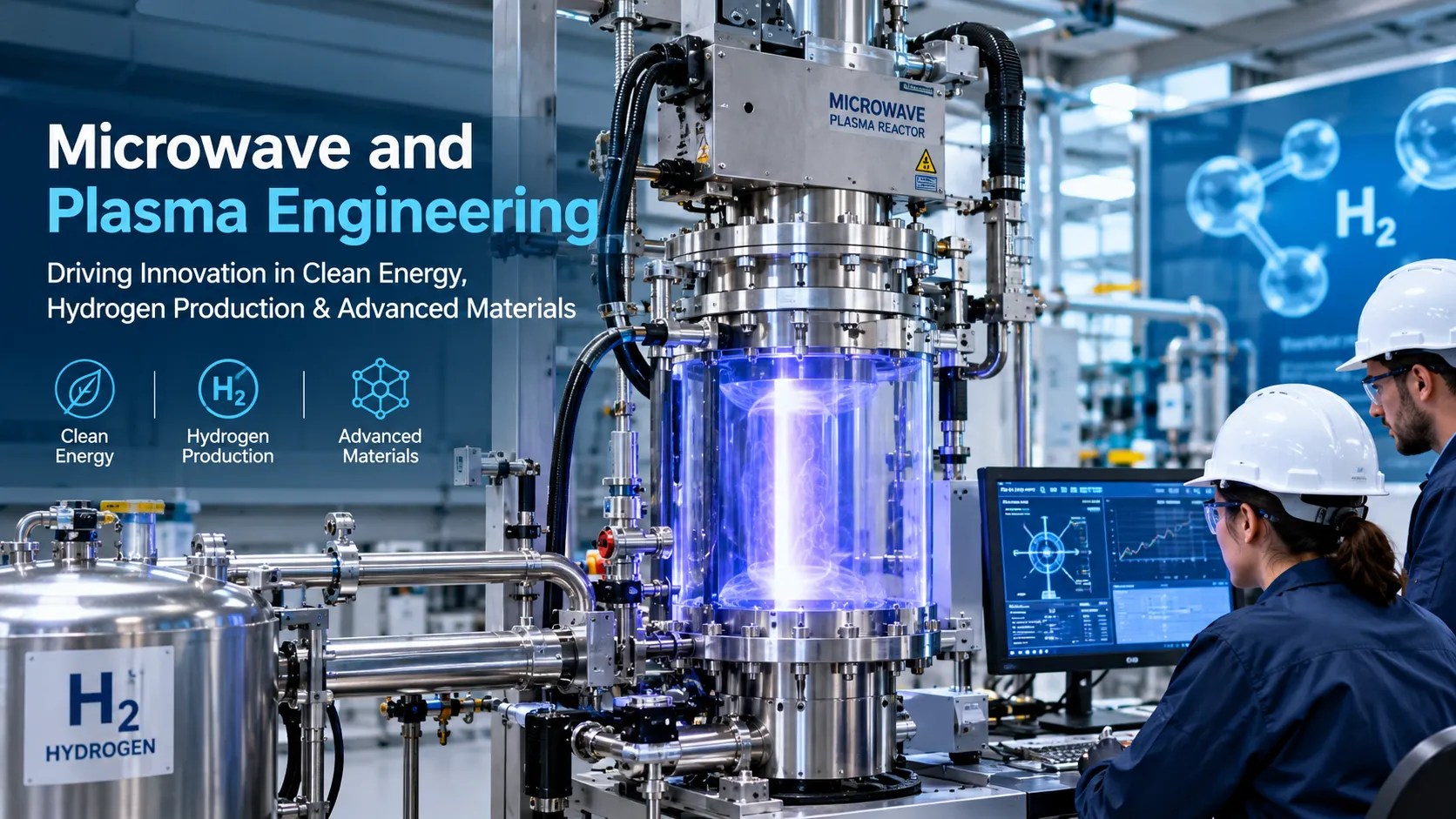

Many people are familiar with microwaves because of their use in household appliances, but microwave technology plays a much larger role in science and industry than most realize.
When combined with plasma technology, microwaves can help create highly controlled environments capable of supporting advanced manufacturing, energy production, materials processing, and environmental applications. This growing field, known as microwave and plasma engineering, is attracting attention because of its ability to improve efficiency and support innovative industrial processes. Microwave plasmas are increasingly being explored for hydrogen production, waste treatment, material processing, and nanomaterial synthesis.
As industries look for cleaner and more efficient technologies, microwave plasma systems are becoming an important area of research and development.
Understanding Microwave Plasma Technology
Plasma is often called the fourth state of matter.
It forms when a gas receives enough energy for electrons to separate from atoms, creating a mixture of charged particles. Microwave energy can be used to generate and sustain this plasma without direct electrode contact, creating what is known as a microwave plasma.
Because these systems can deliver energy directly and efficiently, they offer advantages in applications that require high temperatures, precise control, and fast reaction rates.
Why Industries Are Interested in Microwave Plasma Systems
Traditional industrial processes often depend on combustion-based heating methods that can be energy-intensive.
Microwave plasma technology offers an alternative approach by concentrating energy where it is needed. Researchers continue to explore microwave plasma systems because of their efficiency, controllability, and suitability for a wide range of industrial applications.
Some potential benefits include:
- Improved energy efficiency
- Faster processing times
- Better process control
- Reduced waste generation
- Greater operational flexibility
- Support for cleaner industrial processes
These advantages have encouraged interest across multiple sectors.
Applications in Hydrogen Production
Hydrogen is increasingly being discussed as an important energy carrier for the future.
One area of active research involves using microwave plasma systems to support hydrogen production processes. Microwave-induced plasmas can provide the high-energy environments needed for chemical reactions involved in fuel generation and energy conversion. Researchers continue to study these technologies as part of broader efforts to improve sustainable energy production.
As industries work toward lower-emission energy solutions, interest in advanced plasma-based technologies continues to grow.
Advanced Materials and Nanotechnology
Modern manufacturing often depends on materials with specialized properties.
Microwave plasma systems can be used in the production and processing of advanced materials, including nanoparticles, specialty coatings, and engineered surfaces. Scientists are investigating these technologies because they can provide highly controlled reaction environments that influence material characteristics at a microscopic level.
These capabilities are relevant to industries such as electronics, aerospace, energy storage, and advanced manufacturing.
Environmental and Waste Treatment Applications
Environmental sustainability is another area where microwave plasma technology is receiving attention.
Researchers are exploring its use for:
- Waste treatment
- Pollution control
- Water treatment
- Hazardous material processing
- Resource recovery
Studies have highlighted the potential of microwave plasma systems to support the breakdown of pollutants and improve treatment efficiency in certain industrial applications.
Although development is ongoing, these applications demonstrate the versatility of the technology.
Supporting Advanced Manufacturing
Manufacturers are constantly searching for ways to improve quality while reducing production costs.
Microwave plasma systems can support processes such as:
- Surface modification
- Material coating
- Etching
- Precision manufacturing
- Chemical processing
Because microwave plasmas can operate under carefully controlled conditions, they help engineers achieve consistent results across complex manufacturing environments.
This level of control is particularly valuable in industries where precision and reliability are critical.
The Importance of Engineering Design
Successful microwave plasma systems require more than simply generating energy.
Engineers must carefully consider factors such as frequency selection, reactor design, electromagnetic field distribution, plasma behavior, operating conditions, and system efficiency. Research in microwave engineering and plasma physics continues to improve how these systems are designed and optimized for industrial use.
As technology advances, improved designs are helping make microwave plasma systems more practical for large-scale applications.
Looking Ahead
Interest in microwave plasma technology continues to grow as industries seek cleaner, more efficient, and more flexible solutions.
Ongoing research is expanding potential applications in energy production, materials science, environmental management, and manufacturing. Advances in microwave power systems, plasma generation techniques, and process control are creating new opportunities for innovation across multiple sectors.
While many applications are still evolving, the technology's versatility makes it an area worth watching.
Final Thoughts
The combination of microwave technology and plasma science is creating exciting possibilities for modern industry. From hydrogen production and advanced materials to environmental applications and precision manufacturing, microwave and plasma engineering offers a unique approach to solving complex technical challenges.
As research and industrial adoption continue to expand, these technologies are likely to play an increasingly important role in the development of cleaner, more efficient, and more sustainable industrial processes.
























Sign in to leave a comment.