
In Saudi Arabia's extreme climate, where outdoor temperatures routinely climb past 45°C, a single cooling failure can spoil an entire batch of vaccines, medicines, or perishable food within hours. This is exactly why a refrigerator monitoring system has become an essential investment for hospitals, pharmacies, cold storage warehouses, restaurants, and food distributors across the Kingdom. Rather than relying on manual temperature checks and paper logs, modern facilities are turning to connected, automated solutions that watch every refrigerator and freezer around the clock, alert staff the moment something goes wrong, and create the audit trail regulators expect.
This article explains what a refrigerator monitoring system is, why it matters so much in the Saudi market, and how the right solution can protect product quality, patient safety, and business reputation.
From large hospital networks in Riyadh and Jeddah to independent pharmacies and neighborhood supermarkets, organizations of every size are recognizing that cold storage can no longer be left to chance. Manual checks, however diligent, cannot catch a compressor failure at 2 a.m., and a single missed reading can be enough to spoil an entire shipment of temperature-sensitive stock.
What Is a Refrigerator Monitoring System?
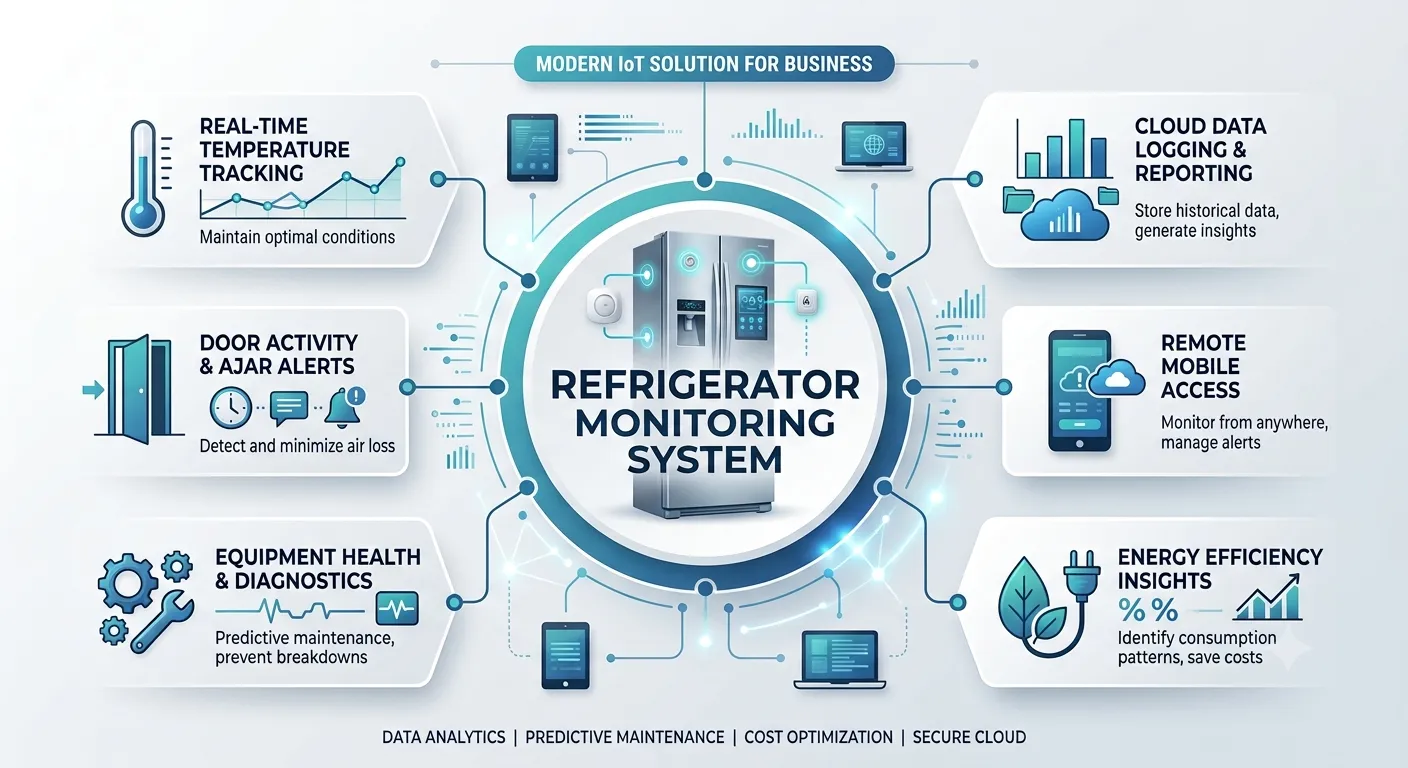
A cold chain monitoring solution is a network of sensors, gateways, and software that continuously tracks the internal temperature (and often humidity) of refrigerators, freezers, and cold rooms. Instead of a technician opening the door to check a thermometer once or twice a day, IoT temperature sensors placed inside each unit send readings to the cloud every few minutes. If a reading drifts outside the safe range, the system triggers an instant notification, giving staff time to act before stock is lost.
These platforms typically combine wireless sensors, a central gateway, a cloud dashboard, and a mobile app, so managers can check the status of every unit — whether they are standing in the store or halfway across Riyadh — from a single screen.
Why Cold Chain Monitoring Matters in the Saudi Market
Saudi Arabia's ambitious healthcare, retail, and logistics expansion under Vision 2030 has raised expectations for quality and accountability across every cold-dependent industry. At the same time, the Kingdom's harsh summer heat puts extra strain on refrigeration equipment, increasing the risk of compressor failure, door seal issues, and power interruptions.
For hospitals and pharmacies, a lapse in pharmaceutical cold chain control can render vaccines and insulin ineffective or unsafe. For restaurants, supermarkets, and food distributors, it can mean spoiled inventory and serious food safety compliance Saudi Arabia violations. In both cases, the financial loss is only part of the problem — the greater risk is to health outcomes, brand trust, and regulatory standing.
Key Features of a Modern Refrigerator Monitoring System
Real-Time Temperature and Humidity Tracking
Sensors record conditions continuously, giving facility managers real-time temperature alerts instead of relying on periodic manual spot-checks that can easily miss a short but damaging temperature spike.
Instant Alerts via SMS, Email, and App
The moment a unit drifts outside its configured safe range, designated staff receive an automatic alert on their phone or email, allowing rapid intervention before products are compromised.
Cloud-Based Dashboards and Historical Reporting
Every reading is logged and stored securely, producing time-stamped reports that satisfy internal quality checks as well as external inspections and audits.
Remote, Multi-Site Visibility
Organizations with several branches, warehouses, or clinics across the Kingdom can monitor all locations from one dashboard, supporting true remote temperature monitoring without needing staff physically present at every site.
Battery Backup and Power-Failure Detection
Battery-powered sensors and backup connectivity ensure that monitoring continues uninterrupted even during power outages — a common concern during peak summer load on the grid.
Key Benefits for Saudi Businesses
- Reduced spoilage and product loss, protecting profit margins and inventory investment.
- Stronger regulatory readiness, with documented, tamper-evident records ready for inspection.
- Faster response times, since staff are alerted within minutes rather than discovering a failure the next day.
- Lower labor costs, as manual logging and physical spot-checks are largely automated.
- Improved customer and patient trust, built on consistently safe products and medicines.
- Actionable insights, using historical data to spot recurring equipment issues before they cause a major failure.
Applications Across Key Industries in Saudi Arabia
The value of temperature monitoring solutions spans a wide range of sectors within the Kingdom:
- Hospitals, clinics, and pharmacies — protecting vaccines, insulin, blood products, and temperature-sensitive medications.
- Cold storage and logistics warehouses — safeguarding bulk inventory during storage and transit across regional distribution networks.
- Supermarkets and grocery chains — maintaining freshness across dairy, meat, seafood, and produce sections.
- Restaurants, hotels, and catering operations — supporting consistent food quality and guest safety.
- Food and beverage manufacturers — maintaining strict process control from production to distribution.
- Laboratories and research facilities — preserving samples and reagents that require precise, stable conditions.
Compliance and the Regulatory Landscape in KSA
Saudi regulators are placing increasing emphasis on verifiable cold storage compliance across healthcare and food sectors. Facilities are expected to demonstrate consistent temperature control in line with the Saudi Food and Drug Authority (SFDA) requirements, alongside internationally recognized GDP GMP HACCP standards that govern good distribution and manufacturing practice for medicines and perishable food.
Digital monitoring platforms also support SFDA compliance by generating the automatic, time-stamped audit trails that inspectors look for, replacing handwritten logs that are easy to falsify or lose. Many systems are further built on secure cloud architecture aligned with recognized information-security practices such as ISO 27001, protecting sensitive facility and product data as well as physical safety.
Implementation Best Practices for Saudi Facilities
Rolling out a monitoring solution successfully takes more than simply installing sensors. Facilities generally see the best results when they start with a clear inventory of every refrigerator, freezer, and cold room that needs coverage, then define appropriate temperature thresholds for each product category — vaccines, insulin, dairy, seafood, and pharmaceuticals often require different acceptable ranges.
It also helps to assign clear escalation procedures so that an alert always reaches someone who can act, whether that is a pharmacist on night shift, a store manager, or a facilities engineer. Regular sensor calibration and periodic review of historical trend reports allow teams to spot aging equipment before it fails outright, turning the system from a reactive alarm into a proactive maintenance tool.
Staff training is equally important. Even the most advanced dashboard delivers limited value if employees do not understand how to interpret alerts or respond within the recommended time window. Facilities that pair the technology with a short onboarding process for staff typically see faster adoption and fewer missed alerts.
How to Choose the Right Refrigerator Monitoring System
When evaluating a solution for a Saudi facility, decision-makers should look closely at sensor accuracy and calibration certificates, wireless range and reliability in large or multi-room facilities, battery life and backup power handling, ease of integration with existing building management or hospital information systems, and the strength of local support and maintenance service.
A system that combines dependable hardware with an intuitive cloud dashboard, configurable alert thresholds, and clear historical reporting will deliver the strongest long-term return, both in reduced losses and in regulatory peace of mind.
Conclusion
As Saudi Arabia's healthcare, retail, and food service sectors continue to expand under Vision 2030, protecting temperature-sensitive products is no longer optional — it is a fundamental part of operating responsibly and competitively. A well-implemented refrigerator monitoring system gives facility managers continuous visibility, immediate alerts, and audit-ready records, turning cold chain management from a manual, error-prone task into a reliable, automated safeguard. For hospitals, pharmacies, food businesses, and logistics operators across the Kingdom, investing in modern cold chain monitoring is a direct investment in safety, compliance, and customer trust.
Frequently Asked Questions
1. What is a refrigerator monitoring system used for?
It continuously tracks the temperature (and often humidity) inside refrigerators, freezers, and cold rooms, sending real-time alerts if conditions move outside a safe range so staff can act before products are damaged.
2. Why is cold chain monitoring especially important in Saudi Arabia?
Saudi Arabia's extreme summer heat places extra strain on cooling equipment, and industries such as healthcare and food distribution face strict compliance expectations, making early detection of temperature deviations critical to avoiding spoilage and regulatory issues.
3. Which industries benefit most from these systems?
Hospitals, pharmacies, cold storage warehouses, supermarkets, restaurants, hotels, food and beverage manufacturers, and laboratories all rely on stable temperatures and benefit significantly from automated monitoring.
4. How do alerts work if a refrigerator temperature rises unexpectedly?
Sensors detect the deviation almost immediately and the system sends an automatic notification — typically via SMS, email, or a mobile app — to designated staff, allowing a fast response before products are compromised.
5. Does a refrigerator monitoring system help with regulatory compliance?
Yes. These systems automatically generate time-stamped historical records and reports, which support compliance with SFDA requirements and internationally recognized GDP, GMP, and HACCP standards during inspections and audits.

























Sign in to leave a comment.