
Across the UAE's healthcare, food and beverage, and hospitality sectors, protecting temperature-sensitive products is no longer optional — it is a business imperative. A dependable Refrigerator Monitoring System gives hospitals, pharmacies, restaurants, supermarkets, and logistics providers continuous visibility into how their refrigerators and freezers are performing, day and night, without relying on manual temperature logs. As regulatory bodies across Dubai, Abu Dhabi, and Sharjah tighten storage and food safety requirements, more organizations are adopting connected monitoring technology to reduce spoilage, protect compliance status, and safeguard brand reputation.
Why the UAE Needs Smarter Cold Chain Protection
The UAE's extreme climate, dense urban supply chains, and rapidly expanding healthcare and retail sectors make temperature control uniquely challenging. A single power outage, faulty compressor, or door left ajar can spoil thousands of dirhams' worth of vaccines, medicines, or perishable stock within hours. Traditional manual checks — a clipboard and a daily walkthrough — simply cannot catch problems fast enough. Facilities across Dubai, Abu Dhabi, Sharjah, and the wider Emirates are instead moving toward automated, always-on monitoring that flags issues the moment they happen, not the next morning.
The pressure is compounded by the sheer scale of operations many UAE businesses now run. A supermarket chain, hospital network, or catering group may operate dozens of refrigeration units across multiple branches, making manual tracking not just slow but practically impossible to do consistently. Without a centralized, automated approach, small issues go unnoticed until they become costly ones.
What Is a Refrigerator Monitoring System?
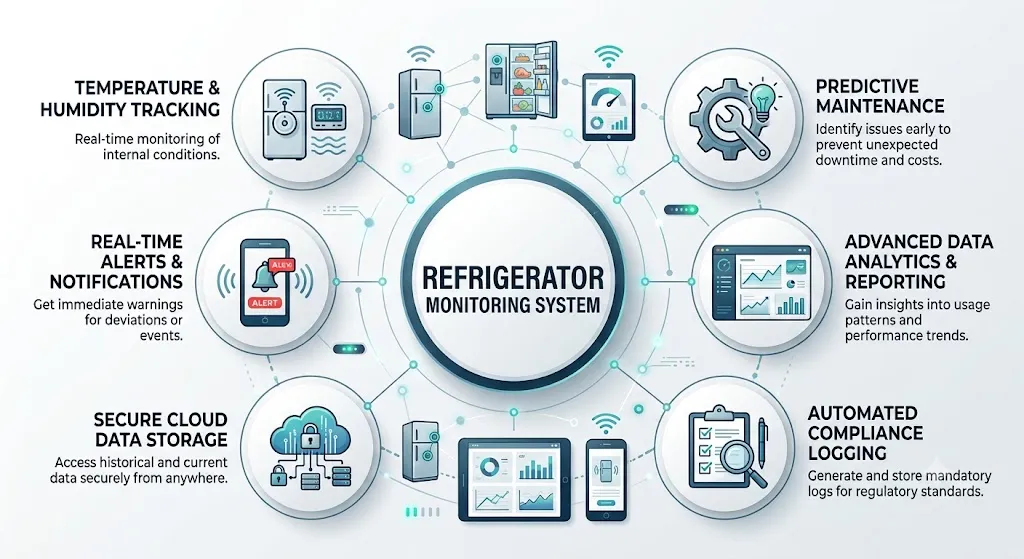
A Refrigerator Monitoring System is a connected solution that continuously tracks temperature, humidity, and door-open events inside refrigeration units, transmitting that data to a secure cloud dashboard. Built on IoT temperature monitoring technology, the system replaces manual spot-checks with continuous digital surveillance, giving facility managers a live, accurate picture of every unit on their premises — whether it's a single pharmacy fridge or a network of cold rooms spread across multiple branches.
How the Technology Works
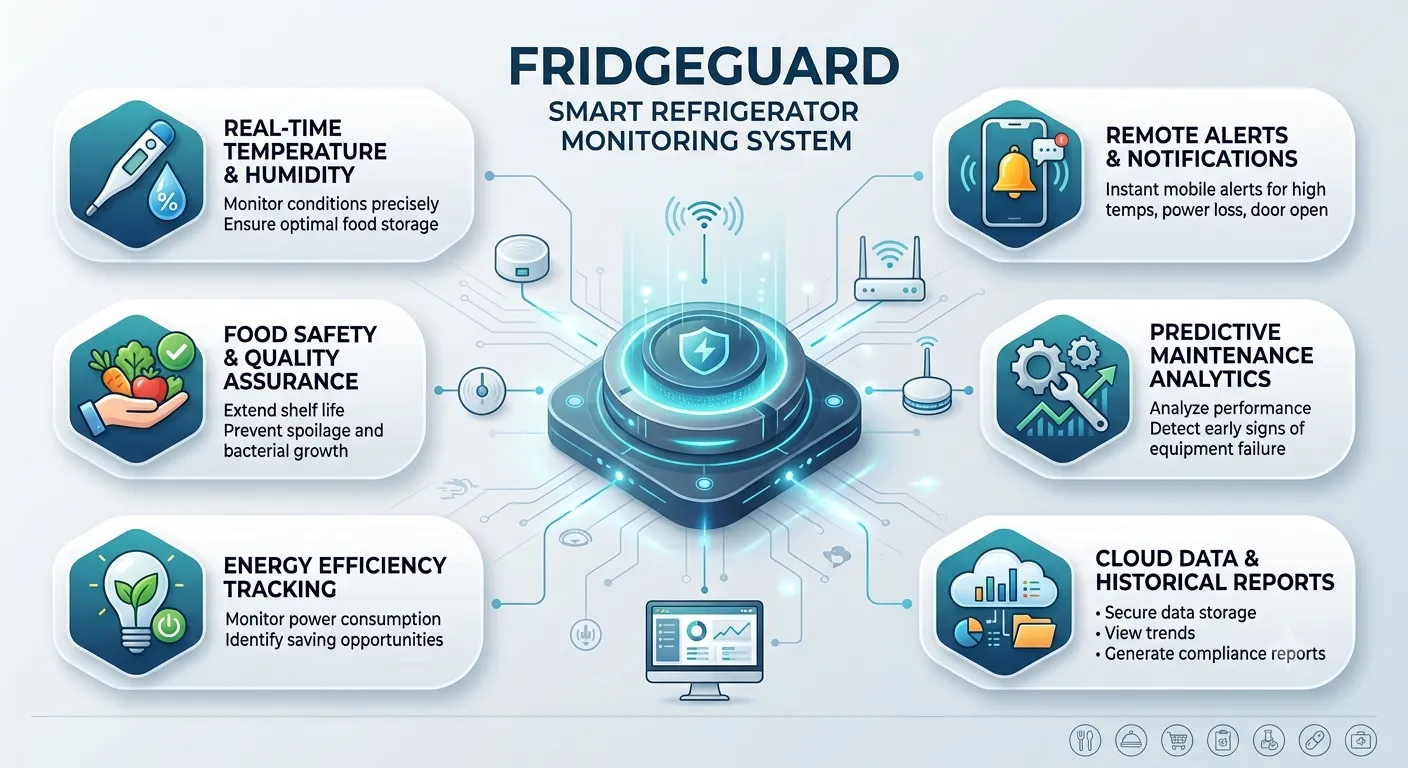
Small battery-powered or wired sensors are placed inside each refrigerator or freezer. These sensors relay readings through a gateway to a cloud platform, where the data is logged, analyzed, and compared against pre-set safe ranges. If a reading drifts outside the acceptable threshold, the platform triggers an alert instantly — by SMS, email, or app notification — so staff can respond before stock is compromised. Historical data is stored automatically, building a searchable record that facility managers can pull up in seconds during an inspection or internal review.
Key Features to Look For
When evaluating a system, UAE businesses should prioritize solutions that offer:
- Wireless temperature sensors that install in minutes without disrupting daily operations
- Real-time temperature alerts sent directly to managers' phones or email the moment conditions drift out of range
- Cloud-based dashboards accessible from anywhere, ideal for multi-branch operations across the Emirates
- Temperature data loggers that create a timestamped, audit-ready history for inspections and insurance claims
- Door-open and power-failure detection to catch human error and infrastructure faults alike
- Integration with existing building management or security systems for centralized oversight
Business Benefits Across the UAE
Beyond compliance, a well-implemented monitoring system delivers measurable operational value:
- Reduced spoilage and waste, protecting profit margins in food service and pharmacy operations
- Stronger cold storage management across multiple sites, with a single dashboard replacing dozens of paper logs
- Improved energy efficiency, as consistent monitoring identifies underperforming units before they waste power
- Predictive maintenance insights that flag failing compressors or seals before a full breakdown occurs
- Faster incident response, minimizing losses during power cuts or equipment faults
- Stronger documentation to support audits, insurance claims, and customer trust
Taken together, these benefits mean the system frequently pays for itself — a single avoided spoilage event, whether a batch of vaccines or a walk-in cooler of fresh produce, can offset months of subscription costs.
Industries That Depend on Reliable Temperature Monitoring
Cold chain protection matters most where the cost of failure is highest:
- Healthcare and pharmacies rely on monitoring to protect the pharmaceutical cold chain UAE facilities depend on for vaccines, insulin, and temperature-sensitive medicines
- Food and beverage businesses — from supermarkets to central kitchens — use monitoring to maintain food safety compliance and protect perishable stock
- Hospitality groups across Dubai and Abu Dhabi use it to safeguard kitchen operations across multiple properties
- Laboratories and diagnostic centers depend on continuous records to protect sample integrity
- Logistics and distribution companies use it to protect goods in transit and in warehouse storage
Meeting UAE Compliance Standards
Regulatory expectations for temperature-controlled storage continue to rise across the Emirates. Healthcare facilities must align with Dubai Health Authority (DHA) regulations and equivalent standards set by the Department of Health in Abu Dhabi, while food businesses are expected to demonstrate HACCP compliance during municipality inspections. Automated monitoring systems generate the timestamped records inspectors look for, turning compliance from a manual burden into a background process that runs quietly and reliably in the background.
The Real Cost of Temperature Failures
The financial impact of an undetected refrigeration failure extends well beyond the value of the spoiled goods. A pharmacy that loses a batch of temperature-sensitive vaccines faces replacement costs, potential regulatory reporting obligations, and lost patient trust. A restaurant that serves food from a compromised walk-in cooler risks a health inspection failure, a temporary closure, or reputational damage that follows the brand across social media and review platforms. In a market as competitive as the UAE's food and healthcare sectors, that kind of setback can take months to recover from.
Insurance providers are also paying closer attention to how businesses manage cold storage risk. Facilities that can demonstrate continuous, automated monitoring — rather than relying on handwritten logs — are often better positioned during claims related to spoilage or equipment failure, since the data provides an objective, time-stamped account of exactly what happened and when.
The Growing Role of Automation and Analytics
As UAE businesses scale, the value of a monitoring system extends beyond simple alerting. Modern platforms increasingly layer analytics on top of raw sensor data, helping facility managers spot patterns rather than just individual incidents — a unit that runs warmer during peak afternoon hours, a compressor whose performance degrades gradually over several weeks, or a branch that repeatedly reports door-open violations during shift changes. These insights allow operations teams to address root causes rather than reacting to the same problem again and again.
This shift toward data-driven facility management mirrors a broader trend across the UAE's smart infrastructure landscape, where IoT sensors, cloud dashboards, and automated alerting are steadily replacing manual, paper-based processes across construction, retail, and public sector projects alike. Cold chain monitoring is simply one of the clearest, most measurable examples of that shift in action.
Choosing the Right Monitoring Partner
Selecting a provider experienced in cold chain monitoring in the UAE matters as much as the technology itself. Look for a partner who understands local regulatory requirements, offers remote temperature monitoring with 24/7 alerting, and can support multi-site deployments as your business grows — from a single restaurant walk-in to a nationwide pharmacy chain. Installation support, staff training, and ongoing technical assistance are just as important as the sensors themselves, since a monitoring system is only as effective as the team that responds to its alerts.
Conclusion
As temperature-sensitive industries across the UAE face rising regulatory scrutiny and increasingly complex supply chains, manual temperature checks are no longer sufficient. A modern refrigerator monitoring system gives healthcare providers, food businesses, and logistics operators the continuous visibility, instant alerts, and audit-ready records needed to protect stock, meet compliance requirements, and operate with confidence. Investing in the right solution today is a practical step toward safer, smarter, and more resilient cold chain operations across Dubai, Abu Dhabi, Sharjah, and the wider Emirates.
Frequently Asked Questions
1. What is a refrigerator monitoring system used for?
It continuously tracks temperature and humidity inside refrigerators and freezers, alerting staff immediately if conditions move outside safe ranges — preventing spoilage of medicines, food, and other temperature-sensitive goods.
2. Which industries in the UAE benefit most from temperature monitoring?
Healthcare, pharmaceuticals, food and beverage, hospitality, laboratories, and logistics all rely heavily on continuous monitoring to protect stock and meet regulatory requirements.
3. How do businesses receive alerts if a refrigerator malfunctions?
Most systems send instant alerts via SMS, email, or app notification the moment a sensor detects a temperature deviation, an open door, or a power failure.
4. Does a monitoring system help with compliance audits?
Yes. The system automatically records timestamped temperature history, giving businesses audit-ready documentation for health authority inspections and HACCP reviews.
5. Can one dashboard monitor refrigerators across multiple UAE locations?
Yes. Cloud-based platforms allow facility managers to monitor refrigeration units across multiple branches or sites from a single dashboard, anywhere in the UAE.




























Sign in to leave a comment.