

Introduction
In the United Arab Emirates (UAE), maintaining the correct temperature of refrigerators and cold storage facilities is essential for protecting food quality, preserving medicines, ensuring regulatory compliance, and reducing operational costs. With high ambient temperatures throughout the year, businesses must pay particular attention to temperature-sensitive products and refrigeration performance. Even a minor temperature fluctuation can result in food spoilage, pharmaceutical losses, product contamination risks, and unnecessary financial expenses.
A refrigerator monitoring system in UAE provides a reliable solution for continuously tracking refrigerator temperatures, detecting abnormal conditions, and alerting responsible personnel before a minor issue becomes a major problem. By combining digital temperature sensors, wireless connectivity, automated alerts, cloud-based dashboards, and historical data logging, businesses can monitor refrigeration equipment more efficiently and maintain consistent storage conditions.
From restaurants and supermarkets to hospitals, pharmaceutical facilities, laboratories, hotels, and food distribution centers, refrigerator temperature monitoring has become an important part of modern cold chain management.
This article explains how a refrigerator monitoring system works, its key benefits, applications, essential features, and the factors businesses should consider when selecting a suitable solution in the UAE.
What Is a Refrigerator Monitoring System?
A refrigerator monitoring system is a technology-based solution designed to measure, record, and monitor the internal temperature of refrigerators, freezers, chillers, and other temperature-controlled storage equipment.
Unlike traditional thermometers that require employees to check temperatures manually, an automated monitoring system can collect readings continuously or at predefined intervals. It can then display the information on a digital dashboard and send notifications when temperatures exceed configured limits.
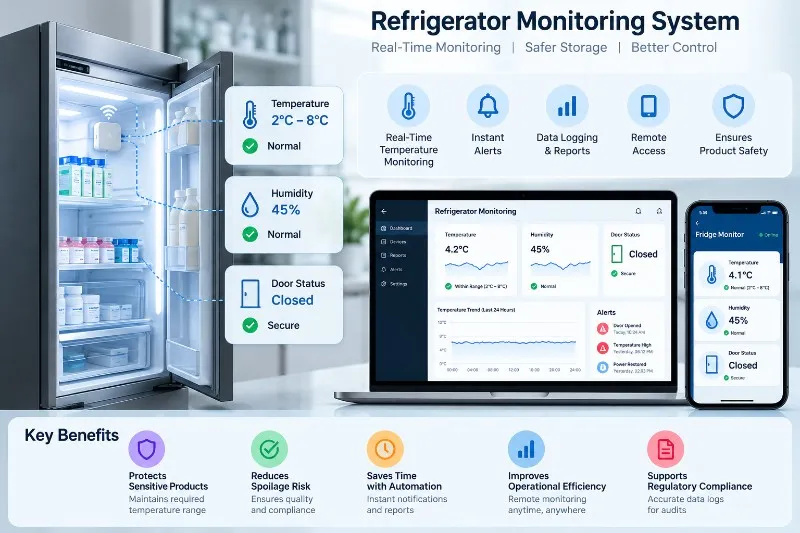
A comprehensive remote refrigerator monitoring system typically includes temperature sensors, a monitoring gateway or connectivity module, monitoring software, an alert mechanism, and a data storage platform.
Depending on the application, the system may also monitor door openings, humidity, power failures, equipment performance, and other environmental conditions.
For businesses operating in the UAE, this technology supports better refrigeration management, faster incident response, improved recordkeeping, and greater confidence in the quality of temperature-sensitive products.
Why Refrigerator Monitoring Is Important in the UAE
The UAE’s hot climate creates additional challenges for refrigeration equipment. High outdoor temperatures can increase cooling demand, while frequent refrigerator access, improper loading, damaged door seals, and equipment malfunctions can contribute to temperature instability.
A reliable refrigerator monitoring system in UAE helps businesses identify these risks and respond promptly.
1. Protecting Food Safety
Restaurants, catering businesses, supermarkets, hotels, and food processing facilities depend on consistent refrigeration to protect perishable food products.
When a refrigerator operates outside its recommended temperature range, bacteria may multiply more rapidly, depending on the food and the conditions involved. A monitoring system helps staff identify temperature deviations and take corrective action before products are served or distributed.
2. Maintaining Pharmaceutical Storage Conditions
Medicines, vaccines, biological samples, and certain healthcare products require carefully controlled storage conditions. Some products must remain within a specified refrigerated temperature range throughout storage and transportation.
A pharmaceutical refrigerator monitoring system provides continuous visibility into storage conditions and maintains records that can support internal quality procedures and applicable regulatory requirements.
3. Reducing Product Waste
Undetected refrigeration problems can cause substantial losses, particularly when large quantities of food, medicines, or laboratory materials are stored in one location.
With real-time refrigerator temperature monitoring, businesses can receive early warnings and investigate potential problems before losses increase.
4. Improving Energy Efficiency
Refrigerators that operate inefficiently may consume excessive electricity because of damaged seals, faulty components, poor ventilation, or inappropriate temperature settings.
Temperature trends and equipment alerts can help maintenance teams identify issues, improve servicing schedules, and reduce avoidable energy consumption.
5. Supporting Compliance and Documentation
Businesses that handle food, medicines, and other temperature-sensitive products may need to maintain appropriate temperature records and demonstrate adherence to relevant procedures.
An automated system simplifies documentation by recording temperature readings, alert events, and corrective actions. However, the system alone does not guarantee compliance; businesses must also follow the applicable UAE regulations and sector-specific requirements.
How Does a Refrigerator Monitoring System Work?
A modern automatic refrigerator temperature monitoring system operates through several interconnected components.
Temperature Sensors
Digital or calibrated temperature sensors measure conditions inside refrigerators and freezers. Sensor selection should reflect the required accuracy, operating range, placement, and intended application.
Wireless or Wired Connectivity
Readings are transmitted through suitable communication technologies, such as Wi-Fi, Bluetooth, cellular connectivity, or other wired and wireless networks. The appropriate option depends on building infrastructure, coverage, security, and reliability requirements.
Monitoring Dashboard
A centralized dashboard displays current temperatures, historical readings, device status, and alert notifications. Authorized users can access this information through compatible computers, tablets, or smartphones.
Automated Alerts
When temperatures exceed configured limits, the system can notify designated staff through available channels, such as SMS, email, app notifications, or other supported communication methods.
Alerts may also be configured for power interruptions, sensor failures, communication loss, or prolonged refrigerator door openings when the relevant hardware is available.
Data Logging and Reporting
A refrigerator temperature data logger records measurements over time, allowing users to review temperature trends, investigate incidents, and prepare reports.
Depending on the system, records may be stored locally, in the cloud, or through a combination of both. Businesses should verify data retention, backup, export, and access-control capabilities before implementation.
Key Features of a Smart Refrigerator Monitoring System
When evaluating a smart refrigerator monitoring system in UAE, businesses should consider the following features.
1. Real-Time Temperature Monitoring: Provides frequent or continuous visibility into refrigeration conditions and helps identify abnormal readings quickly.
2. Remote Temperature Monitoring: Allows authorized users to monitor equipment from different rooms, buildings, branches, or locations without physically checking every refrigerator.
3. 24/7 Automated Alerts: Sends notifications when configured temperature thresholds are breached or when selected system faults occur. Escalation procedures help ensure alerts receive appropriate attention.
4. Historical Temperature Data: Maintains records that support quality assurance, operational reviews, and investigations into temperature excursions.
5. Multi-Refrigerator Monitoring: Enables businesses to monitor several refrigerators, freezers, cold rooms, or storage facilities from one interface.
6. Mobile Accessibility: Provides convenient access to current readings, alerts, and reports through compatible mobile devices.
7. Power Failure Detection: Identifies interruptions when the monitoring system includes suitable power-status detection and backup arrangements.
8. Sensor Calibration and Accuracy: Supports dependable measurements through appropriate sensor specifications, calibration procedures, and periodic verification.
9. Secure User Access: Uses suitable authentication, access permissions, and data protection controls to help prevent unauthorized access.
10. Reporting and Audit Support: Makes it easier to retrieve records, review alarms, document corrective actions, and demonstrate adherence to internal procedures.
Applications of Refrigerator Monitoring Systems in the UAE
A commercial refrigerator monitoring system can benefit many industries across the Emirates.
Restaurants, Cafes, and Hotels
Commercial kitchens store meat, seafood, dairy products, prepared meals, vegetables, and other perishable ingredients. Automated monitoring helps kitchen managers maintain appropriate storage conditions and respond quickly to refrigeration issues.
Hotels and catering facilities can also monitor multiple kitchen refrigerators, banquet storage areas, and centralized food preparation facilities.
Supermarkets and Grocery Stores
Supermarkets frequently operate numerous display refrigerators, freezers, and back-of-house cold rooms. Centralized monitoring helps identify equipment failures, reduce spoilage risks, and maintain visibility across multiple storage zones.
Hospitals and Medical Facilities
Hospitals store temperature-sensitive medicines, diagnostic materials, and certain laboratory products. A medical refrigerator monitoring system helps healthcare teams detect deviations, document storage conditions, and investigate potential risks to product integrity.
Pharmacies and Pharmaceutical Warehouses
Pharmacies and pharmaceutical distributors may require temperature monitoring, alarm management, and documented storage controls appropriate to the products they handle.
A pharmaceutical cold storage monitoring system can help support these processes by maintaining temperature histories and alerting responsible personnel when configured limits are exceeded.
Laboratories and Research Centers
Laboratories may store reagents, specimens, and research materials under specific environmental conditions. Monitoring systems help personnel identify temperature excursions and assess whether stored materials require further evaluation.
Food Processing and Distribution
Food manufacturers, distributors, and cold chain operators rely on stable storage conditions throughout handling and distribution. Monitoring multiple refrigeration points improves operational visibility and supports consistent quality management.
Benefits of Remote Refrigerator Temperature Monitoring
Implementing remote refrigerator monitoring in UAE offers operational advantages beyond simple temperature measurement.
Faster Problem Detection: Automated alerts help staff identify abnormal conditions sooner than periodic manual checks alone.
Lower Spoilage Risk: Early warnings create an opportunity to investigate faults and protect products, although they cannot guarantee that spoilage will be prevented.
Reduced Manual Workload: Automated records reduce repetitive temperature checks and administrative effort.
Improved Accountability: Time-stamped readings and alarm histories help managers review incidents and establish clear responsibilities.
Better Maintenance Planning: Temperature patterns can reveal recurring problems that require inspection or servicing.
Centralized Visibility: Multi-site organizations can review refrigeration performance across different branches and facilities.
Stronger Operational Resilience: Backup power, communication-loss alerts, escalation rules, and documented response procedures help businesses prepare for unexpected failures.
How to Choose the Right Refrigerator Monitoring System in UAE
Selecting the right solution requires an assessment of the equipment, operating environment, and compliance obligations.
1. Identify Monitoring Requirements
Determine whether the application involves food refrigeration, pharmaceutical storage, laboratory equipment, freezers, or cold rooms. Each application may have different temperature limits, accuracy requirements, and recordkeeping needs.
2. Evaluate Sensor Accuracy
Choose sensors with suitable measurement ranges and documented accuracy. For critical storage applications, consider calibration traceability, calibration frequency, and the ability to verify sensor performance.
3. Check Connectivity Reliability
Ensure the monitoring solution provides adequate network coverage throughout the facility. Where network interruptions are possible, consider local data buffering, offline alarms, or backup communication options.
4. Review Alert Configuration
Confirm that users can set appropriate temperature thresholds, delay periods, escalation procedures, and notification recipients. Alert settings should reflect product requirements and operating procedures rather than relying on a universal temperature limit.
5. Assess Data Security and Storage
Review user permissions, encryption, backup policies, data retention, audit trails, and access to historical records. These features are particularly important for healthcare and other regulated environments.
6. Consider Scalability
A scalable refrigerator monitoring solution should accommodate additional sensors, refrigerators, storage rooms, and locations as business needs expand.
7. Verify Local Support and Maintenance
Consider installation, staff training, technical support, sensor replacement, calibration services, and system maintenance within the UAE.
8. Evaluate Total Cost of Ownership
Compare equipment, installation, connectivity, software subscriptions, maintenance, calibration, and potential replacement costs. The lowest initial price may not provide the best long-term value.
Best Practices for Refrigerator Monitoring in the UAE
To achieve reliable results, businesses should combine monitoring technology with established operating procedures.
- Set temperature limits according to the requirements of the products being stored and applicable regulations.
- Position sensors appropriately and avoid relying on measurements taken only from unrepresentative locations.
- Establish procedures for responding to alarms, including product assessment and escalation to responsible personnel.
- Test alerts, connectivity, backup arrangements, and power-failure notifications periodically.
- Maintain calibration and verification records for temperature sensors.
- Inspect refrigerator doors, seals, ventilation, and cooling performance regularly.
- Train employees to recognize temperature excursions and document corrective actions.
- Review temperature trends and recurring alarms to identify opportunities for improvement.
- Establish contingency plans for prolonged outages, including suitable alternative storage arrangements.
For food businesses, refrigerated storage is commonly maintained at 5°C or below as a general food-safety benchmark, but requirements vary by product and applicable local rules. Some products, particularly medicines and vaccines, require different or narrower temperature ranges. Businesses should verify the requirements that apply to their specific operations rather than treating one temperature setting as suitable for every application.
Conclusion
A refrigerator monitoring system in UAE is a valuable investment for businesses that depend on reliable refrigeration, product quality, and effective temperature control. By combining accurate sensors, real-time monitoring, automated alerts, historical data logging, and centralized reporting, organizations can improve visibility into refrigeration performance and respond more effectively to unexpected temperature changes.
For restaurants, supermarkets, hospitals, pharmacies, laboratories, hotels, and cold storage facilities, remote refrigerator temperature monitoring can reduce manual workload, support preventive maintenance, strengthen documentation, and help minimize the risk of avoidable product losses.
Choosing the right solution involves evaluating sensor accuracy, connectivity, alert reliability, data security, calibration, scalability, and relevant regulatory requirements. Most importantly, monitoring technology should be supported by trained staff, appropriate maintenance, and clear corrective-action procedures.
As businesses across the UAE continue to prioritize food safety, pharmaceutical integrity, operational efficiency, and digital transformation, a well-designed smart refrigerator monitoring system can play an important role in building a safer, more reliable, and more efficient cold storage operation.
Frequently Asked Questions (FAQs)
1. What is a refrigerator monitoring system?
A refrigerator monitoring system measures and records refrigerator temperatures using digital sensors. Depending on its features, it can provide real-time readings, automated alerts, historical records, and remote access to help businesses maintain appropriate storage conditions.
2. Why is refrigerator temperature monitoring important in the UAE?
The UAE’s hot climate can increase refrigeration demand and make equipment reliability particularly important. Monitoring helps businesses identify temperature deviations, respond to equipment problems, protect temperature-sensitive products, and maintain appropriate records.
3. Can a refrigerator monitoring system send alerts remotely?
Yes. Systems with suitable connectivity and notification features can send alerts through supported channels such as SMS, email, or mobile applications. Some systems also provide notifications for power interruptions, sensor faults, or communication failures.
4. Which industries need refrigerator monitoring systems?
Restaurants, hotels, supermarkets, food processing facilities, hospitals, pharmacies, pharmaceutical warehouses, laboratories, and cold storage operators can benefit from refrigerator monitoring. The specific features required depend on the products stored and the applicable operating standards.
5. How much does a refrigerator monitoring system cost in the UAE?
The cost depends on the number of refrigerators, sensor accuracy, connectivity requirements, monitoring software, alert features, installation complexity, calibration needs, and ongoing maintenance. Businesses should request a solution based on their operational requirements and compare the total cost of ownership rather than considering hardware prices alone.



















Sign in to leave a comment.