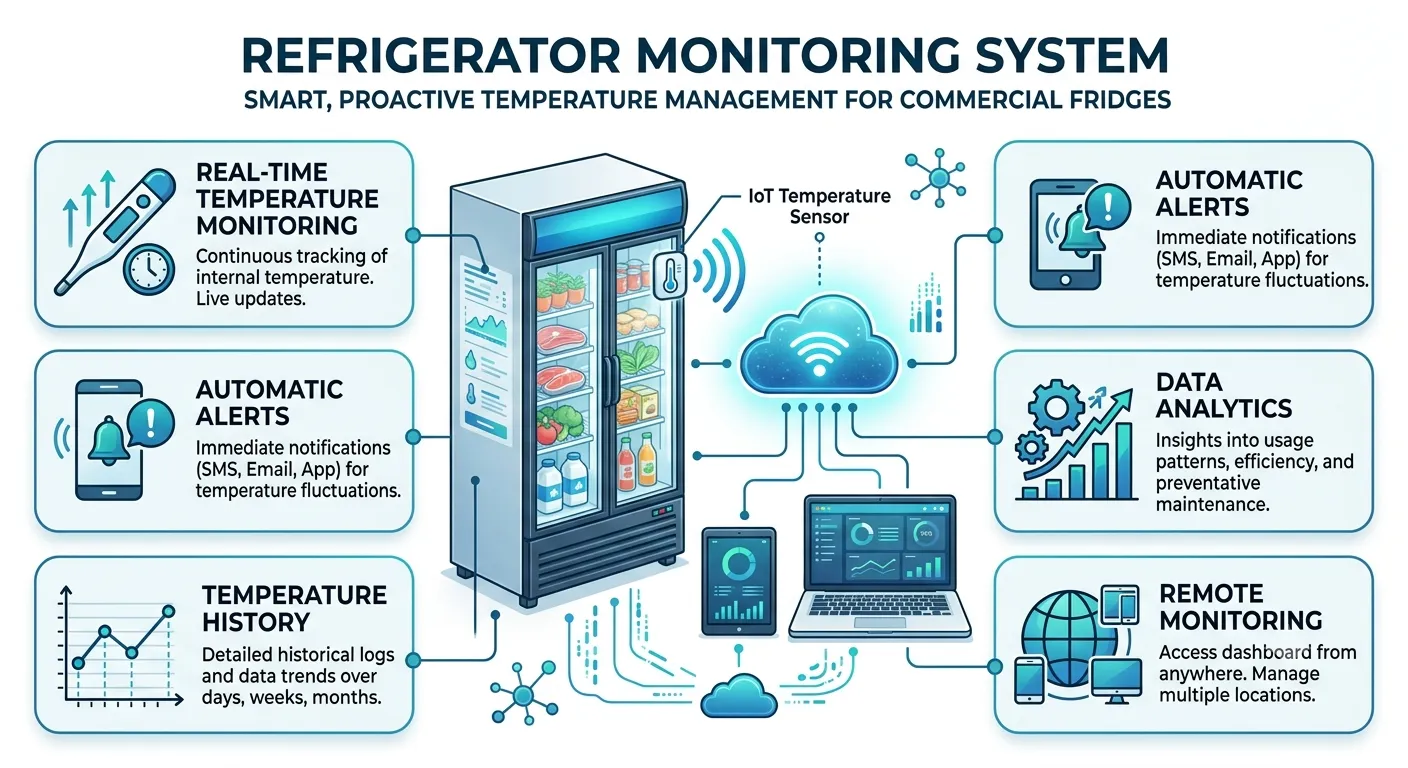

In today’s increasingly connected world, the importance of maintaining precise temperature control in refrigeration systems cannot be overstated. Whether in pharmaceutical storage, food service operations, or research laboratories, temperature fluctuations of just a few degrees can result in product spoilage, regulatory non-compliance, and substantial financial losses. Refrigerator monitoring systems have emerged as critical infrastructure for organizations managing cold chains, offering real-time visibility, automated alerts, and comprehensive data logging that were once impossible to achieve with traditional analog thermometers.
This comprehensive guide explores how modern refrigerator monitoring systems work, their applications across industries, the technology behind them, and the measurable benefits they deliver to businesses of all sizes.
What is a Refrigerator Monitoring System?
A refrigerator monitoring system is an IoT-enabled solution that continuously tracks temperature, humidity, and other environmental parameters inside refrigeration units. Unlike passive thermometers that require manual observation, these systems use networked sensors, cloud-based platforms, and intelligent algorithms to provide real-time monitoring and automated alerts when conditions deviate from acceptable ranges.
Core Definition: A refrigerator monitoring system is a digital infrastructure that automatically measures, records, and reports refrigeration unit conditions to authorized personnel through mobile apps, dashboards, and email/SMS notifications.
Key Components of a Modern System
- Wireless Temperature Sensors: High-precision probes with ±0.5°C accuracy that measure internal refrigerator temperature continuously
- Humidity Sensors: Optional sensors that track moisture levels, critical for pharmaceutical and vaccine storage
- Gateway/Hub Device: A local hub that collects data from multiple sensors and transmits it to the cloud
- Cloud Platform: Secure servers that store historical data, run analytics, and manage alert logic
- Mobile/Web Dashboard: User interface for viewing real-time status, historical trends, compliance reports, and alarm logs
- Alerting Engine: Automated notification system that sends alerts via email, SMS, or push notifications when thresholds are breached
How Refrigerator Monitoring Systems Work
Understanding the operational flow of a refrigerator monitoring system is essential for maximizing its value. Here’s how the system operates from installation through continuous monitoring:
System Architecture Flow
TemperatureSensorMeasuresGateway/HubCollects dataCloudPlatformProcessesAlertEngineEvaluatesUserNotifiedEmail/SMS/AppData Logged & Analyzed
Step-by-Step Operation
- Continuous Measurement: Sensors take temperature readings every 5–15 minutes (configurable)
- Data Transmission: Gateway collects and sends data to cloud via WiFi, cellular, or LoRaWAN
- Cloud Processing: Platform receives data, applies business logic, and updates dashboards
- Threshold Evaluation: Alert engine compares readings against configured limits
- Notification Dispatch: If thresholds are breached, alerts are sent immediately
- Data Archival: All readings are permanently stored for compliance and trend analysis
Temperature Monitoring Technology in Detail
Modern refrigerator monitoring relies on sophisticated sensor technology and data analysis to ensure accuracy and reliability. Let’s examine how temperature data flows through these systems and what insights they provide.
Real-Time Temperature Tracking
Typical Temperature Parameters by Industry
2–8°C
Vaccine & Pharmaceutical Storage
-18°C
Frozen Food & Blood Products
1–4°C
General Laboratory Samples
Data Storage & Compliance
One of the most critical features of modern refrigerator monitoring systems is their ability to maintain complete audit trails. Every temperature reading is timestamped and stored, creating an immutable record that satisfies stringent regulatory requirements including FDA 21 CFR Part 11, WHO guidelines, and ISO 13485 standards.
These systems typically retain data for 5–7 years with redundant cloud backups, ensuring that historical temperature records are always available for compliance inspections and root cause analysis of any incidents.
Key Benefits of Refrigerator Monitoring Systems
Organizations implementing comprehensive refrigerator monitoring systems report significant improvements across multiple operational dimensions:
✓ Reduced Product Loss
Early detection of temperature deviations prevents spoilage. Organizations report 15–40% reduction in refrigeration-related waste.
✓ Regulatory Compliance
Automated logging and reporting meet all compliance requirements, eliminating manual documentation and reducing audit risk.
✓ 24/7 Monitoring
Systems operate continuously with no human intervention required, ensuring protection during nights, weekends, and holidays.
✓ Actionable Insights
Historical data analytics reveal efficiency trends, enabling predictive maintenance and equipment optimization.
✓ Reduced Liability
Complete audit trails protect organizations from liability claims related to temperature excursions or product quality issues.
✓ Cost Efficiency
Prevent emergency repairs and replace refrigeration units proactively, reducing downtime and emergency service costs.
Monitoring System ROI Analysis
Real-World Applications Across Industries
Pharmaceutical & Vaccine Storage
Vaccines, insulin, and biologics require precise temperature maintenance. A single temperature excursion can render an entire shipment unusable. Monitoring systems provide the documentation required by the WHO and national regulatory bodies, enabling organizations to maintain complete traceability of product integrity throughout the cold chain.
Food Service & Hospitality
Restaurants, catering companies, and food distributors use monitoring systems to prevent foodborne illness outbreaks. Automatic alerts enable staff to address equipment failures within minutes, rather than discovering spoilage hours or days later.
Laboratory & Medical Research
Blood banks, tissue repositories, and research institutions depend on monitoring systems to protect invaluable biological samples. These systems often integrate with existing laboratory information systems (LIMS) for seamless data management.
E-Commerce & Last-Mile Delivery
As cold-chain delivery becomes mainstream, monitoring enables companies to provide real-time temperature data to customers, building confidence in product quality and enabling predictive interventions before delivery.
Technology Architecture & Implementation
Modern refrigerator monitoring systems employ several technical approaches, each with distinct advantages:
WiFi-Based Systems
Ideal for facilities with robust network infrastructure. Offers lowest latency and highest bandwidth, but requires stable internet connectivity and periodic network maintenance.
Cellular/4G Systems
Suitable for remote locations or facilities without fixed WiFi. Provides cellular backup, though may require SIM cards and ongoing service costs.
LoRaWAN Systems
Long-range, low-power network technology perfect for large facilities with multiple sensors. Requires dedicated gateway but excels in complex environments.
Hybrid Approaches
Advanced systems combine multiple connectivity options, automatically failover between channels, ensuring continuous monitoring even during network disruptions.
Industry Best Practice: Enterprise-grade monitoring systems should support multiple connectivity options with automatic failover capability and minimum 99.9% uptime SLA guarantees.
Conclusion
Refrigerator monitoring systems have evolved from optional conveniences to essential infrastructure for any organization managing cold chains. The combination of real-time visibility, automated alerts, compliance documentation, and actionable analytics delivers compelling business value while significantly reducing operational risk.
Whether you’re managing pharmaceutical products worth thousands per unit, protecting irreplaceable biological research samples, or ensuring food safety for thousands of customers, a modern refrigerator monitoring system provides the visibility and control essential in today’s regulatory environment. The cost of implementation is typically recouped within months through reduced product loss and operational efficiency gains alone.
As cold-chain logistics become increasingly critical across healthcare, life sciences, and food industries, organizations that invest in robust monitoring infrastructure today will be better positioned to maintain compliance, protect product quality, and scale operations confidently.
Frequently Asked Questions
- How often should refrigerator temperature be monitored?
Industry standards recommend monitoring at least every 15 minutes for pharmaceutical and vaccine storage, with FDA guidance suggesting readings at minimum once daily for food service applications. Most modern IoT systems default to 5–15 minute intervals, providing optimal balance between data granularity and battery/bandwidth consumption. Critical facilities often use 1–5 minute intervals to enable immediate detection of equipment failures.
2. What happens if the monitoring system loses internet connection?
Robust monitoring systems are designed to operate offline. Local gateway devices maintain local storage buffers and continue logging temperature data even when cloud connectivity is unavailable. Once connection is restored, accumulated data is automatically synced to the cloud. Some systems include cellular/LTE backup connectivity to ensure redundancy. It’s important to verify that your system includes offline capability as part of its design architecture.
3. Are refrigerator monitoring systems compliant with regulatory standards?
Yes, systems designed for pharmaceutical and healthcare use are built specifically to comply with FDA 21 CFR Part 11, WHO guidelines, ISO 13485, and similar standards. These systems provide audit trails, tamper-evident logging, role-based access controls, and data integrity features required for regulatory compliance. Always verify that your chosen system has documentation of compliance with your specific regulatory requirements.
4. How much do refrigerator monitoring systems cost?
Costs vary widely based on features, scale, and deployment model. Entry-level systems start around $500–2,000 per unit for basic temperature monitoring. Enterprise solutions with advanced analytics, multiple sensors, and comprehensive compliance features range from $5,000–15,000+ per installation. Cloud platform subscriptions typically cost $50–300 per refrigerator monthly depending on features and data retention requirements. Most systems achieve ROI within 6–18 months through reduced product loss alone.
5. Can monitoring systems be retrofitted to existing refrigeration equipment?
Yes, most modern monitoring systems are designed for retrofitting without modifications to existing equipment. Wireless sensors are placed inside refrigerators, while gateway devices connect to network infrastructure externally. Installation typically requires 15–30 minutes per unit with no downtime. Some organizations prefer integrated systems built directly into commercial-grade refrigeration equipment, though these require purchasing new units. Both approaches provide equivalent monitoring capability when properly configured.




























Sign in to leave a comment.