
Maintaining the correct temperature inside refrigerators, freezers, medical refrigerators, and cold storage units is essential for protecting temperature-sensitive products. Across Bahrain and the GCC, businesses in healthcare, pharmaceuticals, food and beverage, hospitality, laboratories, supermarkets, catering, and logistics depend on reliable refrigeration to preserve product quality and safety.
A modern Refrigerator Temperature Monitoring System provides continuous visibility into temperature conditions and helps organizations respond quickly when temperatures move outside predefined limits. Instead of depending only on manual temperature checks, businesses can use connected sensors, automated alerts, cloud-based dashboards, and remote temperature monitoring to maintain better control over refrigerated environments.
In Bahrain, food-safety guidance specifies temperature monitoring and control for refrigerated and frozen food, while pharmaceutical facility standards emphasize electronic monitoring and temperature alarms for pharmaceutical refrigerators.
What Is a Refrigerator Temperature Monitoring System?
A Refrigerator Temperature Monitoring System is a smart solution that continuously measures and records the temperature inside refrigeration equipment. Sensors installed inside refrigerators, freezers, cold rooms, vaccine refrigerators, medicine storage units, or other temperature-controlled environments send readings to a monitoring platform.
The system can automatically:
- Monitor temperature 24/7
- Record temperature readings
- Detect abnormal temperature changes
- Send instant alerts
- Provide remote access to temperature data
- Generate historical reports
- Identify prolonged temperature deviations
- Support compliance and auditing
- Help prevent temperature-related product losses
This makes smart refrigerator monitoring significantly more proactive than traditional manual temperature recording.
Why Temperature Monitoring Is Important in Bahrain and GCC
The GCC region experiences high ambient temperatures for significant periods of the year. This creates additional challenges for refrigeration equipment, particularly when doors are frequently opened, power interruptions occur, cooling systems malfunction, or equipment operates under heavy loads.
A refrigerator may appear to be functioning normally while its internal temperature gradually moves outside the required range. Without continuous monitoring, staff may not discover the problem until products have already been exposed to unsuitable conditions.
For this reason, real-time temperature monitoring is particularly valuable for facilities where temperature stability is critical.
Bahrain's food-safety guidance states that chilled food should generally be maintained between 4°C and 7°C and frozen materials at -18°C or below, while also requiring appropriate refrigeration equipment and temperature monitoring. Actual limits should always be determined according to the specific product, manufacturer instructions, and applicable regulations.
How a Smart Refrigerator Monitoring System Works
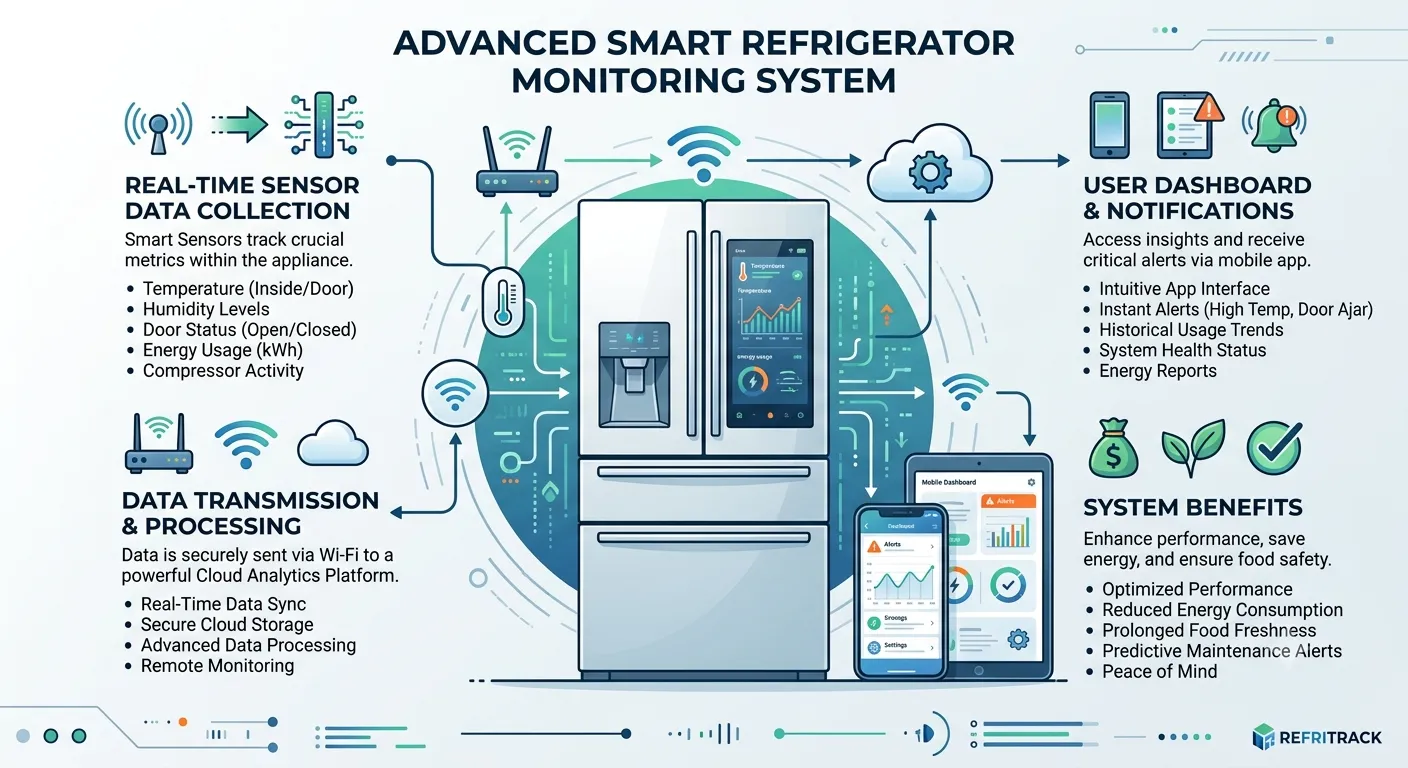
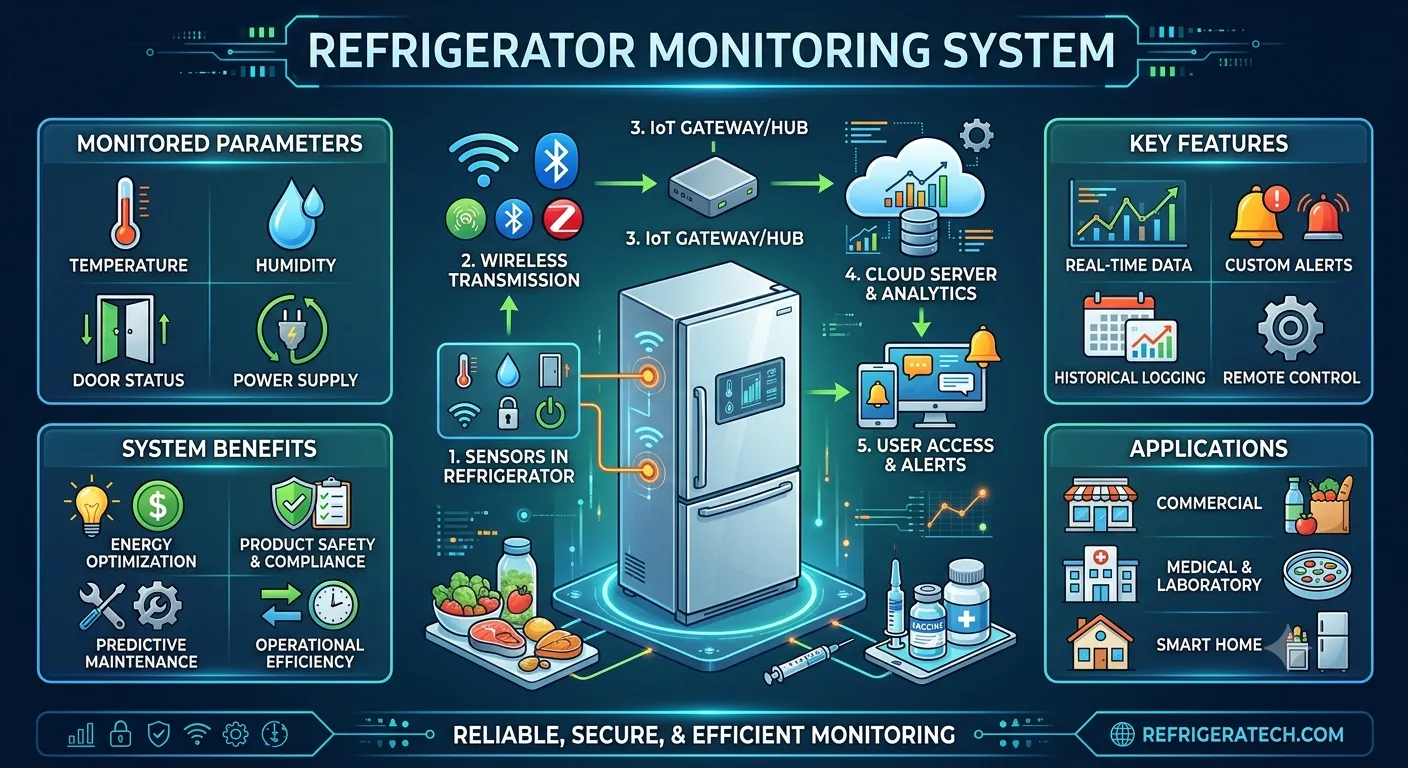
A typical wireless refrigerator temperature monitoring system consists of several connected components.
1. Temperature Sensors
A temperature sensor is installed inside the refrigerator or cold-storage unit. It continuously measures the internal temperature at predefined intervals.
For critical applications, sensors should be appropriately selected, calibrated, installed, and maintained to provide dependable measurements.
2. Data Transmission
The sensor sends temperature information to a gateway or directly to a connected monitoring platform using an appropriate communication technology.
Depending on the application, organizations can use wireless connectivity, cellular communication, Wi-Fi, or other IoT technologies.
3. Cloud-Based Monitoring
Collected information can be transmitted to a centralized IoT temperature monitoring platform. Authorized personnel can access current and historical readings through a dashboard.
This allows multiple refrigerators or storage locations to be monitored from one centralized system.
4. Automated Alerts
The system continuously compares actual temperature readings with configured thresholds.
If the temperature becomes too high or too low, the system can automatically generate an alert. This allows responsible personnel to investigate the problem before it causes significant product damage.
5. Historical Reports
Temperature data is stored digitally, creating a historical record that can be reviewed for quality assurance, audits, maintenance investigations, and operational analysis.
Real-Time Temperature Alerts
One of the most important capabilities of an advanced temperature monitoring system is automated alert management.
Manual monitoring depends heavily on employees checking equipment at scheduled intervals. A temperature problem can occur between two checks and remain unnoticed.
With automated monitoring, the system can identify abnormal conditions as they happen.
Common alerts include:
- High-temperature alert
- Low-temperature alert
- Temperature deviation alert
- Power failure alert
- Sensor failure alert
- Communication failure alert
- Door-open alert
- Battery-low alert
- Prolonged temperature excursion alert
For example, if a refrigerator configured for a specific temperature range begins warming because of a compressor problem, an automated alert can notify the responsible person immediately.
Modern monitoring standards also recognize the importance of warning systems when refrigeration temperatures move outside permitted ranges.
Remote Refrigerator Temperature Monitoring
Remote refrigerator monitoring is particularly useful for organizations managing multiple facilities.
Instead of physically visiting every refrigerator, authorized users can view equipment status through a centralized dashboard.
A manager could monitor:
- Hospital refrigerators
- Pharmacy refrigerators
- Laboratory storage
- Restaurant refrigerators
- Supermarket cold storage
- Vaccine refrigerators
- Food preparation refrigerators
- Warehouse cold rooms
- Pharmaceutical storage areas
from a central location.
This improves visibility while reducing dependence on manual inspection.
Remote monitoring can also provide temperature trends, allowing users to identify whether a refrigerator is maintaining stable conditions or experiencing repeated fluctuations.
Temperature Alerts Through Mobile and Digital Channels
A good IoT refrigerator monitoring system should make critical information easy to receive and act upon.
Depending on the platform configuration, alerts may be delivered through channels such as:
- SMS
- Mobile notifications
- Web dashboard notifications
- Audible or local alarms
For critical pharmaceutical and laboratory applications, alarm functionality is especially important. Bahrain's pharmaceutical standards specifically identify temperature alarms and calibrated electronic minimum/maximum thermometers as important controls for pharmaceutical refrigerators.
The objective is not simply to generate alerts, but to ensure that the right personnel receive useful information quickly.
Monitoring Temperature During Power Failures
Power interruptions can create serious risks for refrigeration.
When electrical power is lost, the refrigeration system may stop operating and the internal temperature can gradually rise. Without monitoring, staff may not know how long the equipment has been affected.
A comprehensive refrigerator monitoring system can detect temperature increases and, where supported, power-related events.
This helps organizations establish a response process such as:
- Detect the abnormal condition.
- Notify responsible personnel.
- Check the refrigerator and power supply.
- Assess the temperature history.
- Determine how long the product has been exposed.
- Take appropriate corrective action.
- Document the event.
Such historical information is valuable when investigating temperature excursions.
Door-Open Monitoring
Frequent or prolonged door opening can cause temperature fluctuations.
This is common in:
- Restaurants
- Supermarkets
- Hospitals
- Pharmacies
- Food storage facilities
- Laboratories
- Catering operations
A system with refrigerator door monitoring can identify unusual door activity and generate alerts when a door remains open beyond a configured period.
This can help reduce unnecessary temperature fluctuations and improve operational discipline.
Temperature Monitoring for Healthcare and Pharmaceuticals
Healthcare facilities depend on controlled storage conditions for many temperature-sensitive products.
These can include:
- Vaccines
- Medicines
- Insulin
- Biological products
- Blood-related products
- Laboratory reagents
- Diagnostic materials
Bahrain's pharmaceutical standards identify vaccines, insulin, biotech products, and blood/plasma-derived products as high-risk cold-chain products because they can be affected by both elevated temperatures and freezing.
For this reason, medical refrigerator temperature monitoring should provide reliable measurements, configurable alarms, historical records, and appropriate escalation procedures.
Different products require different storage conditions, so temperature limits should never be assumed universally. They should be configured according to product specifications and applicable regulatory requirements.
Temperature Monitoring for Food and Beverage
The food and beverage sector is another major application.
Restaurants, hotels, catering companies, supermarkets, food processors, and distributors depend on refrigeration to protect perishable products.
Typical monitored equipment can include:
- Walk-in refrigerators
- Display refrigerators
- Commercial freezers
- Cold rooms
- Food preparation refrigerators
- Beverage coolers
- Meat storage
- Seafood storage
- Dairy storage
A food temperature monitoring system can continuously record conditions and notify staff when temperatures move outside the organization's defined limits.
This supports preventive food-safety practices and helps reduce spoilage and unnecessary waste.
Data Logging and Historical Temperature Records
A major advantage of digital monitoring is automated data logging.
Instead of maintaining handwritten temperature sheets, the system can automatically store readings with timestamps.
Historical records can help answer important questions:
- When did the temperature change?
- How long did the deviation continue?
- How frequently does the refrigerator fluctuate?
- Was the temperature stable overnight?
- Did the equipment experience repeated excursions?
- Was the issue related to a power failure or door opening?
Digital records can also simplify internal reviews and audits.
Dashboards and Temperature Trends
A centralized temperature monitoring dashboard provides an overview of connected refrigeration assets.
Users can see:
- Current temperature
- Minimum and maximum temperature
- Historical trends
- Active alarms
- Device status
- Connectivity status
- Battery status
- Temperature excursions
- Equipment performance
Temperature graphs are particularly useful because they show patterns rather than isolated readings.
For example, repeated temperature increases at the same time every day could indicate frequent door opening, excessive loading, or another operational issue.
Benefits of Refrigerator Temperature Monitoring
Implementing an advanced remote temperature monitoring system can provide several operational benefits.
Reduced Product Loss
Early detection of abnormal temperatures gives staff more time to respond before sensitive products are compromised.
24/7 Monitoring
Monitoring continues outside normal working hours, including nights, weekends, and holidays.
Faster Response
Automated alerts reduce the delay between a temperature problem occurring and staff becoming aware of it.
Better Visibility
Managers can monitor multiple refrigeration assets from a centralized platform.
Automated Documentation
Digital temperature records reduce dependence on manual logging.
Improved Maintenance
Temperature trends can help identify refrigeration equipment that repeatedly struggles to maintain stable conditions.
Better Cold Chain Management
Continuous monitoring supports more reliable cold chain temperature monitoring from storage through operational handling.
Supporting Cold Chain Compliance
Temperature control is an important component of cold-chain management.
Bahrain's pharmaceutical standards call for procedures addressing cold-chain failures, validated and monitored transportation arrangements, and controls for high-risk cold-chain products.
Across the GCC, requirements can differ according to the industry, product category, and local authority. Therefore, a monitoring system should be configured around the actual storage requirements rather than relying on generic temperature thresholds.
A strong system combines technology with documented procedures, calibration, maintenance, staff responsibilities, and corrective actions.
Choosing the Right Refrigerator Monitoring System
Organizations should consider several factors when selecting a wireless temperature monitoring system.
Sensor Accuracy
Sensors should provide suitable accuracy for the application and should be calibrated according to the organization's procedures.
Alert Configuration
The system should support appropriate high and low temperature thresholds and configurable alert conditions.
Remote Access
Users should be able to securely access temperature information remotely.
Data Storage
Historical records should be retained for an appropriate period.
Scalability
The solution should support expansion from a few refrigerators to hundreds or thousands of monitored assets.
Connectivity
The communication method should be suitable for the facility's environment and network availability.
Battery Management
Wireless sensors should provide reliable battery performance and notify users when battery levels become low.
Reporting
The platform should make it easy to generate temperature reports and investigate historical events.
Conclusion
A Refrigerator Temperature Monitoring System is an important technology for businesses across Bahrain and the GCC that depend on controlled refrigeration. From healthcare and pharmaceuticals to restaurants, supermarkets, laboratories, catering, and cold-chain logistics, continuous temperature visibility can help organizations protect valuable products and respond to problems faster.
Unlike manual temperature checks, 24/7 temperature monitoring provides continuous measurement, automated alerts, remote access, historical data, and centralized visibility. Features such as temperature deviation alerts, door monitoring, power-failure detection, digital data logging, and remote dashboards can significantly strengthen cold-storage management.
For Bahrain and GCC organizations, the most effective approach is to combine reliable sensors, appropriate temperature limits, automated alerts, remote monitoring, data logging, calibration, and clearly defined response procedures. This creates a proactive approach to cold chain monitoring, helping organizations maintain product quality, reduce avoidable losses, and improve operational control.
Frequently Asked Questions
1. What is a refrigerator temperature monitoring system?
A refrigerator temperature monitoring system continuously measures temperature using sensors and records the readings digitally. If the temperature moves outside configured limits, the system can automatically generate alerts so responsible personnel can take corrective action.
2. Can refrigerator temperature be monitored remotely?
Yes. A connected remote refrigerator temperature monitoring system can transmit temperature information to a centralized cloud platform, allowing authorized users to view current conditions and historical data remotely.
3. What happens when refrigerator temperature becomes too high?
When the temperature exceeds the configured threshold, the system can generate an automatic alert through supported notification channels. Staff can then inspect the equipment, power supply, door condition, cooling system, and stored products and follow the organization's corrective-action procedure.
4. Is temperature monitoring useful for pharmacies and hospitals?
Yes. It is particularly useful for healthcare facilities storing temperature-sensitive medicines, vaccines, insulin, laboratory materials, and other products. Bahrain's pharmaceutical standards specifically include electronic temperature monitoring and temperature alarms for pharmaceutical refrigerators.
5. Why is remote monitoring important for Bahrain and GCC businesses?
Remote monitoring provides continuous visibility without requiring staff to manually inspect every refrigerator at frequent intervals. It can provide alerts outside working hours and help organizations respond quickly to temperature deviations, power problems, equipment failures, or other cold-chain risks.


























Sign in to leave a comment.