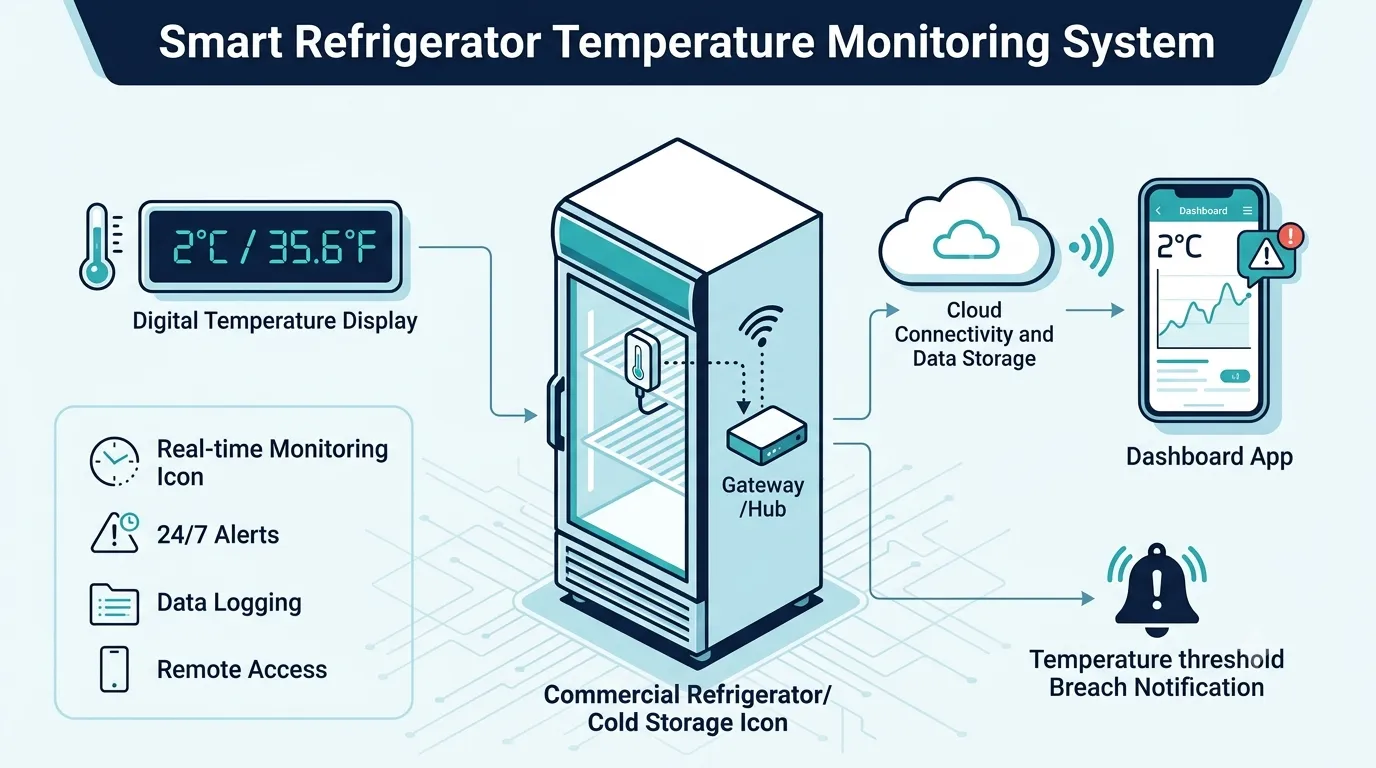

Maintaining the right temperature is essential for protecting temperature-sensitive products, reducing spoilage, and maintaining product quality. In Saudi Arabia, where high ambient temperatures can place additional pressure on refrigeration equipment, businesses need reliable and continuous monitoring rather than depending only on manual temperature checks.
A Refrigerator Temperature Monitoring System provides real-time visibility into refrigerator conditions through sensors, wireless connectivity, cloud-based dashboards, alerts, and historical temperature records. It can help organizations identify temperature deviations quickly and take corrective action before products are damaged.
Saudi Food and Drug Authority (SFDA) guidance emphasizes temperature monitoring for temperature-controlled storage, including refrigerators and freezers used for temperature-sensitive products. Its guidance also highlights accurate sensors, calibration, appropriate sensor positioning, and continuous or frequent monitoring.
What Is a Refrigerator Temperature Monitoring System?
A Refrigerator Temperature Monitoring System is a digital solution designed to continuously measure, record, and monitor the temperature inside refrigerators, medical refrigerators, freezers, cold rooms, and other temperature-controlled environments.
The system generally consists of:
- Temperature sensors
- Wireless communication devices
- Cloud-based monitoring software
- Mobile and web dashboards
- Automated temperature alerts
- Historical data storage
- Reports and analytics
- Notification systems
Instead of relying on employees to manually check a thermometer, the system automatically collects temperature readings at predefined intervals. If the temperature moves outside the configured range, authorized users can receive an immediate notification.
This makes real-time temperature monitoring particularly valuable for facilities where temperature excursions can result in product loss, safety concerns, or compliance issues.
Why Refrigerator Temperature Monitoring Is Important in Saudi Arabia
Saudi Arabia's climate presents unique challenges for refrigeration and cold-chain operations. High outdoor temperatures can increase cooling loads, while power interruptions, equipment failures, frequent door opening, poor sealing, and overloaded refrigerators can cause internal temperatures to fluctuate.
A refrigerator may appear to be functioning normally while experiencing temperature variations that are not immediately visible to staff.
A smart refrigerator monitoring system helps address this problem by providing continuous visibility.
For example, if a refrigerator storing temperature-sensitive products experiences a compressor failure during the night, a manual checking process may not detect the problem until the following morning. With automated monitoring, the system can identify the temperature rise and generate an alert much earlier.
This enables staff to investigate issues such as:
- Refrigerator malfunction
- Power failure
- Door left open
- Excessive temperature rise
- Excessive cooling
- Sensor failure
- Communication failure
- Unexpected temperature fluctuations
How a Refrigerator Temperature Monitoring System Works
1. Temperature Sensors Collect Data
A high-accuracy sensor is installed inside the refrigerator at an appropriate monitoring location. The sensor continuously measures the internal temperature.
For regulated or temperature-sensitive applications, sensor accuracy and calibration are important considerations. SFDA guidance for temperature-controlled storage specifies electronic monitoring sensors with accuracy of ±0.5°C or better for relevant applications.
2. Data Is Transmitted Automatically
Temperature readings are transmitted through an appropriate communication technology to a monitoring platform. Depending on the facility and system architecture, connectivity may use Wi-Fi, cellular, Ethernet, LoRaWAN, or other IoT technologies.
3. Data Is Stored in the Monitoring Platform
The system stores temperature information so authorized users can review current conditions as well as historical trends.
This creates a useful digital temperature record instead of relying entirely on handwritten logs.
4. Alerts Are Generated
If the temperature exceeds a predefined threshold, the system can generate an automated alert.
Notifications can be configured for different conditions, including:
- High-temperature alerts
- Low-temperature alerts
- Power failure alerts
- Sensor malfunction alerts
- Communication failure alerts
- Door-open alerts
5. Users Take Corrective Action
Once an alert is received, staff can investigate the refrigerator, check the equipment, move affected products if necessary, and document the corrective action.
This converts temperature monitoring from a reactive manual process into a proactive cold chain monitoring system.
Key Benefits of Refrigerator Temperature Monitoring
Real-Time Temperature Visibility
One of the biggest advantages is the ability to see refrigerator conditions in real time. Facility managers do not have to be physically present next to the refrigerator to know whether it is operating within the required range.
A centralized dashboard can provide visibility across multiple refrigerators, branches, laboratories, pharmacies, warehouses, or healthcare facilities.
Automated Temperature Alerts
Automated alerts help reduce the risk of unnoticed temperature excursions.
For example, if a refrigerator normally operates within a defined range and the temperature begins to rise unexpectedly, the system can notify responsible personnel immediately.
Early notification can provide valuable time to investigate the problem and protect temperature-sensitive inventory.
24/7 Monitoring
Manual checks are limited by working hours and staff availability. An IoT temperature monitoring system can operate continuously, including nights, weekends, and holidays.
This is particularly important for refrigerators containing vaccines, medicines, laboratory materials, biological samples, and other high-value products.
Historical Temperature Records
Temperature history can help organizations identify recurring problems.
For example, temperature graphs may reveal that a refrigerator experiences repeated increases every afternoon. Further investigation might identify frequent door opening, excessive loading, inadequate ventilation, or equipment performance issues.
Historical records also provide useful documentation for audits, quality management, and internal reviews.
Reduced Product Loss
Temperature excursions can result in spoiled food, compromised medicines, damaged laboratory materials, and financial losses.
Continuous monitoring helps organizations identify problems earlier, allowing them to respond before a minor equipment issue becomes a major inventory loss.
Better Operational Efficiency
Automated monitoring reduces the amount of manual work involved in recording temperatures.
Instead of employees repeatedly writing readings into logbooks, the system automatically collects and stores the information, allowing staff to focus on more important operational activities.
Applications Across Saudi Arabia
A Refrigerator Temperature Monitoring System in Saudi Arabia can be used across many industries.
Hospitals and Healthcare Facilities
Hospitals use temperature-controlled refrigerators for medicines, vaccines, laboratory materials, and other sensitive products.
Continuous monitoring can provide healthcare teams with visibility into refrigerator conditions and help identify temperature deviations quickly.
Pharmacies
Pharmacies may store temperature-sensitive medicines that require controlled storage conditions. A digital monitoring solution can continuously track refrigerator temperatures and generate alerts when readings move outside configured limits.
Laboratories
Laboratories may need to protect reagents, diagnostic materials, samples, and other temperature-sensitive products. Automated monitoring provides an electronic record of storage conditions.
Blood Banks
Blood and blood-related products require carefully controlled storage conditions. Temperature monitoring can provide continuous visibility and help personnel respond quickly to abnormal conditions.
Food and Hospitality
Restaurants, supermarkets, hotels, catering companies, food warehouses, and food-processing facilities can use food temperature monitoring to help maintain appropriate refrigeration conditions.
SFDA food-safety guidance states that refrigerated food should be maintained at 5°C, while frozen food should be maintained at -18°C.
Pharmaceutical Warehouses
Large pharmaceutical storage facilities can deploy multiple sensors across refrigerators, freezers, cold rooms, and controlled storage environments.
The system can provide centralized monitoring and temperature reports across different storage locations.
Supporting Cold Chain Management
A reliable cold chain monitoring system is not limited to one refrigerator. It can become part of a broader temperature-controlled supply chain.
The cold chain can involve:
Manufacturer → Transportation → Warehouse → Distribution Center → Pharmacy/Hospital → Refrigerator
At every stage, temperature conditions can influence product quality.
SFDA states that certain products—including medical IVDs, chilled and frozen foods, and products requiring specific transportation or storage temperatures—may require temperature indicators or data loggers.
This highlights the importance of maintaining traceable temperature information throughout temperature-sensitive operations.
Data Analytics and Temperature Trends
Modern monitoring platforms can do more than display a current temperature.
Temperature data can be presented through graphs and reports to help organizations understand refrigerator performance.
For example, a dashboard might show:
- Current temperature
- Minimum temperature
- Maximum temperature
- Average temperature
- Temperature deviation
- Duration of excursion
- Historical trends
- Alert history
This information can help facility managers identify abnormal patterns and improve preventive maintenance.
Importance of Calibration and Sensor Placement
Installing a sensor is only one part of an effective monitoring strategy.
Sensor placement can significantly influence the quality of temperature data. SFDA guidance recommends positioning monitoring sensors in areas where greater temperature variability is expected and considering temperature mapping when determining appropriate locations.
Sensors should also be appropriately calibrated according to the requirements of the application.
For organizations handling regulated or highly sensitive products, maintaining reliable monitoring equipment and documented records is an important part of quality management.
Power Failure and Connectivity Monitoring
Power failure is another important consideration in Saudi Arabian refrigeration environments.
If a refrigerator loses power, the internal temperature may begin rising. A monitoring solution with power-failure detection can notify responsible personnel so they can respond quickly.
Similarly, communication monitoring can help identify when a sensor or gateway stops transmitting data.
A comprehensive system should therefore monitor not only temperature but also the health of the monitoring infrastructure itself.
Choosing the Right Refrigerator Monitoring Solution
Organizations should consider several factors before implementing a wireless temperature monitoring system.
Important considerations include:
- Sensor accuracy – Sensors should meet the accuracy requirements of the application.
- Calibration – The solution should support appropriate calibration procedures.
- Real-time alerts – Notifications should be delivered quickly when temperature limits are exceeded.
- Data logging – Temperature history should be securely recorded.
- Cloud accessibility – Authorized users should be able to monitor systems remotely.
- Scalability – The platform should support additional refrigerators and locations.
- Reporting – Users should be able to generate useful temperature reports.
- Backup and reliability – Monitoring should remain dependable during unexpected events.
- User management – Different personnel should be able to receive appropriate alerts and access.
- Integration – The system should be capable of integrating with broader IoT or facility-management environments where required.
Conclusion
A Refrigerator Temperature Monitoring System in Saudi Arabia provides organizations with a smarter and more reliable approach to protecting temperature-sensitive products. By combining accurate sensors, real-time monitoring, automated alerts, cloud-based dashboards, historical records, and data analytics, businesses can move beyond manual temperature checks toward continuous cold-storage visibility.
For hospitals, pharmacies, laboratories, blood banks, pharmaceutical warehouses, supermarkets, restaurants, hotels, and food-storage facilities, continuous temperature monitoring can help reduce product losses, improve operational efficiency, strengthen documentation, and support cold-chain management.
As temperature-sensitive operations become increasingly dependent on reliable digital infrastructure, IoT temperature monitoring, automated alerts, and centralized data management can play an important role in maintaining controlled storage conditions across Saudi Arabia.
5 Frequently Asked Questions
1. What is a Refrigerator Temperature Monitoring System?
A Refrigerator Temperature Monitoring System uses digital sensors and monitoring software to continuously measure refrigerator temperature, store historical readings, and notify users when temperature conditions exceed configured limits.
2. Why is temperature monitoring important for refrigerators in Saudi Arabia?
High ambient temperatures, equipment failures, power interruptions, and frequent door opening can affect refrigeration performance. Continuous monitoring helps organizations detect temperature deviations quickly and take corrective action.
3. Can the system send alerts when refrigerator temperature increases?
Yes. Modern remote refrigerator monitoring systems can generate alerts when temperature rises above or falls below predefined thresholds. Depending on the platform, notifications may be delivered through mobile, email, SMS, or dashboard alerts.
4. Which industries can use refrigerator temperature monitoring?
The technology can be used in hospitals, pharmacies, laboratories, blood banks, pharmaceutical warehouses, supermarkets, restaurants, hotels, catering businesses, food-storage facilities, and other organizations handling temperature-sensitive products.
5. Can temperature data be stored for reporting and audits?
Yes. A digital monitoring platform can store historical temperature readings and provide graphs, reports, alert histories, and other records. This can help organizations review temperature performance and maintain documented evidence of storage conditions. SFDA guidance also emphasizes maintaining temperature records for temperature-controlled products and making records accessible for review.






























Sign in to leave a comment.