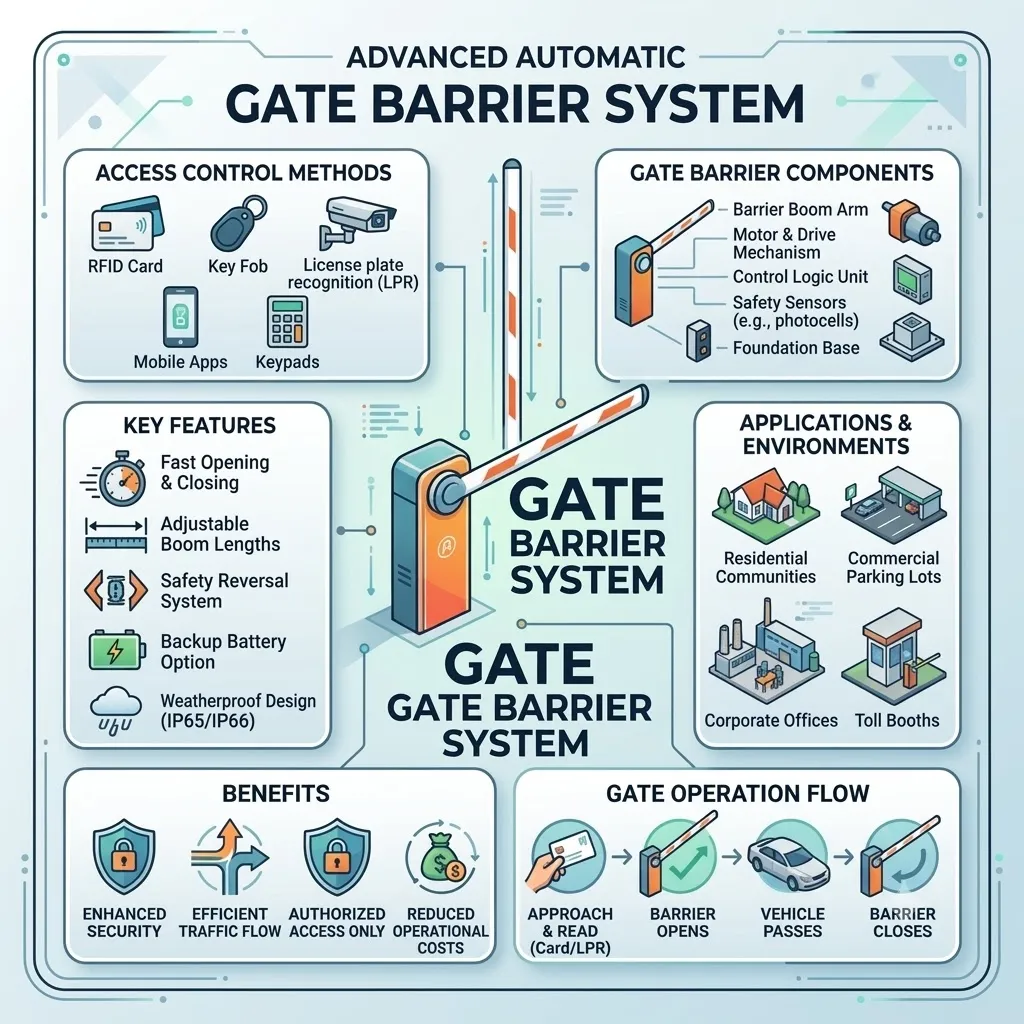

A dependable Gate Barrier System is now considered essential infrastructure for any Saudi facility that manages vehicle traffic, from corporate campuses and government compounds to parking structures and industrial plants. As the Kingdom's cities and giga-projects expand under Vision 2030, security teams are replacing manual boom gates and guard-operated checkpoints with automated, credential-based vehicle control that verifies every entry without slowing traffic flow. This guide breaks down every major barrier type, where each performs best, and what to evaluate before selecting a supplier.

Why Vehicle Perimeter Security Is a Growing Priority in Saudi Arabia
Rapid urban expansion, new business districts, and giga-projects such as NEOM and the Red Sea developments have significantly increased vehicle traffic at facility entrances across Saudi Arabia. Manual guard-operated gates struggle to keep pace with peak-hour surges at office parks, shopping malls, and industrial zones, creating both congestion and security gaps when guards are overwhelmed or distracted. Facility owners are now prioritising automated vehicle entry systems that can verify a driver's credentials in seconds, log every vehicle movement, and integrate directly with broader site security platforms — reducing dependence on large manual guard rosters while improving both throughput and accountability at every entry point.
What Is a Gate Barrier System and How Does It Work?
A Gate Barrier System combines a motorised physical barrier — typically a boom arm, sliding gate, or rising bollard — with a credential-reading mechanism and a control unit that decides whether to grant passage. When an approaching vehicle presents a valid credential, such as an RFID tag, access card, mobile app signal, or recognised license plate, the control unit verifies it against the permissions database and raises or opens the barrier automatically. Loop detectors embedded in the road surface confirm the vehicle has fully passed before the barrier closes again, preventing tailgating by a second, unauthorised vehicle. The entire sequence typically completes in one to three seconds, allowing continuous traffic flow without a human operator at the gate.
Boom Barrier System: The Core of Vehicle Entry Control
Boom Barrier System installations remain the most widely deployed vehicle control mechanism because of their proven reliability, fast cycle times, and relatively low installation cost compared to sliding or swing gates. A motorised arm pivots upward to grant passage and returns to the closed position within seconds, making it well suited to high-frequency entry points such as staff parking, logistics yards, and toll-style checkpoints. Available in straight, folding, and skirted arm configurations, boom barriers can be adapted to different lane widths and security requirements, while heavy-duty models rated for continuous-duty cycles are commonly specified for facilities with round-the-clock vehicle traffic, such as ports, industrial parks, and distribution centres across the Eastern Province.
Entry Point Barriers for Facilities, Campuses and Government Sites
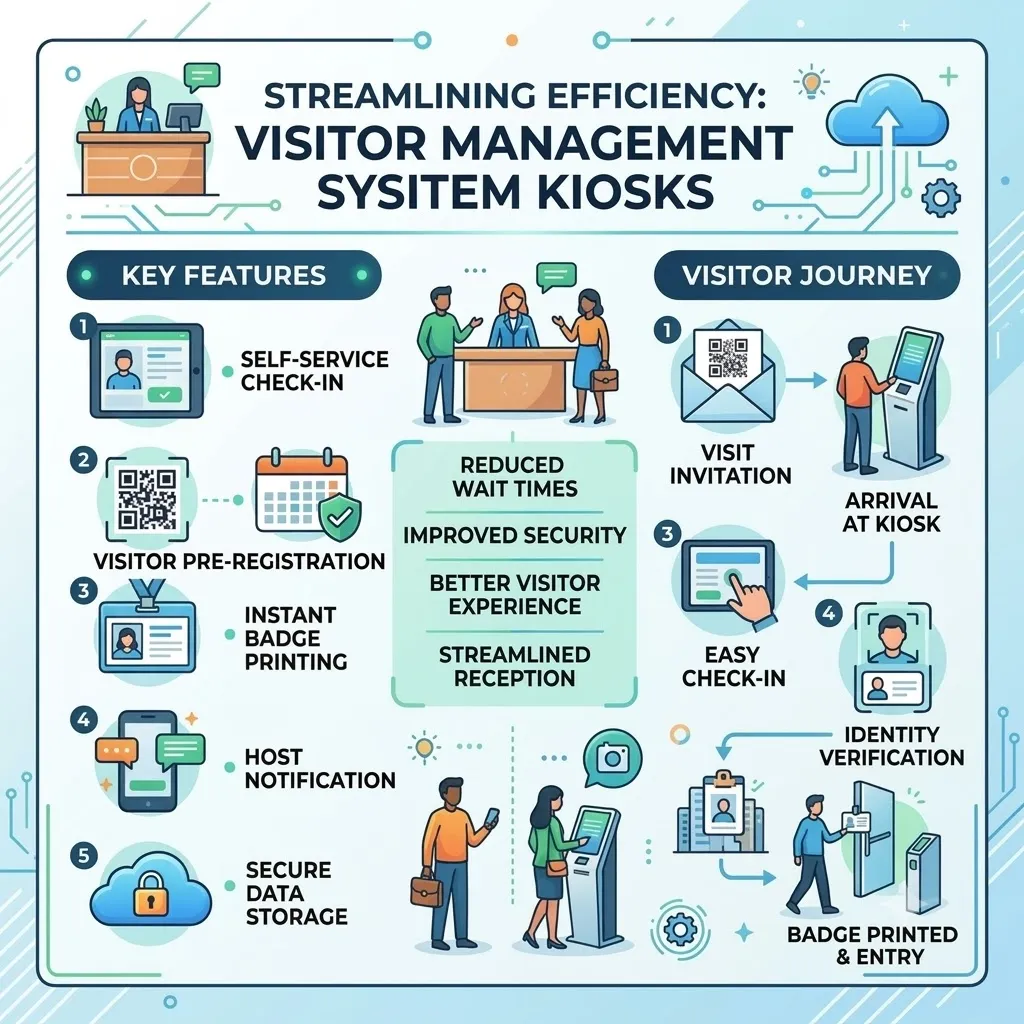
Entry Point Barriers are configured differently depending on the sensitivity of the site they protect. Government compounds and critical infrastructure typically deploy a layered approach — a perimeter boom barrier for initial screening, followed by a secondary crash-rated barrier or bollard system closer to the building for higher-assurance sites. Corporate campuses and educational institutions generally favour a single, well-integrated barrier paired with visitor-management software, allowing pre-registered guests to be granted temporary access codes ahead of arrival. In every case, the goal is the same: create a controlled, auditable checkpoint that verifies every vehicle before it reaches sensitive areas, without creating unnecessary congestion during peak arrival and departure periods.
Parking Access Barriers for Malls, Offices and Residential Compounds
Parking Access Barriers are optimised for a different priority than perimeter security — smooth, high-volume vehicle flow at malls, office towers, and residential compounds where hundreds or thousands of vehicles may enter and exit within a short window. These systems are frequently paired with automated ticketing, pay-on-foot kiosks, or subscription-based RFID tags for residents and staff, along with real-time occupancy counters that direct drivers to available spaces via digital signage. In mixed-use developments increasingly common across Riyadh and Jeddah, integrating parking barriers with mobile apps allows residents and shoppers to pre-book spaces or pay seamlessly, reducing queue times at exit lanes during peak shopping or commuting hours.
Vehicle Access Control: Integrating Barriers with Smart Software
Vehicle Access Control software is what transforms a standalone barrier into an intelligent, policy-driven security layer. Rather than manually programming each gate individually, administrators manage permissions, schedules, and blacklists from a centralised dashboard that can span multiple sites and hundreds of registered vehicles. This software layer also generates the detailed entry and exit logs that facility managers, auditors, and law-enforcement agencies may require during an investigation, while supporting rule-based restrictions such as limiting delivery-vehicle access to specific hours or blocking a flagged license plate across an entire portfolio of properties in a single update.
Automatic Road Barrier for High-Traffic Roads and Checkpoints
Designed for continuous, high-volume operation, an Automatic Road Barrier is engineered for demanding environments such as toll plazas, port entrances, and major checkpoint roads where thousands of vehicle movements occur daily. These heavy-duty barriers typically feature reinforced arms, industrial-grade motors rated for tens of thousands of cycles per month, and integrated safety sensors that detect obstructions and reverse the arm instantly to prevent vehicle or pedestrian collision. Their robust construction and rapid cycle speed make them the standard choice for any Saudi facility where downtime or gate failure would create significant traffic disruption or safety risk.
RFID Barrier System for Seamless Credential-Based Entry
RFID Barrier System technology allows registered vehicles to pass through a checkpoint without stopping, using a windshield-mounted tag that communicates wirelessly with a reader as the vehicle approaches. This hands-free approach significantly reduces queuing at staff and resident entrances compared to card-insertion or keypad-based systems, while still producing a precise, timestamped log of every vehicle movement. RFID-based access is particularly popular for large residential compounds, university campuses, and industrial parks across Saudi Arabia, where hundreds of regular commuters benefit from a fast, contactless daily entry experience.
LPR Boom Barrier: License Plate Recognition for Touchless Access
An LPR Boom Barrier uses a camera and optical character recognition software to read a vehicle's license plate automatically, matching it against an authorised list without requiring the driver to carry any physical credential at all. This makes it ideal for facilities managing large volumes of both regular staff and occasional visitors, since visitor plates can be pre-registered ahead of arrival and automatically expired after a set date. LPR-based barriers also generate a valuable security dataset — a searchable record of every vehicle that has entered a site — which is increasingly requested by government and enterprise security teams for incident investigation and compliance reporting.
Security Gate Barrier System Across Saudi Industries
A well-specified Security Gate Barrier System is tailored to the specific risk profile of each sector. Oil and gas facilities pair barriers with LPR and guard verification for high-assurance perimeter control. Logistics and warehousing operators use RFID and LPR combinations to speed up truck turnaround times while maintaining a full audit trail. Residential compounds prioritise resident convenience through RFID tags and mobile app integration. Government and diplomatic facilities typically deploy crash-rated barriers alongside credential verification for maximum assurance. Organisations comparing a complete range of gate, barrier, and turnstile solutions for Saudi facilities can evaluate boom, sliding, RFID, and LPR options together before specifying the right combination for a multi-entrance site.
Gate Barrier System KSA — National Infrastructure and Vision 2030
Gate Barrier System KSA deployments are expanding alongside national infrastructure programmes tied to Vision 2030, including new industrial cities, logistics corridors, and giga-projects such as NEOM and the Red Sea developments. Ports, airports, and major industrial zones across the Eastern Province are increasingly specifying automated, LPR-enabled vehicle control as standard infrastructure rather than an optional upgrade, reflecting the Kingdom's broader push toward smart, data-driven perimeter security across both public and private sector facilities.
Gate Barrier System Riyadh — Smart City Vehicle Control
As Riyadh's business districts, government ministries, and residential compounds continue to expand, Gate Barrier System Riyadh installations are concentrated at corporate headquarters, luxury residential communities, and major mixed-use developments across the capital. The city's rapid growth as a global business hub has placed a premium on vehicle entry systems that combine fast, contactless throughput with strong audit capability, making RFID and LPR-based barriers increasingly standard specifications for Riyadh's newest commercial and residential developments.
Standards, Safety, and Compliance for Barrier Deployments
Vehicle barrier installations in Saudi Arabia must meet both mechanical safety standards and site-specific security requirements. Obstruction-detection sensors that reverse the barrier arm instantly on contact are a baseline safety requirement, as is battery backup to maintain operation during power interruptions. For crash-rated barriers protecting government or high-security sites, compliance with recognised international impact-rating standards is essential to confirm the barrier can withstand a vehicle-ramming attempt at a specified speed and weight. Facilities integrating LPR or RFID credential databases should also ensure data-retention and access policies align with the Kingdom's Personal Data Protection Law, particularly where vehicle logs may include visitor or third-party information.
The Technology Stack Behind Modern Barrier Systems
A complete deployment typically combines several layers: the mechanical barrier or gate hardware itself, a credential-reading mechanism — RFID, LPR camera, or mobile signal — a control unit that processes access decisions in real time, and access-control software that manages permissions, schedules, and reporting across a site or portfolio of properties. Ground loop detectors and infrared safety sensors prevent tailgating and obstruction incidents, while integration middleware connects the barrier to visitor-management platforms, parking-payment systems, and central security operations centres. Together, these layers turn a simple mechanical gate into an intelligent, self-auditing vehicle checkpoint capable of enforcing complex access policies with minimal manual intervention.
Return on Investment: Why Facility Owners Are Automating Vehicle Entry
The business case for automated vehicle barriers is straightforward. Reducing dependence on manual gate attendants at every vehicle entrance delivers measurable labour savings, particularly across facilities operating multiple shifts or several entry points. Faster, contactless throughput reduces queuing-related delays during peak arrival and departure periods, while the automated digital log cuts the time security teams spend manually reconciling vehicle movement records after an incident. For large sites managing dozens of daily vehicle movements — such as logistics parks, residential compounds, or corporate campuses — the combined savings in labour, reduced congestion, and improved incident-investigation speed typically deliver a strong return within a short operating horizon.
Why Choose an Experienced Gate Barrier Partner in Saudi Arabia?
Vehicle entry control is a long-term infrastructure investment, so vendor track record matters as much as hardware specification. Look for a provider with documented deployments across government, commercial, and industrial sites in the Kingdom, engineers experienced in both mechanical barrier integration and LPR software configuration, and transparent documentation covering cycle ratings, durability, and warranty terms. Providers offering a full portfolio of gate barriers and access control systems for Saudi projects bring practical regional experience — including familiarity with local climate durability requirements, Arabic-language control panels, and Civil Defense documentation — that generic international suppliers often lack. Before committing, request site references, ask for a live demonstration of LPR accuracy under regional lighting conditions, and confirm obstruction-detection and fail-safe behaviour are certified and tested.
Getting Started: What a Typical Deployment Journey Looks Like
Most organisations follow a similar rollout sequence: a site survey to map vehicle entry points, expected daily traffic volume, and lane widths, followed by selection of barrier types matched to each location's throughput and security requirements. Installation is followed by integration with existing access-control software, visitor-management platforms, and parking-payment systems where applicable, along with staff training on managing exceptions, visitor pre-registration, and emergency override procedures. After go-live, periodic maintenance checks, sensor recalibration, and firmware updates keep the system performing reliably as traffic patterns and site conditions evolve over time.
Conclusion
Gate Barrier System technology has become essential infrastructure for any Saudi facility managing vehicle traffic and perimeter security. From a dependable Boom Barrier System and well-placed Entry Point Barriers to convenient Parking Access Barriers, every environment now has a matching solution. Pairing these with smart Vehicle Access Control software, a heavy-duty Automatic Road Barrier, contactless RFID Barrier System credentials, or an LPR Boom Barrier delivers both speed and accountability at scale. As Gate Barrier System KSA and Gate Barrier System Riyadh adoption accelerates under Vision 2030, a properly specified Security Gate Barrier System gives organisations a lasting operational and safety advantage.
Boom Barrier System
Entry Point Barriers
Parking Access Barriers
Vehicle Access Control

























Sign in to leave a comment.