

A few years back, if you wanted to train a half-decent model in India, your options were painfully thin. You either begged a friend with a gaming rig for spare compute, maxed out Google Colab's free tier and prayed the session didn't disconnect at 2 a.m., or you swiped a card for an AWS instance priced in dollars, billed in rupees, and taxed in ways that made your finance professor wince.
That's changed. GPU cloud platforms built specifically for the Indian market have started showing up, and renting a GPU today is closer to booking a cab than provisioning enterprise infrastructure. But "closer to" isn't the same as "actually simple," and there's still a lot of noise to cut through if you're a student, an indie developer, or a startup trying to figure out where to run your next training job.
This piece breaks down what GPU cloud in India actually looks like right now, what to check before you rent a GPU, and where the market is genuinely improving.
What Do People Actually Mean by "GPU Cloud"?
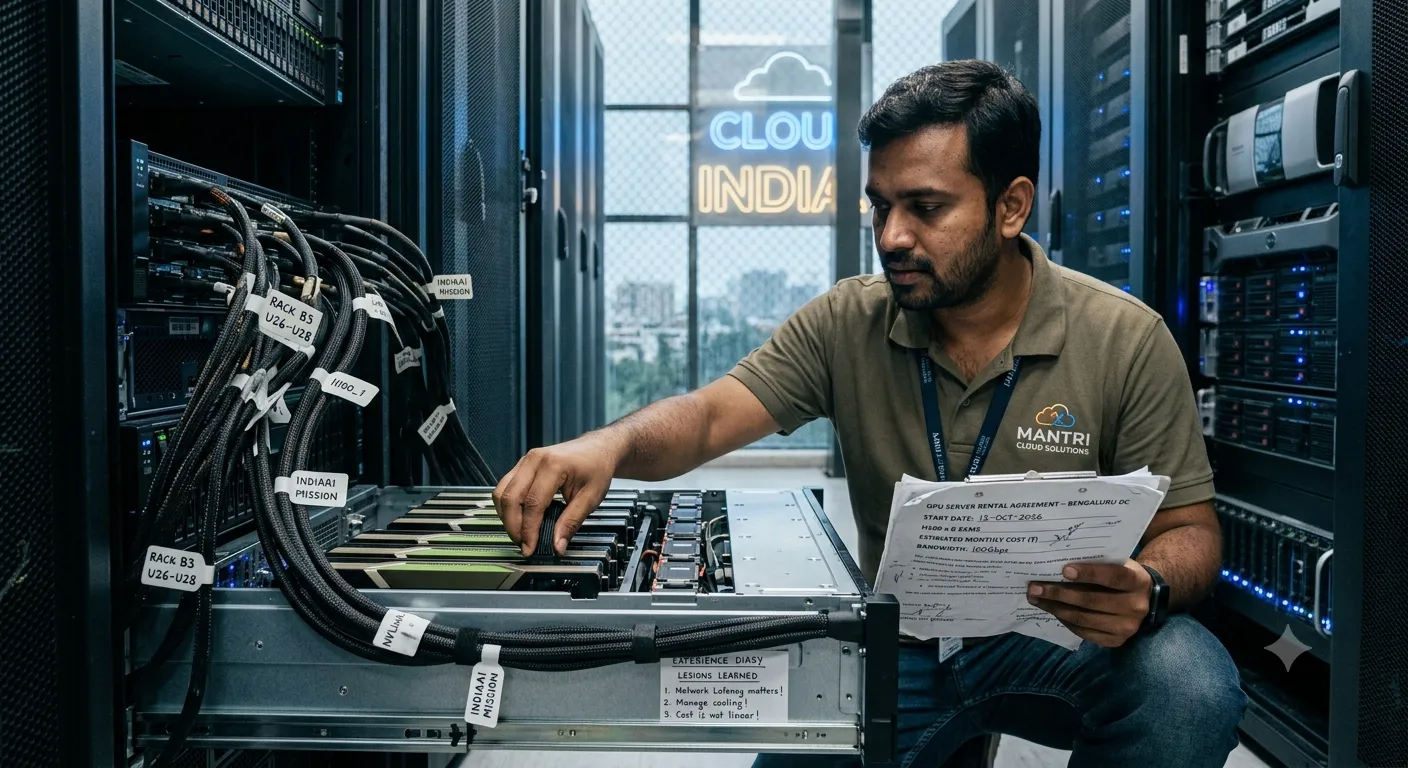
Strip away the marketing language and a GPU cloud is just a data center's worth of graphics cards that you can rent by the hour instead of buying outright. Instead of dropping ₹2-3 lakh on an RTX 4090 or waiting months for an H100 allocation from a hyperscale, you spin up access to that hardware remotely, run your workload, and shut it down when you're done. You pay for compute the way you pay for electricity by usage, not by ownership.
For anyone doing deep learning, fine-tuning LLMs, running diffusion models, or just getting through a computer vision course project, this on-demand model is the difference between "I have an idea" and "I shipped something."
Why "Rent GPUs" Searches Are Spiking in India
A few forces are colliding at once:
- AI education has exploded. Every second engineering student in India is now touching PyTorch or a Hugging Face notebook at some point in their degree, and coursework has outgrown what a free Colab tier or a laptop GPU can handle.
- Global cloud pricing doesn't map cleanly to Indian budgets. Dollar-denominated billing, unpredictable forex swings, and a lack of GST-compliant invoicing make AWS, GCP, and Azure a headache for students and small teams trying to expense compute properly.
- Startups are compute-constrained, not idea-constrained. Plenty of early-stage AI teams in India have a working prototype and a waitlist of users, but no realistic path to affordable, scalable GPU access without burning runway on infrastructure they don't fully need yet.
Put those together, and "rent GPU India" has gone from a niche search to something entire cohorts of builders are typing into Google every week.
What Actually Matters When You Rent a GPU
Not all GPU rental is created equal. Before you hand over your card details, it's worth checking for a few things that separate a genuinely useful platform from one that'll cost you more time than it saves:
- INR pricing with no forex surprises. If your invoice is quoted in dollars and settled at whatever exchange rate your bank feels like charging that day, your actual cost is a moving target.
- GST-compliant billing. Anyone running this as a business expense — a startup, a freelance ML consultant, an agency needs proper invoices, not a PayPal receipt that an accountant will reject.
- Data residency and latency. A GPU sitting in a data center closer to India means lower latency for interactive workloads and, for some use cases, better compliance with data handling expectations.
- Real hourly transparency. Hidden egress fees, storage charges, or minimum commitment tiers can turn a "cheap" GPU into an expensive mistake by month-end.
- Actual GPU choice. Not every workload needs an H200. A student fine-tuning a small model on an L4 is solving a very different problem than a startup training a large model on H100s or H200s, and a platform that only offers one tier isn't built for the full range of Indian builders.
Where Race Engineering Fits In
This is exactly the gap Race Engineering has been built around a GPU cloud platform designed for the Indian AI builder from the ground up, rather than a global platform with India bolted on as an afterthought.
The pitch is straightforward: rent GPUs from L4s for lighter workloads up to H200s for serious training runs with pricing quoted in INR, GST-compliant invoicing that won't get flagged by your accountant, and infrastructure positioned for lower latency within India. For students working through coursework or a side project, and for early-stage teams that need to move fast without over-committing budget, that combination removes most of the friction that used to make "just rent a GPU" easier said than done.
It's a fitting name for a GPU platform, too motorsport engineering has always been about extracting maximum performance from tightly constrained resources, which is precisely the problem every AI builder on a budget is trying to solve.
How to Actually Rent a GPU (Without Overpaying)
If you're renting for the first time, the process is less intimidating than it sounds:
- Define the workload first. Are you fine-tuning a small model, running inference, or training from scratch? This determines whether you need an L4-class card or something heavier like an H100 or H200.
- Compare hourly rates in INR, not dollars. Convert everything to a like-for-like rupee cost before deciding a platform that looks cheaper in USD can end up pricier after conversion fees.
- Check for GST invoicing upfront. Don't find out after your first billing cycle that you can't expense it properly.
- Start small. Spin up the smallest instance that fits your job, benchmark it, and scale up only if you actually hit a bottleneck. Most student and early-stage workloads are less GPU-hungry than people assume.
- Shut it down when you're done. The single biggest way people overspend on GPU cloud is forgetting an instance is still running. Treat it like a meter running in a taxi.
Who This Actually Helps
- Engineering and CS students working on thesis projects, hackathons, or coursework that outgrew Collab's free tier.
- Indie ML developers and researchers who want to experiment without a long-term hardware commitment.
- Early-stage AI startups that need to move from prototype to product without sinking their seed round into owned infrastructure.
- Freelancers and small agencies delivering AI-powered work for clients and needing clean, expansible invoices.
A Few Quick Answers
Is renting a GPU cheaper than buying one in India?
For almost anyone who isn't running GPUs 24/7 year-round, yes. Buying a high-end GPU means a large upfront cost, depreciation, power draw, and maintenance. Renting converts that into a predictable, usage-based expense.
Do I need to know DevOps to rent a GPU cloud instance?
Not really. Most modern platforms are built for a browser-based or SSH-based workflow that a student or solo developer can get running within minutes, not a week of infrastructure setup.
What GPU should a beginner start with?
For most coursework, small fine-tuning jobs, or inference tasks, an L4-class GPU is more than enough. Save the H100s and H200s for larger training runs once you actually need that scale.
The Bottom Line
The GPU cloud market in India has moved past the "make do with whatever's available" phase. Builders now have real, India-first options that handle pricing, billing, and latency the way they should have from the start. If you're evaluating where to rent your next GPU, it's worth putting a platform like Race Engineering on your shortlist built specifically for the constraints, and the ambitions, of AI builders in India.


























Sign in to leave a comment.