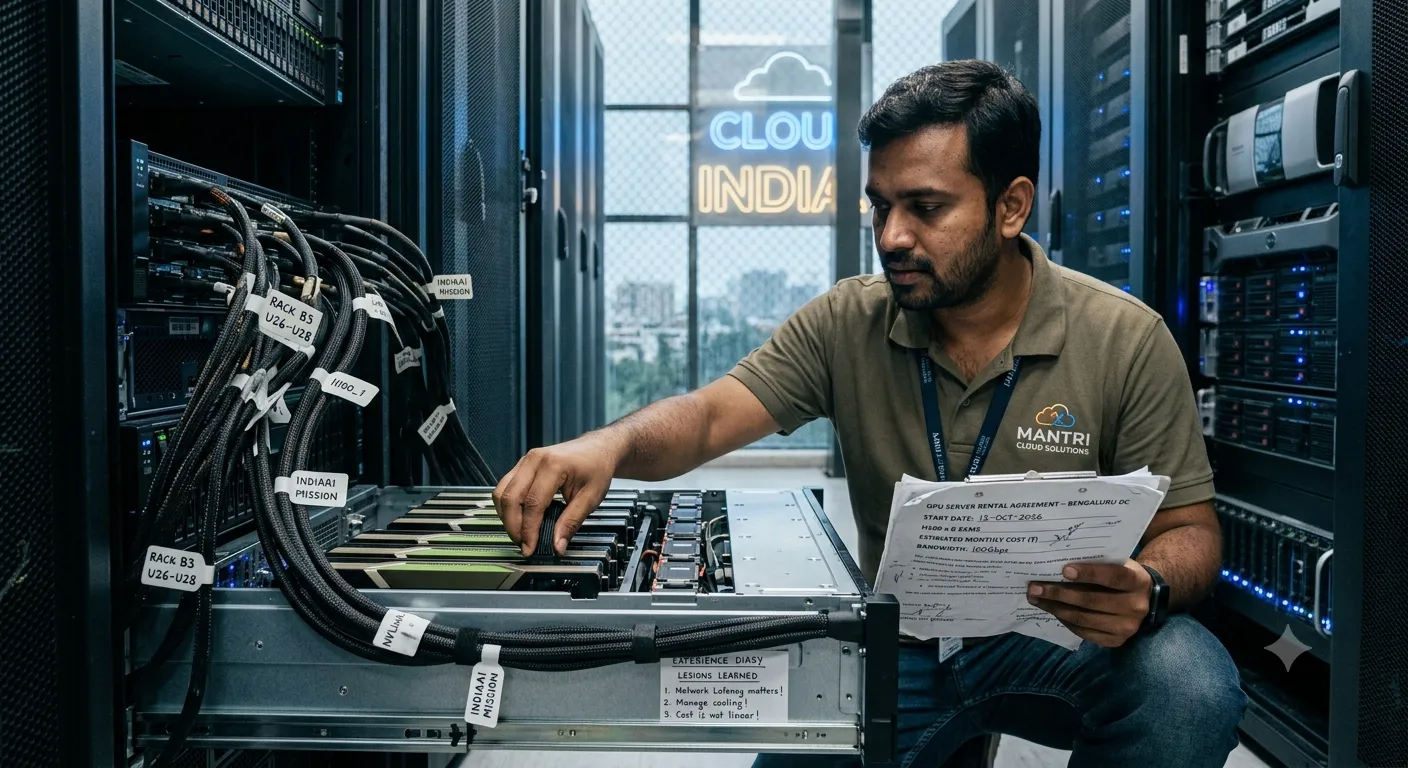

Renting a GPU server was the last thing on my mind until a friend running a small computer vision startup asked me a simple question: "Should I buy hardware, or is it smarter to rent?" I didn't have a clean answer for him on the spot, so I actually went and dug into it properly talked to a couple of people who'd done both, compared numbers, and tested a GPU server setup myself.
Buying a GPU Sounds Great Until You Do the Math
On paper, owning hardware feels like the responsible choice. No recurring bills, full control, nothing to argue about. But once you price out an A100 GPU the card most serious AI teams still reach for the math stops being simple.
A single A100 can run you well into six figures in Indian rupees, before you've even accounted for:
- A machine capable of actually housing and cooling it
- Power draw (these things are not light on electricity)
- Physical space, maintenance, and the eventual hardware failure
- The fact that in 18 months, there's a good chance something faster has replaced it
For a startup, or honestly for most established teams doing variable workloads, that's a lot of capital tied up in something that depreciates the moment you plug it in.
So I Looked Into Renting a Gpu Server Instead
This is where things got interesting. Renting a GPU server flips the entire equation you pay for compute when you need it, and you stop paying the moment you don't. For a training run that takes three days, you're billed for three days, not for owning a card that sits idle the other 362.
The other thing nobody mentions until you've tried it: provisioning time. Buying hardware means procurement delays, import considerations if you're sourcing internationally, and setup time. Renting a server, by contrast, took less than an hour from signup to having a usable instance in the test I ran.
Why A100 GPU Specifically Still Matters
It would be easy to assume everyone's chasing the newest chip, but the A100 GPU remains a genuinely solid choice for a large chunk of real-world work and here's why that matters if you're deciding what to rent.
The A100 hits a sweet spot: 40GB or 80GB memory configurations, strong performance on both training and inference, and because it's been around longer significantly better availability and lower hourly pricing than the newest generation cards. If your workload is:
- Fine-tuning mid-sized models
- Running batch inference jobs
- Doing data science work that needs serious parallel compute, not just cutting-edge benchmarks
then an A100 GPU server gets the job done without you paying a premium for headroom you won't use.
The Part That Actually Surprised Me: Doing This in India
I went into this assuming I'd end up renting from one of the big international clouds, paying in dollars, and dealing with data sitting on servers halfway across the world. That's still the default a lot of Indian developers reach for out of habit.
But it turns out the domestic GPU cloud options have gotten genuinely competitive. And there's a practical reason to care about that beyond patriotism: latency, INR billing (no currency conversion headache eating into your margins), and for anyone in fintech, healthcare, or handling regulated data actual data residency within the country.
I ended up testing an instance through Race Engineering, an India-based GPU cloud platform, mostly out of curiosity about whether a domestic provider could match what I'd get abroad. It did. Spinning up a server was straightforward, billing was in rupees, and I didn't have to explain to anyone why our training data was sitting on a server in another country.
What I'd Tell Anyone Asking the Same Question
If you're weighing whether to rent a GPU server or buy one outright, here's the honest, unglamorous answer: unless you have sustained, round-the-clock utilization that would make ownership pay for itself within a year or so, renting wins. It wins on cash flow, it wins on flexibility, and it wins on not being stuck with hardware that's outdated before your loan on it is paid off.
And if you're in India specifically, there's no real reason left to default to overseas providers just because that's what everyone did five years ago. The domestic options A100 GPU servers included have closed the gap.
My friend, for what it's worth, ended up renting. Six months in, he tells me it was the easiest infrastructure decision he's made for the business.
Frequently Asked Questions
Is it better to rent or buy a GPU server for my startup?
For most startups, renting a GPU server is the smarter choice. It provides flexibility and avoids the large upfront costs associated with purchasing hardware, especially if your workload varies. Renting also eliminates concerns about hardware depreciation and maintenance.
What are the costs associated with buying a GPU like the A100?
Buying an A100 GPU involves significant initial costs, often exceeding six figures in Indian rupees. You must also factor in expenses related to the necessary machine for housing and cooling, electricity usage, maintenance, and the risk of hardware becoming outdated within a couple of years.
How quickly can I set up a rented GPU server?
Setting up a rented GPU server can be remarkably quick—often taking less than an hour from signup to getting a usable instance. This is a significant advantage over purchasing, which can involve lengthy procurement and setup times.
Why is the A100 GPU still relevant for current workloads?
The A100 GPU remains a popular choice due to its solid performance in both training and inference tasks, along with configurations that cater to varied memory needs. Its lower hourly pricing and better availability compared to newer models make it ideal for many practical applications.
Are there advantages to using domestic GPU cloud providers in India?
Yes, domestic GPU cloud providers in India offer lower latency, billing in rupees, and compliance with data residency regulations, making them a practical choice for local businesses. These options have become competitive with international offerings, often providing similar or better service.
What should I consider before renting a GPU server?
Before renting a GPU server, consider your workload needs, budget, and the duration of usage. If you have variable workloads or do not require constant access, renting can be more cost-effective and flexible than owning hardware.
Can I trust domestic GPU cloud providers for sensitive data?
Yes, many domestic GPU cloud providers in India have established secure systems to handle sensitive data, especially in regulated industries like fintech and healthcare. Local providers can ensure your data remains within the country, addressing privacy and compliance concerns.


























Sign in to leave a comment.