Resolving Contradictory Stakeholder Feedback in Music Production: A Troubleshooting Guide for Creative Briefs and Song AI Generator Workflows


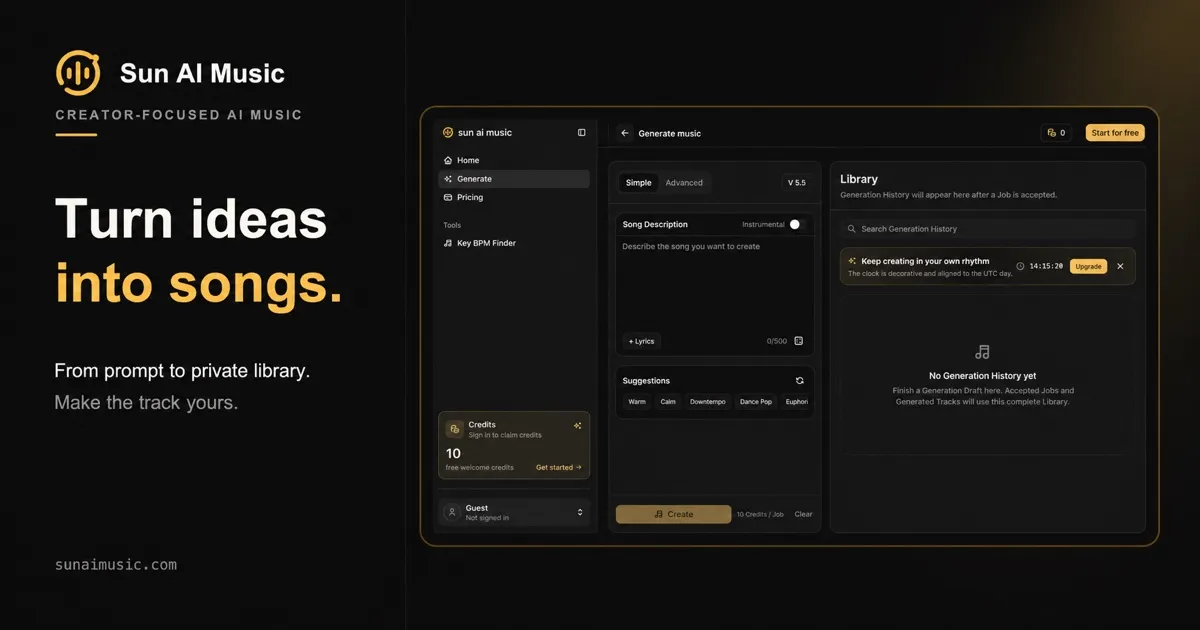
Creative teams frequently encounter a distinct point of breakdown when turning stakeholder notes into an executable musical direction: multiple reviewers submit conflicting revisions that cancel each other out. Marketing asks for high-tempo excitement, the product lead requests understated background ambience, and executive reviewers demand something bold yet universally safe. Expectations for rapid audio turnaround have intensified as browser-based audio production has matured, yet creative alignment often lags behind generation speed. When creative directors rely on an agile tool like sunaimusic.com/ to convert an initial lyric or musical concept into full vocal or instrumental tracks, feeding an unvetted, contradictory brief into a modern song ai generator produces disjointed musical variations rather than finished cues.
Distinguishing between a temporary creative hesitation and a definitive directional conflict is the first step toward recovery. A temporary hesitation occurs when a reviewer struggles with vocabulary, such as describing an acoustic guitar track as "too dry" when they actually mean it lacks stereo width or room reverb. In contrast, a definitive rejection stems from incompatible underlying goals, such as two decision-makers evaluating the same track against fundamentally opposed brand identities. Treating a fundamental misalignment as a simple mix note leads to compounding rounds of aimless adjustments.
Several independent layers of the review system produce identical visible symptoms. When a production draft is rejected as "not quite right," the root problem could be semantic confusion in the brief, unmoderated reviewer scope, lack of an approved audio anchor, or uncalibrated prompt inputs. Pinpointing where the review process broke down prevents creative teams from endlessly adjusting musical parameters when the real failure occurred during stakeholder intake.
Mapping Stakeholder Response Categories to Production Failure Classes
Unfiltered feedback rarely arrives organized by technical musical discipline. To diagnose where a production direction has collapsed, creative leads must categorize stakeholder remarks into distinct failure classes based on the layer of the project they actually affect.
Lexical Misalignment (The Vocabulary Failure)
- Observable Signal: Reviewers use subjective, non-musical adjectives such as "punchier," "more futuristic," or "expensive" to describe the same passage while disagreeing on whether the current draft meets the standard.
- Mechanism Behind the Failure: Non-musical stakeholders lack shared acoustic terminology. One reviewer equates "punchy" with transient drum compression, while another means brass-heavy syncopation.
- Corrective Action: Translate subjective terms into concrete musical properties: instrumentation, tempo (BPM), rhythmic density, vocal register, and dynamic range.
- Evidence to Retain: A shared glossary mapping stakeholder descriptors to specific reference frequencies, instruments, and rhythm patterns.
Competing Strategic Directives (The Governance Failure)
- Observable Signal: One stakeholder demands high-energy vocal hooks to capture short-form social attention, while a co-reviewer requests subdued instrumental textures to avoid clashing with a voiceover.
- Mechanism Behind the Failure: Project stakeholders are evaluating the track against separate, uncoordinated key performance indicators without a designated tiebreaker.
- Corrective Action: Pause generation and require project leadership to confirm primary channel hierarchy before adjusting musical elements.
- Evidence to Retain: The initial creative charter identifying the single authoritative business objective for the asset.
Reference Drift (The Anchor Failure)
- Observable Signal: Feedback praises an element from a discarded preliminary concept while rejecting the corresponding element in the current refined version.
- Mechanism Behind the Failure: Reviewers compare incoming generations against private mental models or shifting external playlists rather than the agreed project benchmark.
- Corrective Action: Re-anchor all critique to a single baseline reference track, evaluating changes strictly as deltas from that baseline.
- Evidence to Retain: Timestamped changelogs demonstrating which structural components were altered between version iterations.
Preserving Detailed Feedback Records Before Attempting Revisions
When a round of review generates contradictory demands, the initial impulse is often to start tweaking prompt parameters or editing MIDI arrangements immediately. Doing so before cataloging the input destroys the diagnostic trail.
Teams should freeze the feedback intake and compile all reviewer notes into an immutable audit table. Every comment must record the reviewer name, their functional role, the precise timestamp of the audio track they referenced, the exact quotation, and the implied musical change. Keeping raw commentary separate from interpretation exposes direct contradictions immediately. For example, placing a comment requesting "driving electronic drums" alongside one requesting "organic acoustic percussion" demonstrates to project leads that the brief is mathematically unsolvable in its current state.
Preserving these records protects production budgets and timelines. If a creative lead alters an arrangement to satisfy Reviewer A without documenting that Reviewer B requested the opposite 24 hours earlier, the production team bears the blame for Reviewer B's inevitable dissatisfaction on the next revision.
Examining Identity Verification and Configuration Consistency
Musical direction must align with established brand identity before individual stakeholder tastes enter the discussion. In many creative projects, feedback failure occurs because stakeholders review a track against personal aesthetic preferences rather than documented brand guardrails.
Verify the project baseline against three structural consistency checks:
- Brand Sonic Palette: Does the track respect established boundaries regarding instrumentation, lyrical tone, and vocal styling? If the brand style prohibits synthesizer leads, a stakeholder request for retro synthwave must be filtered out at the brand consistency gate.
- Channel Asset Constraints: Does the composition meet technical delivery requirements? A track intended for a 15-second mobile placement has arrangement requirements that render long progressive intros invalid, regardless of stakeholder enthusiasm for cinematic builds.
- Target Demographic Standards: Is the feedback evaluated through the lens of the listener rather than the internal review committee? Feedback that pushes an asset toward internal executive preferences often degrades its external audience resonance.
Documenting configuration consistency separates subjective reviewer opinion from objective project requirements, preventing non-authoritative input from corrupting the core creative brief.
Analyzing Operating History and Abrupt Directional Usage Changes
Contradictory feedback frequently emerges midway through production cycles because of sudden changes in project usage or operational scope. When a project brief pivots abruptly—such as expanding an internal presentation video into a paid global campaign—the musical requirements change without the initial production team receiving a clean reset.
Review the project's historical milestones:
- Approved Milestones: Identify the last version that received unanimous or designated lead sign-off. What specific musical elements (tempo, melody, vocal timbre) were locked at that stage?
- Scope Alterations: Did the target runtime, distribution platform, or accompanying media change immediately prior to the contradictory feedback?
- Reviewer Influx: Were new stakeholders introduced to the review chain after initial approvals were completed?
When new reviewers join late in a production cycle, they often critique baseline creative choices that were settled weeks earlier. Identifying this operating history allows creative leads to categorize late-breaking contradictory notes not as active production flaws, but as out-of-scope revisions that require executive scope re-approval.
Checking Input Quality and Calibrating the Song AI Generator Brief
When using artificial intelligence for track generation, input quality dictates output coherence. If a creative brief submitted to a song ai generator contains mutually exclusive descriptions, the model attempts to interpolate between conflicting concepts, resulting in muddy arrangements, erratic genre transitions, and unbalanced instrumentation.
Text Prompt Hygiene
A productive text prompt describes a singular stylistic ecosystem. Inputting "ambient acoustic folk with heavy trap bass and high-energy EDM synths" forces the engine to resolve incompatible rhythmic and timbral models. If stakeholders demand elements from disparate genres, break the production into modular stems or establish a clear primary genre supported by subtle textural accents. Stop submitting runs against briefs that contain conflicting genre tags, mutually exclusive tempos, or contradictory arrangement cues.
Lyric and Vocal Calibration
When generating vocal tracks from original lyrics, verify that the meter, syllable count, and rhyme cadence match the designated tempo and genre. Reviewers often complain that vocal performances sound rushed, unnatural, or poorly phrased when the root cause is an overstuffed lyrical line. Calibrate the text beforehand by reading lyrics aloud against a metronome at the target tempo to ensure natural rhythmic delivery.
[Defective Brief Input] "Fast-paced energetic corporate ballad, slow acoustic guitar, driving stadium drums, minimal background sound, epic synth climax" [Calibrated Single-Intent Brief] Genre: Modern Acoustic Pop Tempo: 118 BPM Instrumentation: Fingerpicked acoustic guitar, light percussion, subtle warm bass Structure: Steady rhythmic build to focused chorus Vocal Style: Direct, conversational, clean melodic phrasing
Calibrating inputs upstream ensures that the generation workspace receives clear musical parameters, eliminating ambiguous sonic artifacts before evaluation begins.
Inspecting Technical Infrastructure and Platform Constraints
Sometimes a stakeholder's feedback appears contradictory simply because they experienced the track through different listening environments or uncalibrated technical pipelines. Before overhauling a musical arrangement, inspect the playback conditions under which the critique was formed.
Monitoring Environments
A lead reviewing on built-in laptop speakers will claim the bassline is missing, while a reviewer using consumer headphones with boosted low-end may complain that the same track sounds boomy and muffled. A balanced arrangement cannot cater to playback extremes simultaneously. Establish a standard playback protocol, noting whether critique was formed on studio monitors, consumer earbuds, or mobile speakers.
File Formats and Compression
Streaming rough cuts through collaboration platforms can introduce dynamic compression, low-bitrate artifacts, or unintended audio ducking. If one stakeholder evaluates a raw uncompressed master and another reviews a screen-recorded video export sent over messaging apps, their perceptions of vocal clarity and dynamic range will diverge completely. Standardize the delivery pipeline so that every reviewer evaluates the identical audio file at equivalent loudness levels.
An Ordered Diagnosis and Correction Workflow
When feedback stalemates occur, follow this structured, sequential remediation path to restore clarity and move production forward without repetitive rework:
[Phase 1: Input Quarantine] ├── Halt new generation runs immediately ├── Collate all raw stakeholder notes into an audit ledger └── Flag direct semantic and musical contradictions [Phase 2: Technical & Format Verification] ├── Confirm uniform review files, loudness levels, and playback context └── Remove comments caused by local platform or compression anomalies [Phase 3: Baseline Alignment] ├── Compare flagged feedback against the approved project brief └── Filter out requests that breach confirmed brand guidelines [Phase 4: Synthesis & Translation] ├── Convert remaining subjective notes into concrete acoustic metrics ├── Generate 2 distinct, focused audio options representing clear alternatives └── Submit options to the designated decision-maker for definitive selection
This sequence prevents creative teams from solving governance problems with technical generation tweaks, ensuring that creative revisions occur only after strategic alignment is restored.
Evidence-Based Escalation for Unresolvable Reviewer Deadlocks
When reviewers remain deadlocked after semantic translation and baseline checks, production teams must escalate the issue for formal decision-making. Escalating effectively requires tangible artifacts rather than emotional or abstract appeals.
Compile an escalation package containing:
- The Contradiction Matrix: A concise summary showing the exact opposing statements (e.g., Stakeholder A requests upbeat pop instrumentation; Stakeholder B requests contemplative cinematic strings).
- Impact on Asset Integrity: An objective explanation of why both notes cannot coexist within a single coherent audio piece without compromising audio balance or lyrical pacing.
- Auditory A/B Proofs: Rather than debating theory, prepare two distinct, high-quality reference sketches that clearly realize Option A and Option B independently.
- Recommendation and Trade-offs: A professional assessment detailing which option aligns best with the project's primary distribution channel and performance goals.
Present this package exclusively to the designated creative arbiter or executive sponsor. Requesting a clean choice between two clear musical paths breaks decision paralysis and establishes a binding direction for subsequent iterations.
Comparing Current Review Enforcement with Earlier Operating Baselines
Over extended production schedules, creative reviews tend to suffer from scope creep and standard dilution. Reviewing teams often become overly sensitive to micro-details while losing sight of the track's broad emotional and functional purpose.
Periodically reset the evaluation framework by comparing the current draft against the project's original baseline:
- The First-Listen Test: Play the original approved reference followed immediately by the latest candidate generation. Does the latest version still perform the fundamental task outlined in the initial charter?
- Reviewer Fatigue Index: If a track has undergone extensive incremental revisions, small compromises may have drained the composition of its dynamic character. Restoring an earlier generation often resolves stakeholder unrest better than attempting a fresh revision on top of a compromised master.
- Metric Alignment: Verify whether current critique corresponds to the key performance metrics defined at kickoff, or if the review process has shifted toward personal entertainment preferences.
Regular calibration against the baseline prevents iterative feedback from wandering away from the strategic goal.
Overlooked Boundary Details and Preventive Workflow Maintenance
A fragile review process can be hardened against future deadlocks by addressing small systemic oversights before projects launch.
Overlooked Boundary Details
- Lack of a Named Arbiter: Projects without a designated final authority invite endless horizontal debate among peers.
- Open-Ended Review Windows: Permitting uncoordinated, rolling feedback allows latecomers to undo decisions made by early reviewers.
- Unanchored Revision Cycles: Allowing reviewers to comment without referencing specific timecodes or musical elements produces untraceable, vague feedback.
Preventive Maintenance Checklist
- Establish a Single Point of Contact: Designate one person responsible for synthesizing and de-duplicating all stakeholder notes before they reach production.
- Institute Timecode-Only Feedback Rules: Require reviewers to supply specific timestamps alongside actionable suggestions rather than broad impressions.
- Limit Iteration Loops: Establish a two-round revision protocol for initial compositions, requiring formal change orders for structural overhauls requested thereafter.
Maintaining Cohesion Across Ongoing Audio Productions
Treating contradictory stakeholder feedback as diagnostic data transforms subjective friction into actionable workflow design. Unclear notes, conflicting requests, and sudden changes in direction are not unpredictable creative hazards; they are measurable indicators that upstream alignment, semantic translation, or review boundaries have slipped.
Protecting project momentum requires disciplined feedback management:
- Isolate and catalog raw stakeholder commentary prior to altering production files.
- Ensure inputs submitted to your song ai generator workflow reflect a cohesive, single-intent musical brief rather than an unvetted compromise.
- Maintain an unbroken chain of approved baselines to keep late-stage revisions grounded in strategic goals.
- Rely on concrete audio demonstrations rather than theoretical debates when arbitrating executive deadlocks.
When internal reviews stall despite systematic remediation, step back and conduct an expert audit with verified baseline samples. Isolating technical acoustic elements from underlying governance decisions ensures that the final track delivers its intended artistic and commercial impact.
Frequently Asked Questions
How should a team handle feedback when an executive overrides earlier approved directions?
Acknowledge the executive directive while clearly documenting the operational impact. Present the newly requested direction alongside the previously signed-off baseline, noting specific adjustments required for delivery timelines, licensing requirements, and platform constraints. Frame the decision as an executive trade-off between alternative strategic outcomes rather than a conflict over personal taste.
What is the most reliable way to translate non-musical adjectives into concrete prompts?
Request external reference tracks from the stakeholder that illustrate their concept. Analyze the reference track's acoustic foundations—specifically its beats per minute (BPM), primary instrumental layers, dynamic build, and vocal presence. Use those measured musical properties to populate your creation brief instead of trying to interpret subjective adjectives directly.
How many distinct musical directions should be offered when resolving a stakeholder stalemate?
Limit the options to two distinct, well-realized alternatives representing the opposing viewpoints, accompanied by a third option only if it represents an established, calibrated baseline. Presenting more than two new choices re-introduces decision fatigue and scatters stakeholder focus, increasing the likelihood of another split review.


Sign in to leave a comment.