

Running a restaurant in Miami means juggling menus, staffing, and customer experience — but none of that matters if your kitchen fails a health inspection. Florida restaurants aren't inspected by the county health department the way many owners assume. Instead, food service establishments across the state, including restaurants, are licensed and inspected by the Florida Department of Business and Professional Regulation (DBPR), under its Division of Hotels and Restaurants. Inspections are based on Florida Administrative Code and the FDA Food Code, and violations are grouped into three severity levels: Basic, Intermediate, and High Priority.
For restaurant owners, this means sanitation isn't just about appearances — it's tied directly to your license, your reputation, and in serious cases, your ability to stay open. Here's a practical compliance checklist, and where professional restaurant cleaning services fit into keeping your Miami establishment inspection-ready year-round.
1. Food Contact Surfaces and Prep Areas
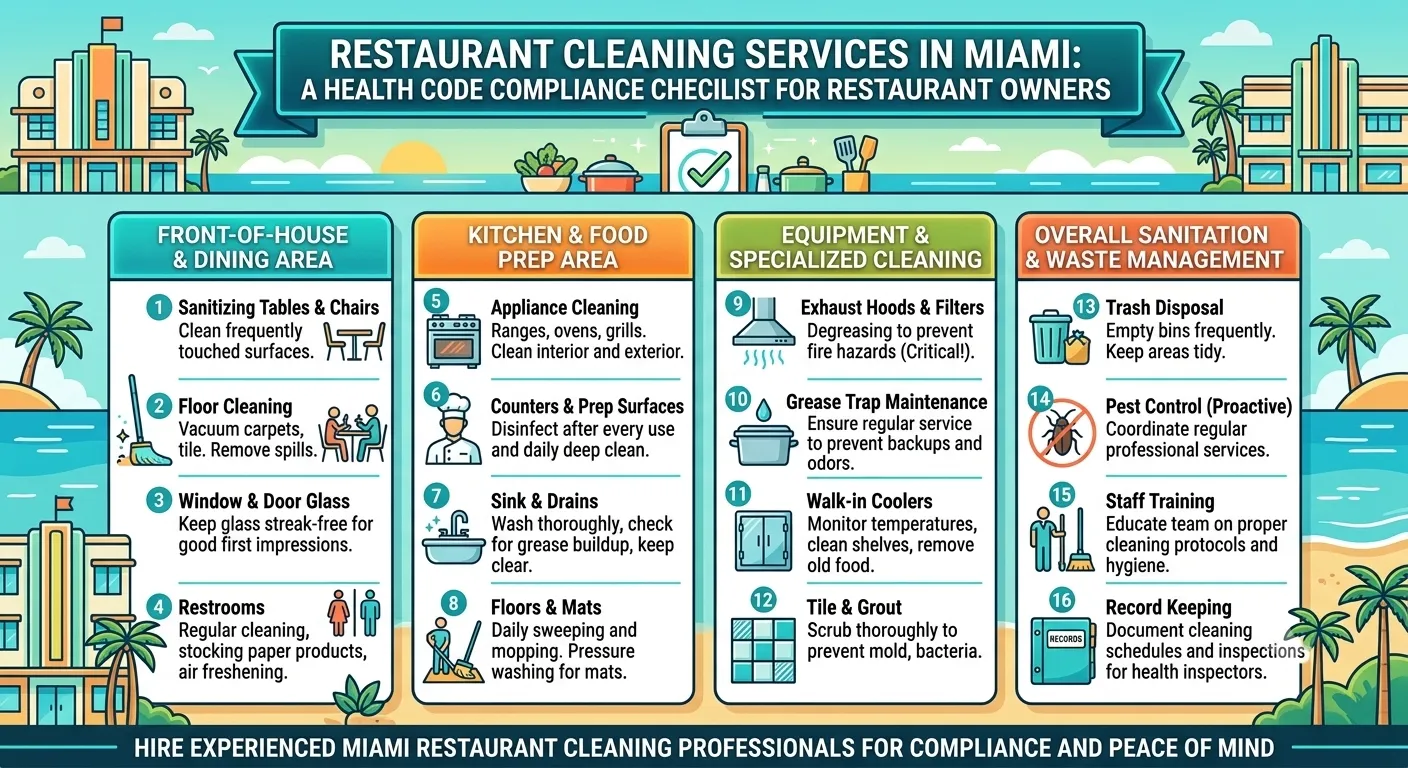
Cutting boards, prep tables, slicers, and countertops are among the most frequently cited areas in Florida inspections. Any surface that touches food needs to be cleaned and sanitized on a consistent schedule — not just wiped down at closing. Cross-contamination between raw proteins and ready-to-eat items is a High Priority concern, meaning it can trigger immediate corrective action.
What to check: Are sanitizing solutions at the correct concentration? Are separate cutting boards used for raw meat versus produce? Is there a documented cleaning schedule staff actually follow? This is one of the areas where reliable restaurant cleaning services make the biggest difference, since surface sanitation needs to happen consistently, not just before an inspection.
2. Handwashing and Employee Hygiene
Proper handwashing is one of the most commonly cited violations across Florida restaurants, and it's classified as High Priority because it's directly linked to foodborne illness risk. Handwashing stations need to be stocked with soap, disposable towels, and easy access — not blocked by equipment or storage.
What to check: Are handwashing sinks stocked and unobstructed? Do employees have visible reminders and proper training? Is there a system for verifying compliance during shifts, not just before an inspection?
3. Storage and Equipment Handling
How clean equipment and utensils are stored matters as much as how they're washed. Improper storage — stacking wet dishes, storing utensils in standing water, or leaving equipment exposed to contamination — shows up repeatedly in Florida inspection records as a Basic-level violation, but repeated citations add up.
What to check: Is clean equipment stored off the floor and away from splash zones? Are storage areas themselves clean, dry, and organized?
4. Ventilation and Exhaust Systems
Kitchen exhaust hoods and ventilation systems don't just affect air quality — grease buildup in hoods and ducts is a fire hazard and a documented inspection concern. Ventilation issues show up often enough in Florida violation data that inspectors specifically check for proper airflow and grease accumulation.
What to check: When was your exhaust hood last professionally cleaned? Is grease visibly building up around vents, filters, or ductwork? Is airflow adequate to prevent stagnant, humid conditions that attract pests? Hood degreasing is typically outside the scope of daily staff cleaning, which is why many owners bring in dedicated restaurant cleaning services for this task specifically.
5. Restrooms and Waste Management
Restrooms are a surprisingly common source of High Priority violations — missing soap, broken hand dryers, or doors that don't self-close can all result in citations, since they directly affect whether staff and customers can maintain hygiene. Waste handling, both inside and outside the building, also matters: improper trash storage attracts pests and creates odor problems that inspectors flag quickly.
What to check: Are restrooms stocked, functional, and cleaned on a set schedule? Is exterior waste storage sealed and away from entry points?
6. General Premises Cleanliness
Florida's "premises clean" requirement is broad by design — it covers floors, walls, ceilings, storage rooms, and anywhere clutter or grime can accumulate. Inspectors treat overall cleanliness as a strong indicator of how seriously a restaurant takes food safety as a whole, so a messy back-of-house can influence how closely other areas get scrutinized.
What to check: Are floors, walls, and ceilings free of grease film and debris? Are unused items and clutter cleared from storage and prep areas? Is there a deep-cleaning schedule beyond daily wipe-downs? This is usually where restaurant cleaning services add the most value, since deep cleaning of floors, walls, and hard-to-reach corners takes more time and equipment than a nightly closing shift allows.
7. Documentation and Certification
Beyond physical cleanliness, Florida requires valid food manager certification and proper licensing to be maintained and displayed. Missing or expired documentation is an easy, avoidable violation that has nothing to do with how clean your kitchen actually is.
What to check: Is your license current and visibly posted? Are food safety manager certifications up to date for the required staff?
Where Professional Cleaning Services Fit In
Daily staff cleaning handles the basics, but many of the areas above — grease trap maintenance, exhaust hood degreasing, deep floor and grout cleaning, walk-in cooler sanitation — require equipment, chemicals, and scheduling that go beyond a nightly closing routine. Professional restaurant cleaning services are built to handle these recurring, harder-to-reach tasks on a schedule that keeps you consistently inspection-ready, rather than scrambling before a visit.
For Miami restaurant owners, that consistency matters even more given the region's humidity and year-round tourist traffic, both of which accelerate grease buildup, pest pressure, and general wear on kitchen surfaces. Investing in scheduled restaurant cleaning services isn't just about passing the next inspection — it's about protecting your license, your reputation, and the health of everyone who walks through your doors.
At MCA Group, we understand that health code compliance in Miami isn't a one-time box to check before an inspector walks in — it's an ongoing commitment that protects your license, your staff, and your customers every single day. The restaurants that consistently pass inspections aren't necessarily the ones with the fanciest kitchens; they're the ones with disciplined, repeatable cleaning systems in place. Partnering with experienced restaurant cleaning services gives you that consistency without pulling your staff away from service, so your team can focus on food and hospitality while the deeper sanitation work gets handled by professionals who know exactly what Florida inspectors are looking for.


























Sign in to leave a comment.