Retractors in Surgery: Types, Uses & Surgical Applications


Retractors in Surgery: Types, Uses, and Their Role in Surgical Site Exposure
Introduction
In surgery, visibility is everything. Even when a surgeon has excellent technical skills and years of experience, working in a deep, narrow, or crowded anatomical area can be challenging without the right instruments. This is where Surgical Retractors play an essential role.
Retractors are surgical instruments designed to hold tissues, organs, skin, or other structures away from the operative field. By maintaining separation, they help surgeons achieve better Surgical Site Exposure, improve visualization, and work with greater precision. Depending on the procedure, retractors may be held manually by an assistant or secured in position so that the surgeon can concentrate on the operation.
From abdominal and thoracic procedures to orthopaedic and minimally invasive operations, retractors are available in many shapes, sizes, and configurations. Choosing the appropriate retractor depends on factors such as the surgical approach, anatomical location, depth of the operative field, tissue characteristics, and the amount of exposure required.
In this guide, we will explore how retractors work, the major types used in modern surgery, and the factors healthcare professionals should consider when selecting them.
What Are Surgical Retractors and Why Are They Important?
The basic purpose of a retractor is straightforward: Tissue Retraction.
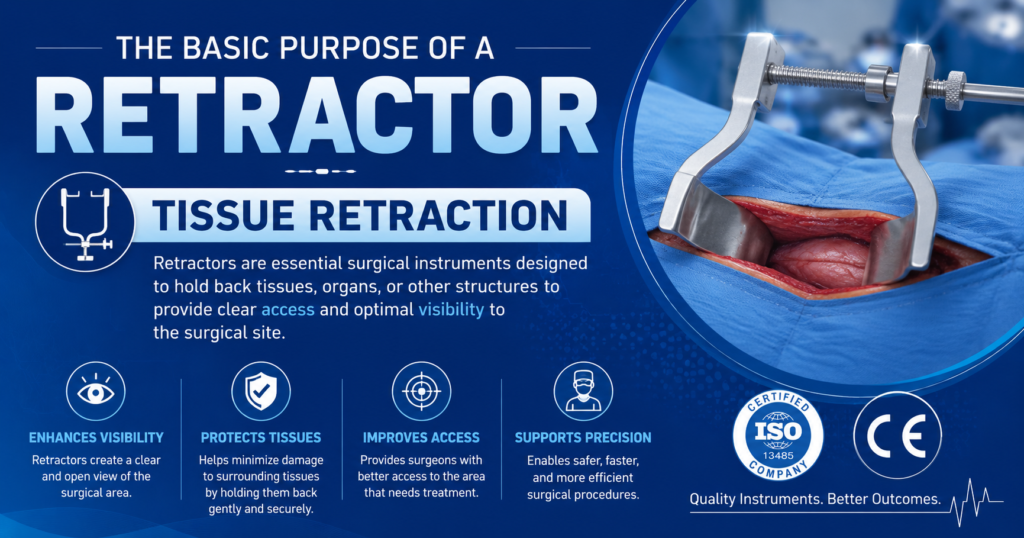
During an operation, tissues naturally move back toward their original position. Blood, muscle, fat, skin, and organs can also obstruct the surgeon’s view. A retractor helps keep these structures away from the surgical field, creating a clearer and more stable working area.
Good Surgical Site Exposure is particularly important when surgeons need to work around delicate anatomical structures. Improved visibility can make it easier to identify vessels, nerves, organs, and other tissues while reducing unnecessary manipulation.
Retractors generally fall into two broad categories:
- Handheld Retractors – held and positioned manually by a surgeon or surgical assistant.
- Self-Retaining Retractors – designed to maintain tissue separation after being positioned, often using a locking or ratcheting mechanism.
Neither type is universally better. The choice depends on the procedure and the surgeon’s preferred technique.
For example, a handheld retractor can be repositioned quickly as the surgical field changes. A self-retaining design, on the other hand, can maintain continuous exposure without requiring an assistant to hold it throughout the procedure.
Read more :- Retractors in Surgery: Types, Uses & Surgical Applications





Sign in to leave a comment.