

By Ethan Whitfield
Revenue operations, usually shortened to RevOps, has become a common job title over the past few years, but the idea behind it is much older than the term. Sales, marketing, and customer service have always affected each other's results, even when each department kept its own spreadsheets, its own definitions of a qualified lead, and its own idea of what counted as a win. RevOps is really just the practice of making those three functions operate off the same numbers instead of three different versions of the truth.
The problem RevOps tries to solve shows up in familiar ways. Marketing reports a strong quarter based on form fills and downloads. Sales reports a weak quarter because half those leads never picked up the phone. Customer service, meanwhile, is fielding complaints from existing accounts that marketing keeps emailing with offers meant for new prospects. Nobody is lying about their numbers. They are just measuring different things, in different systems, with different definitions, and none of it lines up when leadership tries to get a straight answer about how the business is actually performing.
A shared CRM does not automatically fix this, but it removes the biggest excuse for it. When marketing, sales, and service all work inside HubSpot, a lead is either qualified or it is not, based on one agreed definition, visible to everyone at the same time. A deal is either open, won, or lost, and that status updates a dashboard that both the sales manager and the marketing director look at the same afternoon. This alone eliminates a surprising amount of the finger pointing that happens in businesses running three disconnected tools.
Getting to that point takes more than just buying software, though. The first real step is agreeing on shared definitions. What counts as a marketing qualified lead versus a sales qualified lead. What counts as a closed deal for reporting purposes. What information customer service needs to see about a client before that client renews a contract. These conversations are usually uncomfortable, because they force departments to admit that their old metrics were sometimes chosen to make their own team look good rather than to reflect what was actually happening in the business. Working through that discomfort once is far better than continuing to argue about it every quarter.
Once definitions are agreed on, the technical work of connecting the pipeline stages, lifecycle stages, and ticket statuses inside HubSpot becomes fairly straightforward. Lifecycle stages track a contact from subscriber through lead, opportunity, customer, and beyond, and when everyone respects the same stages, a handoff from marketing to sales stops being a mystery. Sales can see exactly what content a prospect engaged with before the first call. Marketing can see which campaigns actually produced customers rather than just form submissions. Service can see the full deal history of an account before that renewal conversation even starts.
Reporting is where the value becomes obvious to leadership. Instead of three separate reports stitched together by hand every month, a RevOps aligned HubSpot setup produces one dashboard that shows the full funnel, from first touch to closed deal to renewal, without anyone exporting a spreadsheet. This matters more than it sounds, because it changes the kind of conversations leadership can have. Instead of debating whose numbers are correct, the conversation shifts to where the funnel is actually leaking and what to do about it.
None of this happens automatically just because a company owns HubSpot licenses. The platform provides the technical foundation, properties, lifecycle stages, workflows, and reporting tools, but the alignment itself is an organizational decision that has to be made deliberately. Some companies bring in an outside partner specifically to run this process, since an external voice can sometimes get sales and marketing leaders to agree on shared definitions faster than an internal manager caught between both teams.
HubXpert works with companies going through exactly this kind of alignment, building out the lifecycle stages, automation, and reporting that make RevOps practical rather than theoretical. The technology is rarely the limiting factor. The limiting factor is usually getting three departments that have operated independently for years to agree on one shared definition of success, and then building the systems that hold everyone to it. Businesses that get through that process tend to find that the reporting headaches disappear almost as a side effect, because the underlying data was finally consistent to begin with.
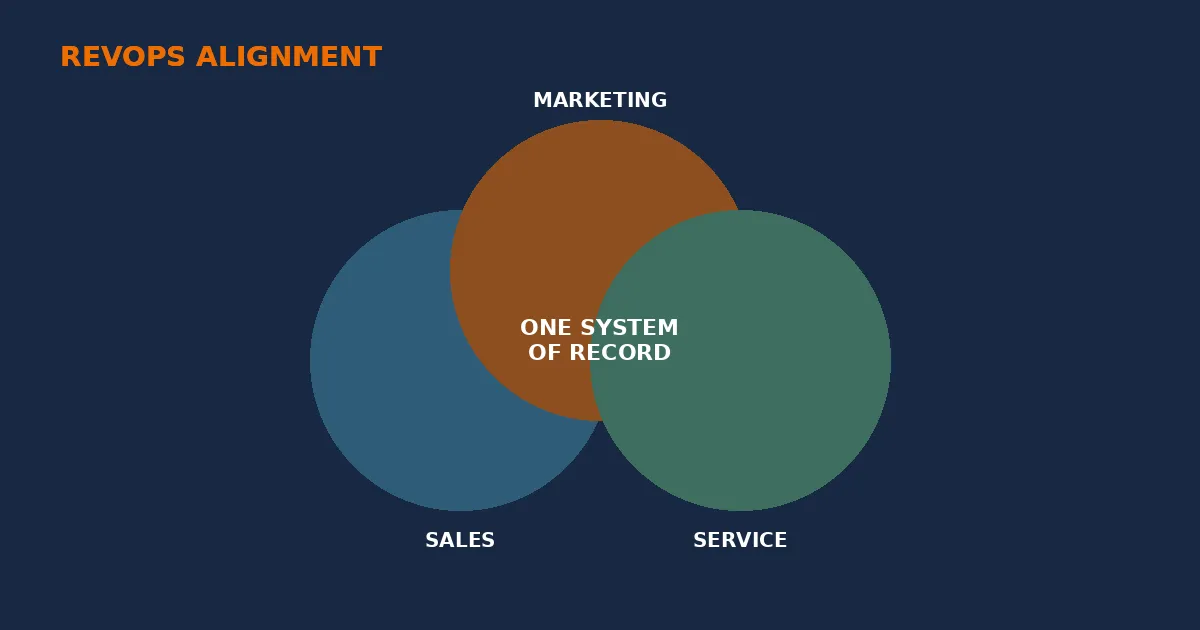
There is also a cultural piece to this that gets less attention than the technical side, and it deserves mentioning. RevOps tends to succeed fastest in companies where leadership is willing to hold every department to the same standard, rather than quietly letting one team keep its old spreadsheet running as a backup because a manager is not fully convinced. That backup spreadsheet defeats the entire point of alignment, since it gives people permission to fall back on the old numbers whenever the new dashboard shows something inconvenient. Committing to one system of record, even during the uncomfortable weeks when trust in the new setup is still building, is what actually makes RevOps stick rather than fade out after a quarter.
Smaller companies sometimes assume RevOps is only relevant once a business reaches a certain size, with dedicated operations staff and a large sales team. In practice, the underlying discipline matters just as much for a fifteen person company as it does for a five hundred person one. A small team without shared definitions runs into the same finger pointing, just on a smaller scale, and the fix is the same regardless of headcount. Getting the habits right early, while the CRM and the reporting structure are still simple, tends to be far easier than untangling years of inconsistent data once a company has grown considerably larger.






















Sign in to leave a comment.