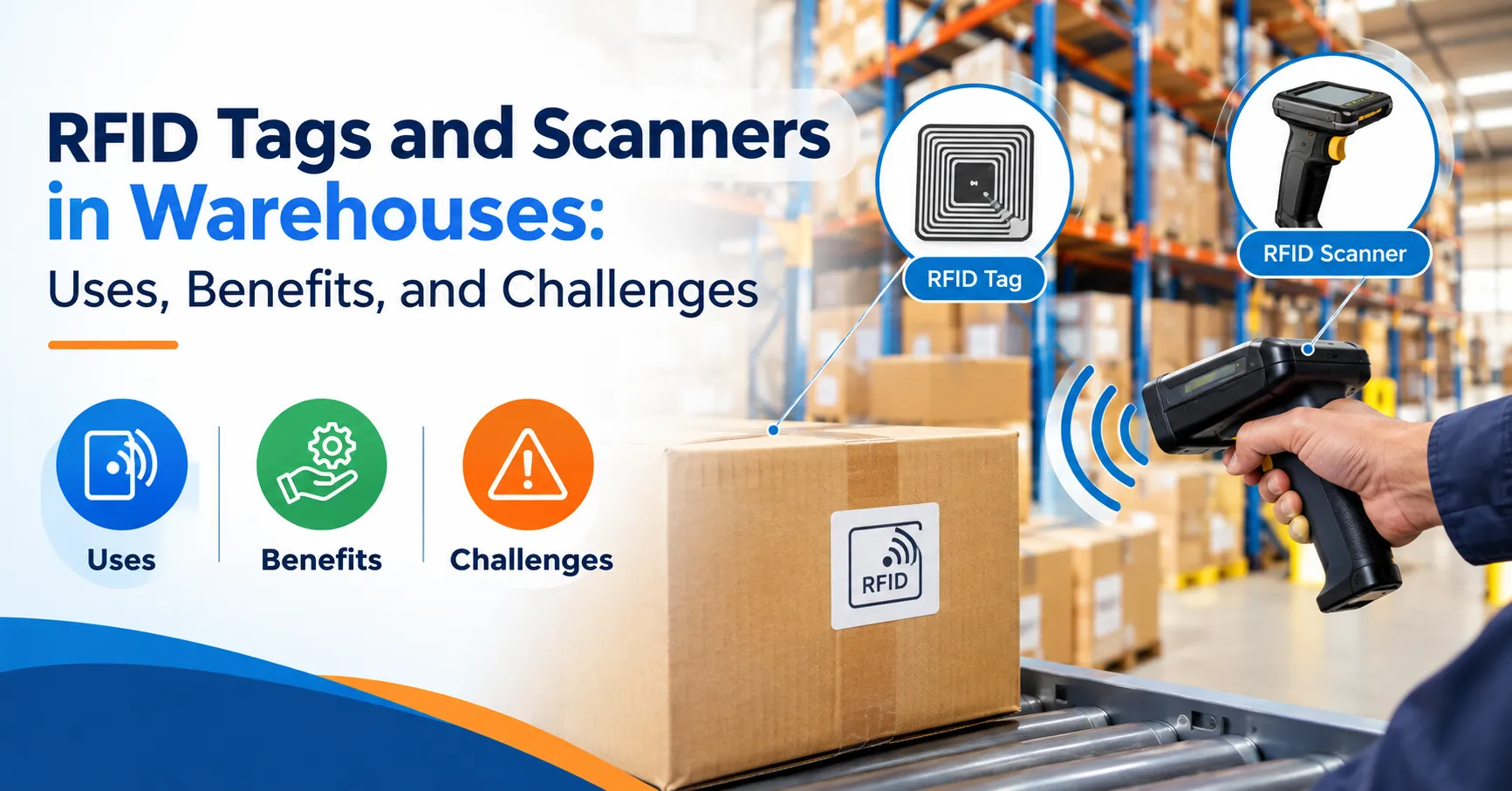

Warehouse managers need accurate inventory records, quick order processing, and clear visibility of goods moving through storage areas. Manual stock counting and barcode scanning can take time, especially when warehouses handle thousands of products every day. RFID Tags and Scanners offer another way to track inventory by using radio waves to identify tagged items and collect information without scanning each label individually.
Radio Frequency Identification (RFID) technology helps warehouses monitor stock movement, locate products, reduce counting errors, and maintain better inventory records. Depending on the system, RFID scanners can read multiple tags within seconds, making them useful for busy warehouses and distribution centres.
However, RFID implementation also comes with challenges, including equipment costs, interference, and integration with existing software. Understanding how the technology works, where it is useful, and what limitations to consider can help businesses decide whether it fits their warehouse operations.
What Are RFID Tags and Scanners?
RFID is a wireless identification technology that uses radio waves to exchange information between a tag and a reader. Each RFID tag contains a microchip and an antenna that allow it to communicate with a compatible scanner or reader.
An RFID system generally includes three main components:
- RFID tags: Attached to products, cartons, pallets, containers, or reusable assets to store identification information.
- RFID scanners or readers: Send radio signals and receive information from compatible tags.
- RFID software: Processes the collected information and updates inventory or warehouse management systems.
For example, a warehouse can attach RFID tags to pallets containing electronic goods. When a tagged pallet passes through an RFID reader at a receiving gate, the system can identify it and record its movement without requiring an employee to scan every box separately.
The amount of information collected depends on the tag type, reader configuration, and software connected to the system.
Types of RFID Tags Used in Warehouses
Different RFID tags suit different products, storage conditions, and tracking requirements.
1. Passive RFID Tags
Passive RFID tags do not have their own battery. They receive energy from the reader's radio signal and use it to communicate their stored identification data.
These tags are widely used for inventory tracking, carton identification, pallet management, and retail stock control. They are generally less expensive than active tags, making them suitable for businesses that need to label large quantities of items.
2. Active RFID Tags
Active RFID tags have their own power source and can transmit signals over greater distances than many passive tags. They are useful for tracking high-value assets, large containers, and equipment moving around extensive facilities.
Their higher cost and battery maintenance requirements should be considered before implementation.
3. Semi-Passive RFID Tags
Semi-passive RFID tags use an internal battery to power certain components, such as sensors, while relying on a reader to communicate their stored data. Depending on the design, they can support applications that require additional monitoring capabilities.
They may be suitable for specialised warehouse environments where tracking conditions or monitoring certain physical parameters is important.
Common Uses of RFID Tags and Scanners in Warehouses
RFID technology can support several warehouse activities, from receiving incoming goods to dispatching customer orders.
1. Inventory Tracking
Keeping inventory records accurate is a major responsibility for warehouse teams. Manual counting can result in missed items, duplicate entries, and discrepancies between physical stock and system records.
RFID readers can identify tagged products or containers as they move through designated reading zones. The software can then update inventory records, helping employees understand which goods are available and where stock movements have occurred.
For example, a distribution warehouse can use RFID readers to record pallets entering storage and leaving for order fulfilment.
2. Receiving and Dispatch Management
Warehouse employees must verify incoming shipments and confirm outgoing orders before goods move to their next destination.
RFID readers installed at receiving and dispatch gates can capture information from tagged cartons or pallets as they pass through. The system can compare the recorded items against expected shipment details and flag potential discrepancies.
This reduces the need for repeated manual scanning, although proper tag placement and reader configuration remain important for accurate identification.
3. Locating Products and Assets
Finding a specific product in a large warehouse can waste time when location records are incomplete or outdated.
RFID can help businesses maintain better records of product and pallet movements between receiving areas, storage racks, packing stations, and dispatch zones. Handheld RFID readers can also help employees search for tagged items within a suitable reading range.
RFID does not automatically provide precise GPS-like location data indoors. More detailed location tracking requires an appropriate reader layout, additional infrastructure, or specialised technology.
4. Order Picking and Packing
Order fulfilment involves selecting the correct products, checking quantities, and preparing shipments for delivery.
RFID systems can support item verification during picking and packing. When tagged products pass through a configured reading area, the system can compare the detected items with the order details and alert employees to possible mismatches.
This can help reduce picking errors and improve the consistency of dispatch operations.
5. Asset and Equipment Tracking
Warehouses depend on equipment such as trolleys, reusable containers, tools, and material-handling assets. Losing track of these items can lead to delays and unnecessary replacement costs.
RFID tags allow businesses to identify tagged assets and record their movement between designated areas. Employees can use handheld readers or fixed scanning points to check asset availability and movement history.
This is particularly useful for warehouses that share equipment across multiple departments or facilities.
Key Benefits of RFID Tags and Scanners
1. Faster Inventory Counting
RFID readers can identify multiple compatible tags within a reading zone without requiring individual line-of-sight scans. This can make stocktaking faster than conventional barcode-based processes, depending on the warehouse layout and system configuration.
Employees can spend less time counting items manually and more time resolving inventory discrepancies.
2. Improved Inventory Accuracy
RFID helps reduce errors caused by missed scans, manual data entry, and incorrect item identification. When integrated with warehouse software, captured tag data can support more consistent inventory records.
However, accuracy depends on reliable tag reads, correct system settings, and regular checks of physical stock.
3. Better Stock Visibility
Warehouse managers need to know what stock is available, where it is stored, and whether goods have moved as expected.
RFID can provide timely records of tagged items passing through monitored locations. This information helps teams identify stock movement, investigate missing goods, and make better replenishment decisions.
4. Reduced Labour Requirements for Repetitive Tasks
Manual barcode scanning requires employees to handle or individually scan items in many workflows. RFID can reduce some of these repetitive steps by identifying multiple tags in one reading cycle.
The technology does not eliminate the need for warehouse staff. Employees still need to handle goods, verify exceptions, maintain equipment, and manage inventory processes.
5. Better Shipment Verification
RFID readers at dispatch points can help compare detected products with shipment records before goods leave the warehouse. This supports more reliable order checks and can help identify missing or unexpected items before dispatch.
6. Support for Warehouse Automation
RFID can connect with warehouse management systems, conveyor controls, automated sorting equipment, and other operational software. This allows businesses to use identification data as part of broader warehouse workflows.
When combined with suitable IoT systems, RFID can also contribute to improved asset visibility and monitoring across multiple operational locations.
Challenges of Using RFID in Warehouses
Although RFID offers several advantages, businesses should assess its limitations before investing in the technology.
1. Initial Setup Costs
An RFID project may require tags, fixed or handheld readers, antennas, software, network infrastructure, and installation. Costs depend on warehouse size, the number of items being tagged, and the level of automation required.
Businesses should begin by identifying specific operational problems and estimating the potential savings before choosing a system.
2. Signal Interference
RFID performance can be affected by the surrounding environment. Metal surfaces may reflect radio signals, while liquids can absorb or interfere with certain RFID frequencies.
Warehouses handling metal equipment, liquid containers, or mixed product types may need specialised tags, careful antenna placement, and testing under actual operating conditions.
3. Integration with Existing Systems
Many warehouses already use warehouse management systems (WMS), enterprise resource planning (ERP) software, and barcode-based workflows.
The RFID solution must exchange data correctly with these systems. Poor integration can result in duplicate records, delayed updates, or incorrect inventory information.
Businesses should check software compatibility and data requirements before deployment.
4. Tagging and Maintenance
Every item or relevant packaging unit must be tagged according to the chosen tracking process. Tag placement, damaged labels, and unsuitable tags can affect reading performance.
Companies should establish clear tagging procedures and train employees to handle exceptions.
5. Employee Training and Process Changes
Warehouse staff need to understand how to use readers, interpret alerts, and resolve inventory mismatches. Introducing RFID without proper training may lead to inconsistent usage or incorrect assumptions about system accuracy.
A pilot project can help employees become familiar with the technology before it is rolled out across the entire facility.
Best Practices for Implementing RFID in a Warehouse
A planned implementation helps businesses avoid unnecessary expenses and improve system performance.
- Define clear objectives: Decide whether the main goal is faster stocktaking, shipment verification, asset tracking, or improved inventory accuracy.
- Choose suitable tags: Consider product materials, tag durability, reading distance, and environmental conditions.
- Test reader placement: Check performance around metal racks, loading bays, conveyors, and storage areas.
- Integrate warehouse software: Ensure RFID data can update the existing WMS or ERP system correctly.
- Start with a pilot: Test the technology in one warehouse zone or product category before expanding.
- Train employees: Explain scanning procedures, exception handling, and equipment maintenance.
- Measure results: Track inventory accuracy, counting time, shipment errors, and equipment availability to evaluate performance.
These steps help businesses select an RFID system that matches their actual warehouse requirements.
Conclusion
RFID Tags and Scanners help warehouses identify products, record stock movement, verify shipments, and track reusable assets with less dependence on individual manual scans. They can improve inventory accuracy, speed up repetitive tasks, and provide better visibility across warehouse operations.
However, businesses must consider installation costs, signal interference, software integration, and employee training before adopting the technology. A pilot project and a clear implementation plan can help determine whether RFID is suitable for a particular facility.
For businesses looking to improve asset visibility and connect operational data across facilities, KritiLabs can be explored alongside other providers of IoT solutions in Chennai. Choosing the right combination of RFID technology, warehouse software, and monitoring tools can help businesses maintain more reliable inventory records and make informed operational decisions.






















Sign in to leave a comment.