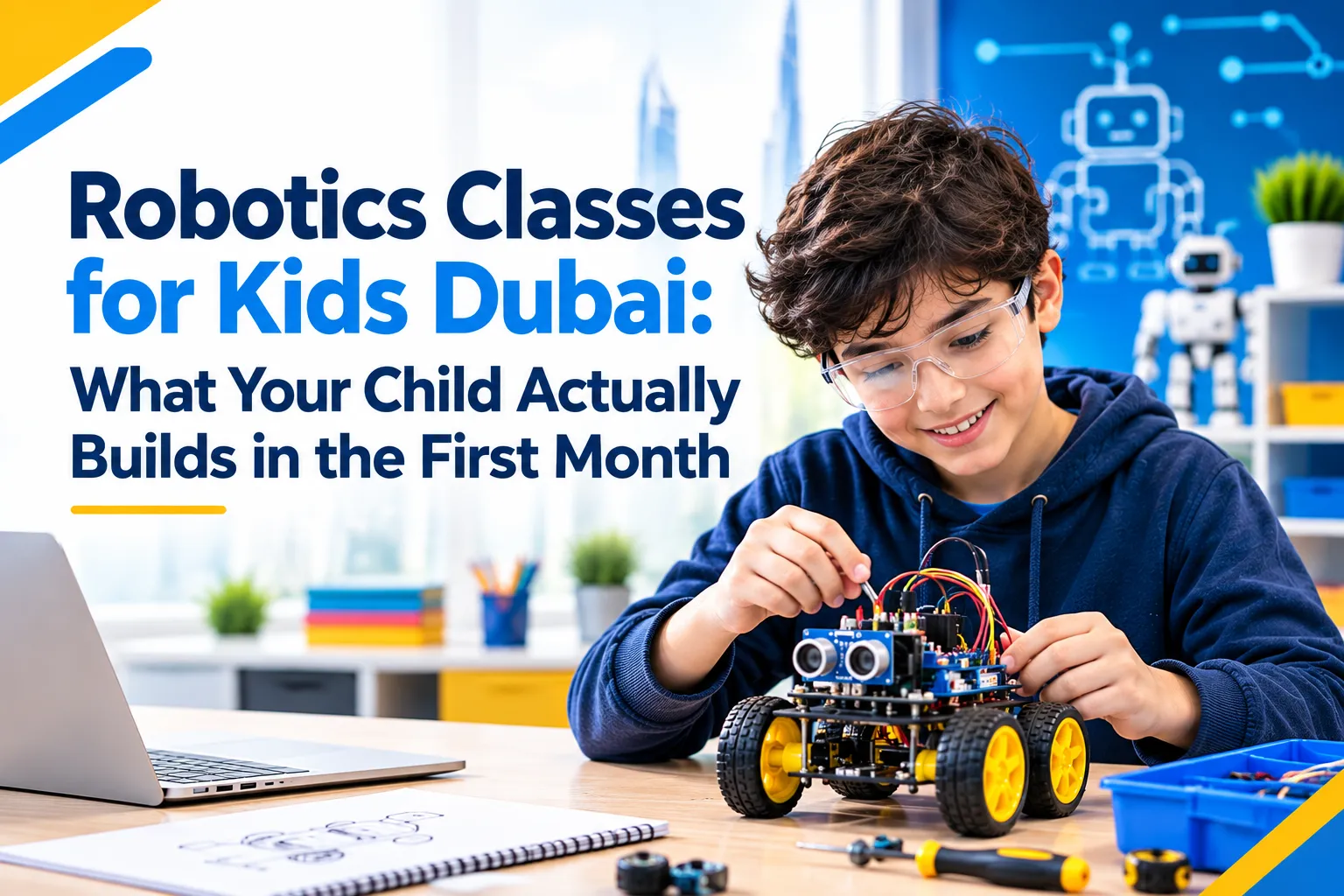

Most parents I talk to have the same quiet worry before signing up. They picture their child sitting in a room for four weeks, watching someone else assemble things, and coming home with nothing but a sticker. It's a fair fear, because some programs really do run that way. So here's the honest picture of what a good set of Robotics Classes for Kids Dubai families can choose from looks like in the first month, week by week, including the messy parts nobody puts in a brochure.
I've watched a lot of first months. The pattern is surprisingly consistent. Kids start unsure, hit a small wall around week two, and by week four they're proudly explaining something that, a month earlier, they couldn't have described at all.
Week One: Learning to Handle the Parts
The first session is rarely about building a robot. It's about getting comfortable with the pieces. Kids pick up motors, sensors, wheels and connectors, and figure out what each one does. There's usually a lot of fiddling, a few wrong connections, and plenty of "wait, which way does this go?"
That sounds slow, but it matters. A child who has never held a motor doesn't yet know that it spins a particular way when power flows a particular way. Letting them find that out with their hands, instead of reading it off a slide, is where the real learning starts. By the end of the week, most kids have built something simple that moves, even if it wobbles. A small wheeled base is typical. It isn't impressive to look at, and it doesn't need to be.
Week Two: The First Real Wall
This is the week I pay the most attention to. The novelty has worn off, and the robot now has to do something specific, like drive in a straight line or stop at a marked spot. It won't, at first.
Kids discover that their robot veers left, or that it stops late, or that it does something nobody asked it to do. Some get frustrated. That's normal, and honestly it's the most valuable moment of the month. A good facilitator doesn't jump in with the fix. They ask questions. "What did you expect to happen? What actually happened? What could be different?" Children who are guided to find the cause themselves learn something no worksheet can teach: that a problem is a puzzle, not a verdict on how smart you are.
This is also where Coding Classes for Kids Dubai and robotics start to overlap. The robot only does what the instructions tell it to, so a mistake in the logic shows up as a physical mistake. Kids who've done a little coding before often adapt faster, but it isn't required. The robot is a patient teacher.
Week Three: Sensors and Decisions
By now the robot can move. In the third week it starts to react. Students add a sensor, often a distance or light sensor, and program the robot to respond to what it detects. A common project is a robot that stops or turns when it gets close to an object.
This is where the thinking gets more interesting. Instead of "go forward," the instruction becomes "if something is close, then turn." That's a decision, and it's the first time many kids write one. Getting the distance right takes trial and error. Set it too short and the robot bumps the obstacle. Too long and it turns away from nothing. Kids tweak the number, test again, tweak again.
I've seen a nine-year-old spend most of a session adjusting a single value until her robot cleared a chair leg. She didn't want a hint. She wanted to solve it herself, and when she did, she told everyone in the room. That small pride is what keeps kids coming back.
Week Four: A Small Challenge and a Show-and-Tell
The month usually ends with a mini challenge. Students might guide their robot through a simple course, or make it complete a short task within a time limit. It's low pressure, but it gives the month a clear finish.
Just as important is the explanation. Each child shows what they built and describes how it works, including what went wrong along the way. This step is underrated. Being able to put your own work into words is a skill that carries well beyond robotics, and children are often surprised by how much they actually understand once they have to say it out loud.
By the end of the first month, a typical student has built a working robot, programmed it to respond to a sensor, debugged at least a few of their own mistakes, and presented the result. That's a real, concrete outcome, not a vague "exposure to technology."
What Your Child Takes Home Beyond the Robot
The physical robot is the least important thing that comes out of the first month. What lasts is a change in how a child handles problems. They've learned to test one change at a time, to check the simple things first, and to treat a failed attempt as information. Parents often notice this at home before they notice anything technical. A child who used to give up on a stuck puzzle starts saying, "let me try something different."
That mindset connects to the bigger picture of STEM Education UAE, where schools and families are increasingly looking for skills that outlast any single tool or gadget. A confident problem-solver adapts to new technology as it arrives, which matters more than mastering one platform.
How the First Month Fits a Longer Path
A good first month is the opening chapter, not the whole book. Children who stay with it move on to more complex builds, text-based coding, and eventually more open-ended projects. Some go on to compete, and events like the Robotics Olympiad UAE give older students a goal to work toward and a chance to test their skills against others.
That progression is also why it helps to think beyond a single class. A strong K-12 STEM Education UAE pathway connects early robotics to later coding, data and AI work, so each stage prepares the next. For parents, the practical takeaway is to ask where a program leads. A first month that sparks interest but has nowhere to go afterwards can leave a child enthusiastic and stuck.
What to Watch For in Your Child's First Month
A few signs tell you the class is working. Your child can describe what they built, even if the explanation is a bit tangled. They mention something that went wrong and how they dealt with it. They're curious about what comes next. And they want to go back.
Warning signs are just as clear. If your child only watched while an instructor did the building, or came home with a finished robot they can't explain, the class may be doing the work for them. Hands-on time should be the bulk of every session.
Practical Takeaway
The first month of Robotics Classes for Kids Dubai parents enrol in should leave your child with a working robot, a few self-fixed mistakes, and the confidence to explain what they made. The robot matters less than the habits behind it: testing, adjusting and trying again.
Stem-Xpert UAE structures its beginner programs around exactly this first-month experience, with hands-on building from day one and a clear path into Coding Classes for Kids Dubai and more advanced robotics. For families working toward Future-Ready Education UAE goals, the best sign of a good start is a child who can't wait to show you what they built.
FAQs
What do kids build in the first month of robotics classes?
Most children build a simple wheeled robot, program it to move, and then add a sensor so it can react to its surroundings. The month usually ends with a short challenge or presentation.
What age can children start robotics classes in Dubai?
Many programs accept children from around age six, using simple, screen-light robots. Children aged nine or ten can usually handle more detailed building and programming.
Does my child need coding experience before starting robotics classes?
No. Beginner-friendly classes start from the basics and introduce coding as part of building the robot, so no prior experience is needed.
How often should kids attend robotics classes?
One session a week is common for beginners. Regular weekly practice tends to work better than occasional intensive sessions because skills build gradually.
How can I tell if a robotics class is actually hands-on?
Look at how much of each session children spend building themselves. If instructors do most of the assembly or children mainly watch, the class is not giving real hands-on experience.
What happens after the first month of robotics classes?
Students typically move on to more complex builds, text-based coding and open-ended projects, and some older students prepare for competitions like the Robotics Olympiad.






















Sign in to leave a comment.