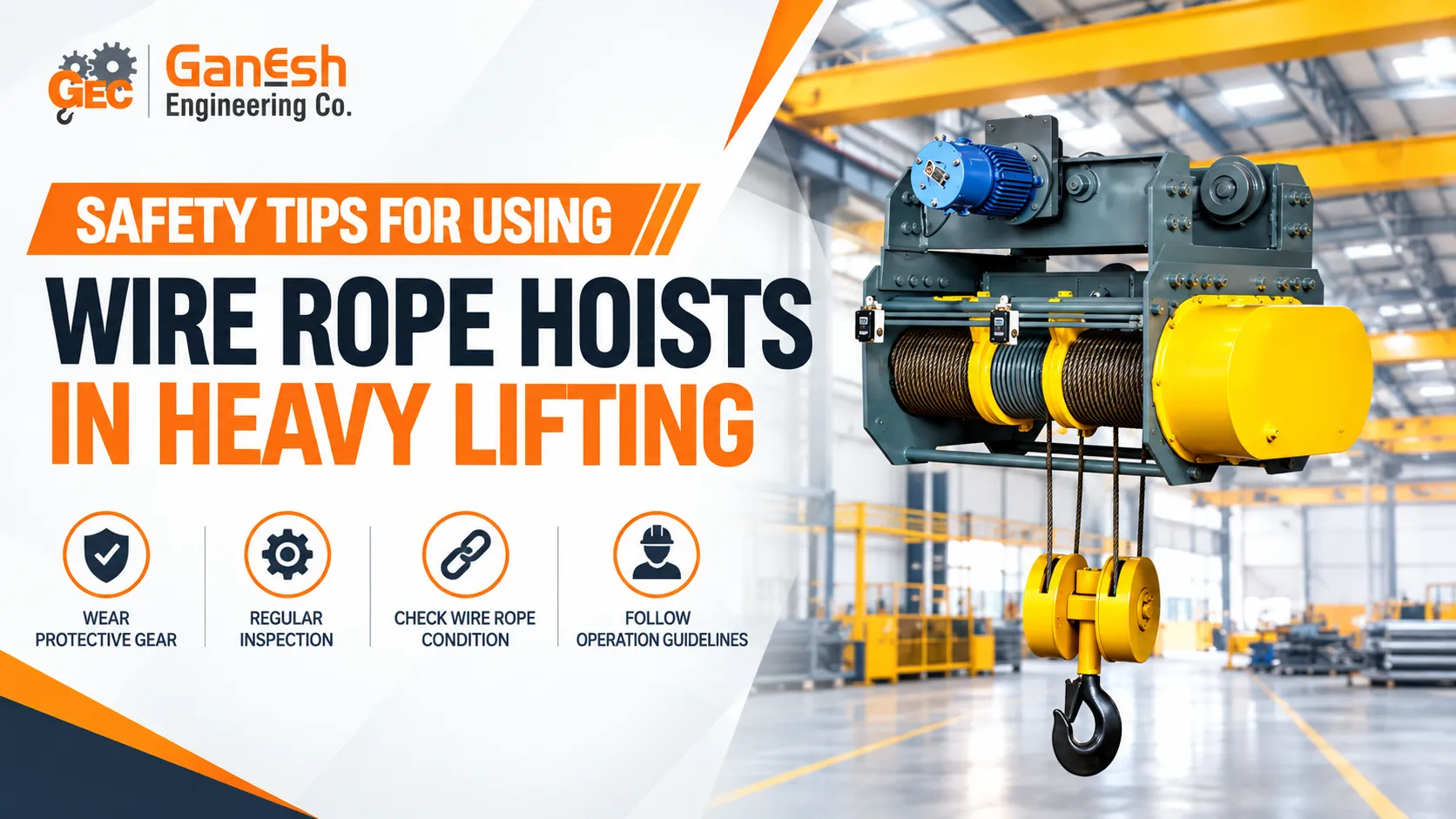

Overview - Most accidents with lifting equipment do not happen because the machine failed on its own; they happen because a basic check got skipped, a load limit got ignored, or a worn part got used one too many times. A wire rope hoist is a strong, dependable machine when it is used the right way, but heavy lifting always carries real risk if safety steps are not followed properly. A hoist that has worked fine a hundred times before can still fail if something was overlooked along the way, which is why safety habits need to stay consistent rather than becoming routine only in name. This blog goes through the practical safety tips worth following before, during, and after a lift.
This blog covers:
- Introduction
- Before You Lift: Pre-Operation Checks
- Safe Practices During the Lift
- Load Limits and Why They Cannot Be Ignored
- Common Mistakes That Lead to Accidents
- Keeping a Wire Rope Hoist Safe Over Time
- Frequently Asked Questions
Introduction
A wire rope hoist does heavy, repeated work, day after day, and this is exactly why safety around it cannot be an afterthought. The wire rope itself, the hooks, the brake, and the control system all need to work exactly as they should every single time a load goes up, since even a small failure at the wrong moment can hurt someone or damage property badly. Most of the safety steps involved are simple and do not take much time, but skipping them, even once, is where real trouble usually starts. A rushed lift to save five minutes is rarely worth the risk it creates, and most experienced operators will say the same thing once they have seen a close call happen in front of them.
Before You Lift: Pre-Operation Checks
A few checks done before every lift catch most of the problems that would otherwise turn into an accident with a wire rope hoist.
Look at the wire rope closely for any signs of fraying, kinks, flattened spots, or broken strands, since a damaged rope can snap under load without much warning. Check the hooks for any bending, twisting, or cracks, and make sure the safety latch on each hook is working properly. Test the brake by lifting a small load first and checking that it holds steady without slipping. Confirm the control buttons respond correctly and that the emergency stop actually stops the hoist immediately when pressed. If anything looks off during these checks, the hoist should not be used until it has been properly looked at and fixed.
Safe Practices During the Lift
A few habits followed consistently during the actual lift keep both the operator and everyone safe while a wire rope hoist is in use.
- Never stand under a suspended load – if the load falls or the hoist fails, standing underneath puts you directly in danger
- Keep the load centered under the hook – an off-center load can swing or tip unexpectedly once it leaves the ground
- Lift slowly and steadily – sudden jerks put extra, unnecessary strain on the rope and the hoist mechanism
- Watch the load throughout the lift – do not look away or get distracted while a heavy object is in the air
- Keep the area around the lift clear – bystanders and unrelated equipment should stay well away from the lifting zone
- Communicate clearly with anyone assisting – use clear hand signals or radio communication so everyone understands what is happening at each step
Following these habits every single time, not just when it feels necessary, is what actually keeps a lifting operation safe over the long run.
Load Limits and Why They Cannot Be Ignored
Every wire rope hoist has a rated working load limit, and going past this limit, even slightly, is one of the most dangerous mistakes anyone can make around heavy lifting equipment.
The rated limit is not a rough guideline; it is based on real testing of the rope, the hooks, and the hoist mechanism, and pushing past it puts stress on components well beyond what they were built to handle safely.
This does not always cause an immediate failure; sometimes the damage builds up quietly over several overloaded lifts before the hoist actually fails, which makes it even more dangerous since there is no obvious warning sign.
Always check the actual weight of a load before lifting, rather than guessing, and never assume a hoist can handle "just a bit more" than its rated capacity because it managed to lift something heavy before without an issue.
Common Mistakes That Lead to Accidents
A few specific mistakes come up again and again in accidents involving a wire rope hoist, and knowing them helps avoid repeating the same errors.
Using a wire rope hoist with a visibly damaged rope or hook because "it still seems to work" is one of the more common and dangerous habits seen on site.
Skipping the pre-lift inspection because the operator is in a hurry or the same hoist was checked fine yesterday is another frequent cause.
Lifting a load at an angle instead of straight up puts uneven stress on the rope and can cause it to slip off the drum or pulley.
Letting an untrained person operate the hoist without proper instruction is also a common, avoidable mistake, since even a well-built hoist depends on the person operating it understanding how to use it safely.
Keeping a Wire Rope Hoist Safe Over Time
Safety with a wire rope hoist is not just about the moment of lifting; it is also about how well the equipment is looked after between uses.
Lubricate the wire rope regularly. This cuts down friction and stops the rope from wearing out before its time. Get a trained person to inspect the hoist now and then, not just a quick look by whoever is operating it, since a proper inspection catches wear that a daily glance would miss. Keep a simple record of every inspection and repair so you can track the hoist's condition over time and spot a pattern before it turns into a real problem.
And when the hoist is not in use, store it away from dust, moisture, and harsh chemicals, since this alone helps it last longer and stay safer.
Frequently Asked Questions
How often should a wire rope hoist be inspected for safety?
A visual check before every lift is the minimum, along with a more thorough inspection by a trained person on a regular schedule, often monthly or quarterly depending on how heavily the hoist is used.
What should I do if I notice the wire rope looks slightly frayed?
Stop using the hoist immediately and have it inspected properly before any further lifting. Even minor fraying can be a sign of deeper damage, and continuing to use a damaged rope puts the load and anyone nearby at real risk.
Is it ever safe to lift slightly more than the rated load limit if the hoist seems to handle it fine?
No, the rated limit already accounts for a safety margin, and going past it, even without an immediate visible problem, can cause hidden damage that leads to failure on a future lift.
Can a wire rope hoist be operated safely by someone without formal training?
It should not be. Even a well-built hoist depends on the operator understanding load limits, proper rigging, and basic safety checks, so proper training is a genuine safety requirement, not just a formality.
Manufacturers such as Ganesh Engineering Co., based in Ahmedabad, Gujarat, and building wire rope hoists and cranes since 2004, design their equipment to IS:807 and IS:3177 standards, tested to 125% of Safe Working Load, with fail-safe brakes, limit switches, and overload protection built in as standard.



















Sign in to leave a comment.