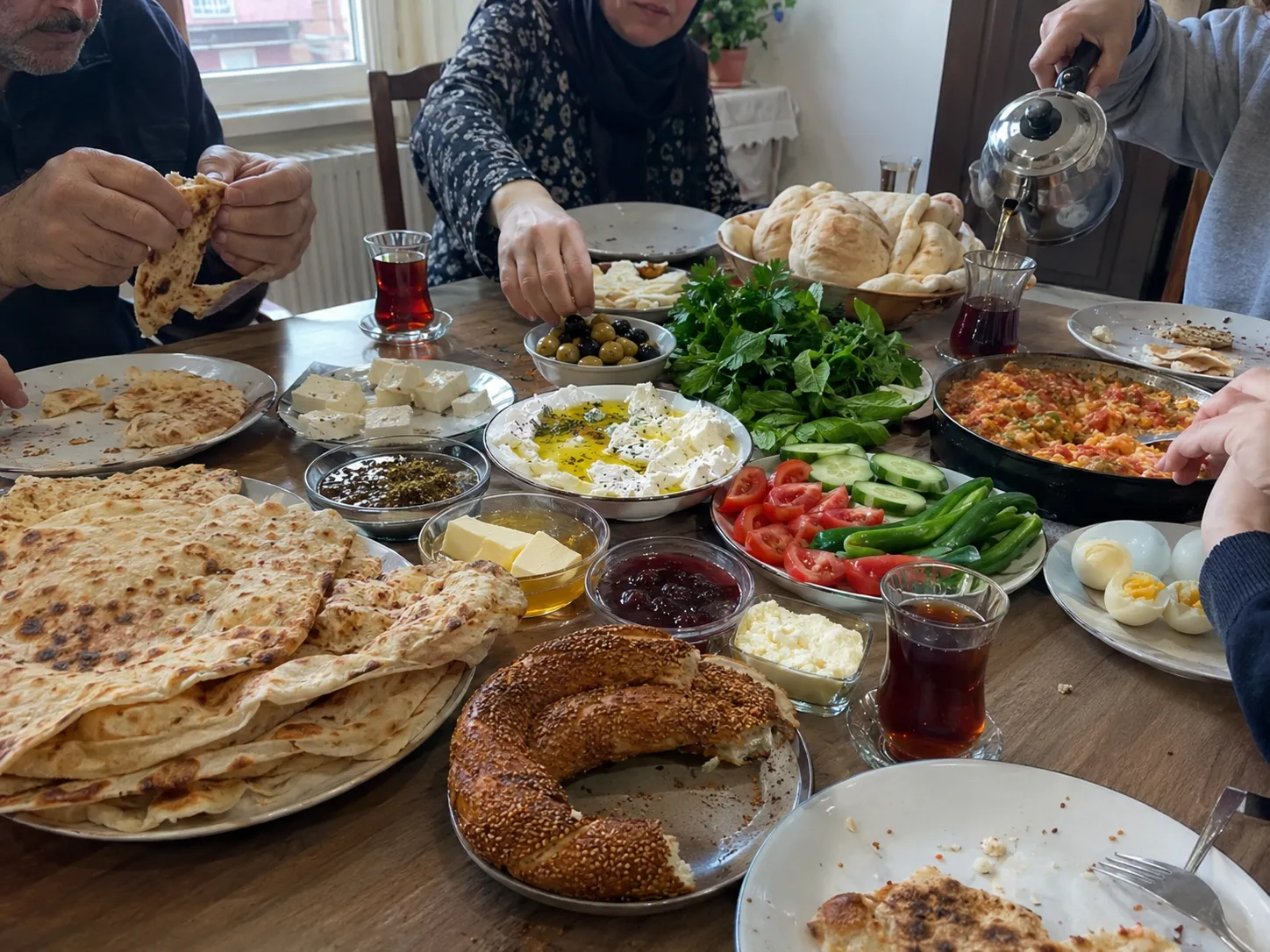


Breakfast in many Middle Eastern households is not built around one dish. It is a table filled with small plates: cheese, olives, labneh, eggs, tomatoes, cucumbers, za'atar, honey, jam, fresh herbs, and, almost always, bread.
Bread is what brings much of it together.
A piece of bread might be used to scoop up labneh, wrap around cheese and vegetables, dip into olive oil and za'atar, or pick up a piece of egg from the plate. It is not treated as something that simply sits beside the meal. It is part of the way the meal is eaten.
The type of bread depends on where the breakfast comes from. A Lebanese table may have pita or saj, while Turkish breakfasts commonly include breads such as simit and lavash. Palestinian and Levantine tables have their own traditional breads, including taboon and markook. The names, shapes, thicknesses, and cooking methods change, but the idea of fresh bread at the center of the table remains familiar.
Saj
Saj is one of those breads that immediately changes the look of a breakfast table.
It is extremely thin, soft, and flexible, traditionally cooked on a rounded metal surface called a saj. The dough is stretched much thinner than ordinary pita before it reaches the hot surface, so it cooks within minutes.
The best saj has a softness that makes it easy to fold without breaking. It can be wrapped around cheese, labneh, za'atar, eggs, or vegetables, and it is also commonly served with grilled meats later in the day.
The preparation is part of what makes saj special. The dough needs enough time to rest so that it can be stretched without constantly pulling back. Traditionally, the baker works the dough by hand until it becomes almost paper-thin before placing it over the hot saj.
Fresh saj does not need much beside it. A little labneh, olive oil, olives, and tea can be enough for breakfast. To make the perfect saj bread, you can follow this recipe:- Saj Bread ( Traditional Arabic Style Flat Bread)
Pita
Pita is probably the bread most people associate with Middle Eastern food.
Its familiar pocket is created when the dough meets very high heat. Water in the dough turns into steam, causing the two sides of the bread to separate while it bakes.
That pocket is useful, but it is not the only reason pita has such a permanent place on the breakfast table.
Warm pita can be torn into pieces and used with hummus or labneh. It can hold cheese and vegetables, wrap around eggs, or simply be dipped into olive oil mixed with za'atar.
There is also a noticeable difference between packaged pita and bread that has just come from a bakery. Fresh pita is soft and warm, with a slight chew that makes it much easier to fold and tear.
For many households, that freshness matters more than having a complicated breakfast dish.
Lavash
Lavash is another thin bread that appears across Turkish and neighboring food traditions.
Unlike pita, lavash does not depend on forming a large pocket. It is generally thin and flexible, making it useful for folding, wrapping, and eating alongside other foods.
At breakfast, lavash works particularly well with soft cheese, olives, tomatoes, cucumbers, eggs, and herbs. It can be torn into smaller pieces or rolled around whatever happens to be on the table.
One reason thin breads like lavash have remained so useful is their versatility. The same bread that works at breakfast can later be used for kebabs, grilled meat, or other fillings.
Markook and Shrak
Markook, also known as shrak in some parts of the Levant, takes thin bread even further.
It is traditionally stretched into a very large, extremely thin sheet before being cooked. In skilled hands, the dough becomes almost translucent.
It is easy to group markook with saj because both are thin flatbreads, but they are not necessarily the same bread. Names and preparation methods vary between countries and even between families.
At breakfast, markook can be eaten with labneh, cheese, olives, za'atar, eggs, or vegetables. Its large size also makes it useful as a wrap.
The texture is what makes it memorable. It is soft enough to fold but thin enough that it does not overwhelm whatever is inside.
Taboon Bread
Taboon bread comes from a different baking tradition.
It is traditionally baked in a taboon oven, particularly associated with Palestinian cooking. Unlike the very thin breads cooked quickly on a saj, taboon bread develops its character from the intense heat of the traditional oven.
The bread can have a slightly thicker and chewier texture, with a baked surface that works beautifully with olive oil, cheese, vegetables, and dips.
A traditional taboon is more than just an oven. The way the dough interacts with the hot surface and the walls of the oven contributes to the finished bread.
That is one reason traditional breads are difficult to reproduce exactly at home. The ingredients may be simple, but the cooking environment is part of the recipe.
Manakish
Manakish is where bread becomes the breakfast itself.
A basic dough is pressed or rolled into a flat round and topped before baking. Za'atar mixed with olive oil is probably the version most familiar to people across the Levant, but cheese and meat toppings are also common.
A warm za'atar manakish has a completely different character from plain pita. The olive oil brings richness, while the za'atar adds herbs, sesame, and a slightly earthy flavor.
It is often eaten in the morning with vegetables, olives, yogurt, or tea.
There is also something very practical about manakish. It is bread and topping in one, which makes it an easy breakfast to prepare for a family or pick up from a bakery on the way home.
Simit
Not every breakfast bread in the region is flat.
Simit is one of the breads that gives a Turkish breakfast its own identity. It is a ring-shaped bread covered generously with sesame seeds, with a slightly crisp outside and a soft interior.
A warm simit with white cheese, olives, tomatoes, cucumbers, and Turkish tea is a simple combination, but it is difficult to improve upon.
The sesame coating is important. It gives the bread a toasted flavor and texture that separates it from softer flatbreads.
Simit can also be eaten on its own, but on a breakfast table it becomes another way of carrying the other foods from the plate to the mouth.
What Goes Around the Bread?
The bread may be the foundation, but it is only one part of the breakfast.
A typical spread can include several cheeses, labneh, olives, sliced tomatoes and cucumbers, boiled or fried eggs, fresh herbs, za'atar, honey, jams, and olive oil.
In Turkish breakfasts, menemen is another popular option. Eggs are cooked with tomatoes and peppers until soft and flavorful, then eaten with plenty of bread.
In Levantine homes, labneh can take a similar central role. Thick strained yogurt is served with olive oil and sometimes za'atar or fresh herbs. A piece of warm bread is all that is needed to scoop it up.
The food is simple, but the combination is what makes the table feel complete.
Bread Is Part of the Meal
There is a reason bread appears in so many different forms across Middle Eastern breakfast traditions.
These breads are designed for eating with other food.
Pita has its pocket. Saj has its flexibility. Lavash is thin enough to fold. Markook can wrap almost anything. Taboon bread brings the flavor of a traditional oven. Manakish puts the topping directly on the dough, while simit brings a completely different texture through its sesame-covered crust.
None of them needs to be treated as a luxury food.
They are everyday breads. Most of the people nowadays use a pita oven to make the bread easier and in less time.
They are made in bakeries, bought on the way home, prepared in family kitchens, and placed in the middle of the table while breakfast is still being put together.
That is also why a Middle Eastern breakfast can feel so different from a breakfast built around one packaged item. The table is meant to be shared. You take some cheese, tear off some bread, add an olive, reach for the tomatoes, and go back for another piece.
The meal changes as you eat it.
A Table That Changes From Home to Home
There is no single Middle Eastern breakfast, just as there is no single Middle Eastern bread.
Lebanon has its own traditions. Palestine has its own. Syria, Jordan, Turkey and other countries and regions have their own breads, ingredients, and ways of serving them.
Even within the same country, breakfast can change from one household to another.
One family may have fresh saj. Another may buy pita from the neighborhood bakery. Someone else may start the morning with simit and tea. A Palestinian household may have taboon bread, while another Levantine table may have markook or manakish.
What stays familiar is the way bread brings the table together.
It is there for the labneh, the cheese, the olives, the eggs, the vegetables, the za'atar and the olive oil.
And whether it is a thin piece of saj, a warm pita, a sheet of lavash, a large markook, a piece of taboon bread, a fresh manakish, or a sesame-covered simit, the bread is never simply an extra item on the plate.
It is part of the breakfast itself.

























Sign in to leave a comment.