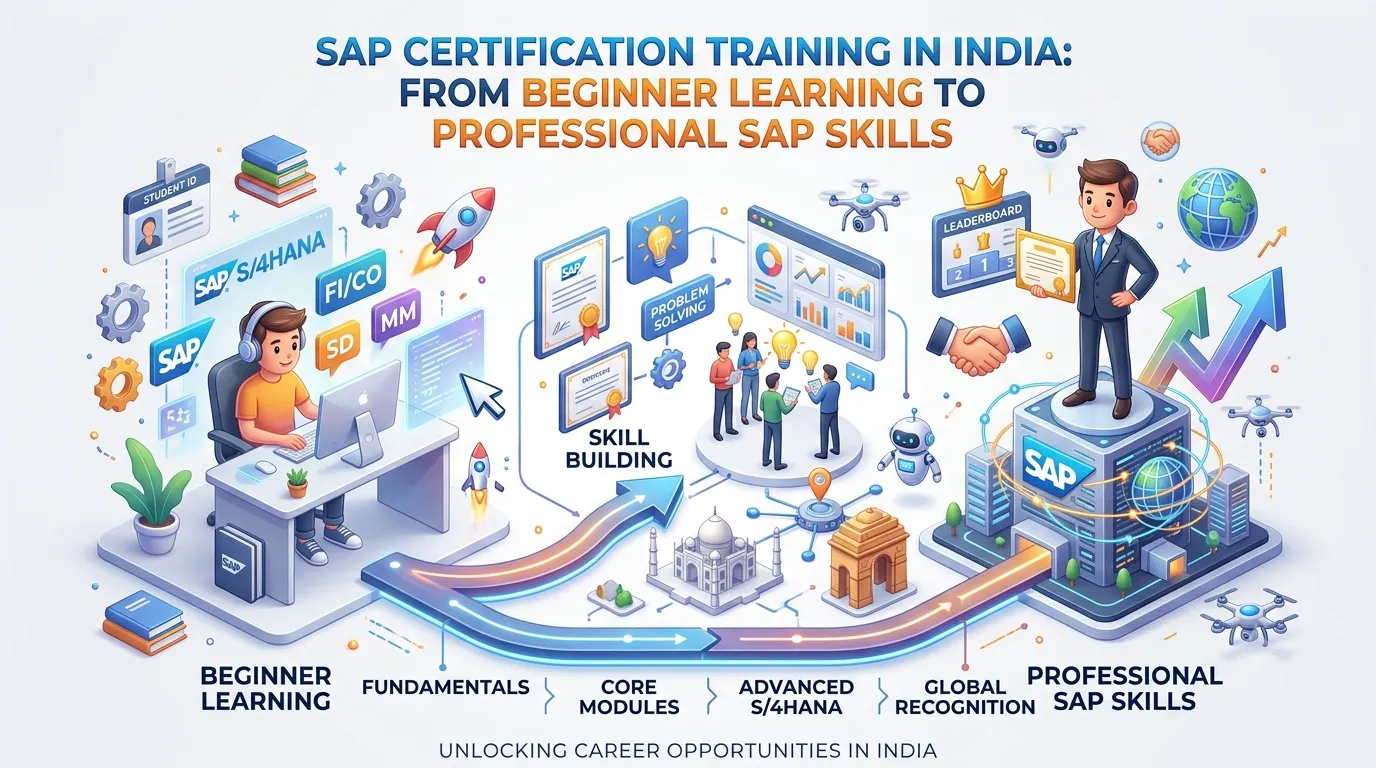


Enterprise systems influence almost every major business function. From finance and procurement to manufacturing and sales, organizations need technology that can connect processes and provide reliable information.
SAP has become an important part of this enterprise technology environment. However, learning SAP effectively requires more than understanding software screens. Professionals need to understand business processes, integration, configuration concepts, testing, reporting, and user requirements.
A structured SAP Training in India with Placement program can help learners develop these capabilities while preparing for career opportunities.
Begin With Business Process Knowledge
The first step for a beginner should be understanding how organizations operate.
For example, procurement begins with a requirement and can continue through purchasing, goods receipt, and invoice processing.
Similarly, sales can involve customer orders, delivery, billing, and financial impact.
Understanding these workflows makes it easier to understand where SAP fits into business operations.
Choose Your SAP Specialization
After learning ERP fundamentals, learners should select a module.
The right choice depends on background and career goals.
Finance professionals can explore finance. Supply-chain professionals can study procurement and inventory. Manufacturing professionals can consider production planning.
Technical learners can explore development, administration, integration, or other technology-focused paths.
What Certification Can Demonstrate
Certification can provide evidence of structured knowledge.
It can also help learners establish a professional learning milestone.
However, certification does not replace experience.
Candidates should understand how concepts are applied in practical situations and be able to discuss business scenarios during interviews.
Preparing for Certification
Learners preparing for certification should first understand the syllabus.
They should then study the concepts systematically and practice questions as part of revision.
Practical exercises can reinforce theoretical knowledge.
SAP Certification Training in India can provide a structured approach by combining curriculum coverage with examination preparation and practical activities.
Practical System Exposure
One of the most important aspects of SAP learning is access to a practical environment.
Students should have opportunities to navigate the system, understand transactions, follow processes, and practice scenarios.
This experience helps reduce the gap between theoretical learning and professional work.
Career and Placement Preparation
Completing certification is only one stage of career preparation.
Candidates should also develop resumes, practice interviews, understand job descriptions, and prepare project explanations.
A placement-focused program can provide guidance through these activities.
SAP Training in India with Placement can help learners organize their transition from education to employment when it includes practical projects and career support.
Why Projects Matter
Projects provide evidence of practical understanding.
A learner can document the business requirement, process flow, configuration approach, testing activities, and expected results.
During an interview, these details can help candidates demonstrate that they understand more than theoretical definitions.
Online Learning Opportunities
Working professionals often prefer online programs because of scheduling flexibility.
A learner searching for SAP Online Training in India should evaluate live instruction, system access, trainer interaction, assignments, and project support.
Online learning should still provide enough practical exposure to build confidence.
Career Opportunities
SAP knowledge can support roles such as SAP Consultant, Functional Consultant, Support Consultant, Business Analyst, Implementation Consultant, and SAP Analyst.
With experience, professionals may specialize further or move into senior consulting and project leadership.
The exact path depends on the selected module and professional background.
Continuous Professional Development
SAP professionals should continue learning after completing certification.
They can explore advanced functionality, integrations, analytics, cloud technologies, and industry-specific processes.
Continuous development helps professionals respond to changing business and technology requirements.
Conclusion
SAP certification can be a useful professional milestone, but the strongest career preparation combines certification with practical skills.
A structured SAP Online Training in India with Placement program can help learners develop business-process knowledge, system familiarity, project experience, and interview readiness.
The goal should be to become capable of understanding and solving business problems through SAP rather than simply collecting a certificate.
With the right specialization, consistent practice, and continuous learning, professionals can build a stronger foundation for long-term opportunities in the SAP ecosystem.


























Sign in to leave a comment.