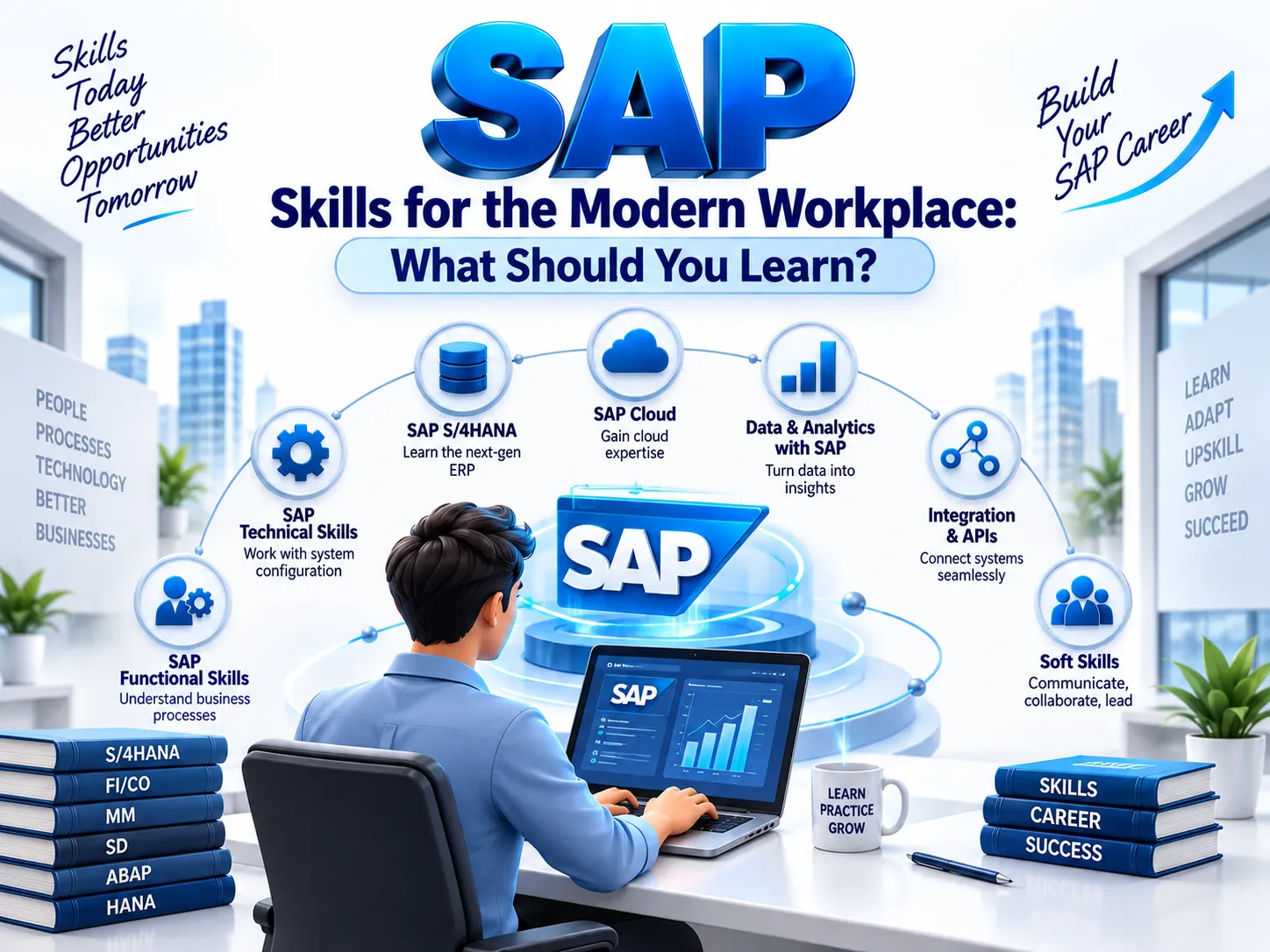

Businesses today need professionals who can understand technology as well as the business processes behind it. SAP continues to play an important role in areas such as finance, procurement, sales, supply chain, manufacturing, human resources, and data management.
For professionals planning to build or advance an SAP career, learning the right skills is more important than simply knowing how to navigate the software. A strong combination of SAP knowledge, business understanding, analytical ability, and practical experience can help professionals stay prepared for changing workplace requirements.
But which SAP skills should you learn? This guide explains the key technical and professional skills that can support career development in the modern SAP ecosystem.
What Are SAP Skills?
SAP skills refer to the knowledge and abilities required to work with SAP solutions and the business processes they support. These skills can range from functional knowledge of areas such as finance and procurement to technical capabilities involving development, integration, data, and cloud technologies.
The skills you need depend largely on your career goal. Someone working toward an SAP Finance role may need strong knowledge of accounting processes and SAP FICO, while an aspiring technical professional may focus more on ABAP, integrations, or SAP BTP.
Therefore, choosing skills based on your intended role is a better approach than trying to learn every SAP technology at once.
Why Are SAP Skills Important in the Modern Workplace?
Modern organizations are increasingly focused on connected business processes, automation, data-driven decisions, and cloud-based technology.
SAP professionals may be involved in implementing systems, supporting business operations, analyzing data, improving workflows, developing applications, or integrating different enterprise systems.
Because of this, employers often look for professionals who can do more than perform basic system tasks. They need people who can understand a business requirement, identify an appropriate SAP solution, communicate with stakeholders, and contribute to successful implementation or support.
This makes a combination of technical knowledge and business skills particularly valuable.
1. SAP Module Knowledge
One of the first skills to develop is knowledge of a specific SAP module or functional area.
Popular areas include:
- SAP FICO for finance and controlling
- SAP MM for procurement and materials management
- SAP SD for sales and distribution
- SAP PP for production planning
- SAP QM for quality management
- SAP SuccessFactors for human resources
- SAP Ariba for procurement processes
- SAP Transportation Management for logistics
- SAP S/4HANA for modern ERP processes
Instead of trying to learn multiple modules at the beginning, choose an area that matches your education, work experience, or career objective.
For example, finance professionals may find FICO more relevant, while professionals with supply chain experience may explore MM, SD, PP, or related areas.
2. SAP S/4HANA Knowledge
Understanding SAP S/4HANA is increasingly useful for professionals working with modern SAP environments.
S/4HANA supports integrated business processes across different organizational functions. Learning its basic architecture, business processes, user experience, and relevant functional areas can help professionals understand how modern SAP environments operate.
You do not necessarily need to master every component. A better approach is to understand S/4HANA in the context of your selected career path.
3. Business Process Understanding
Knowing SAP transactions alone is not enough for long-term career development.
Professionals should understand the business processes behind the system.
For example, an SAP MM professional should understand how procurement works from requirement identification through purchasing and goods receipt. Similarly, an SAP FICO professional should understand accounting and financial processes rather than focusing only on system configuration.
Business process knowledge helps professionals:
- Understand client requirements
- Identify process improvements
- Troubleshoot business issues
- Communicate with functional teams
- Contribute to implementation projects
This is one of the skills that can help an SAP professional progress beyond entry-level responsibilities.
4. SAP Configuration Skills
Functional consultants often need to understand how SAP systems are configured according to business requirements.
Configuration knowledge may include areas such as:
- Organizational structures
- Master data
- Business processes
- Document settings
- Integration points
- Workflow-related requirements
- Reporting requirements
The exact configuration skills depend on the selected SAP module.
Practical exposure is particularly useful because it helps learners understand how theoretical concepts are applied in real business scenarios.
5. SAP Technical Skills
Technical SAP careers require a different set of capabilities.
Depending on the role, useful technical skills may include:
- ABAP
- SAP BTP
- APIs and integrations
- SAP Integration Suite
- Data management
- Application development
- Cloud concepts
- Database fundamentals
Professionals interested in development should focus on building problem-solving abilities alongside technical knowledge. Understanding why a particular technical solution is required is often as important as knowing how to implement it.
6. SAP Integration Knowledge
Modern organizations rarely operate with one isolated application. SAP environments may need to communicate with other enterprise applications, cloud platforms, databases, and external services.
This makes integration knowledge increasingly valuable.
Professionals can develop an understanding of:
- APIs
- Data exchange
- Integration patterns
- SAP Integration Suite
- Cloud-to-cloud integration
- Application connectivity
- Error handling and monitoring
Integration skills can be particularly useful for technical consultants and professionals working on enterprise application projects.
7. Data and Analytical Skills
Data plays an important role in business decision-making.
SAP professionals can benefit from understanding how business data is collected, processed, analyzed, and presented.
Useful skills include:
- Data interpretation
- Reporting
- Business analytics
- Data quality
- Dashboard concepts
- Basic data modeling
- Analytical thinking
Even functional consultants can benefit from these capabilities because business teams increasingly expect technology professionals to help turn operational data into useful insights.
8. Cloud and Modern SAP Technologies
Cloud knowledge has become an important part of modern enterprise technology.
Professionals building an SAP career should understand basic cloud concepts and how SAP solutions can operate within cloud environments.
Depending on the career direction, learners may explore technologies such as SAP BTP, cloud-based ERP concepts, application development, integration, data services, and analytics.
The goal should not be to collect certifications without understanding the technology. Focus on how these technologies solve actual business problems.
9. Problem-Solving Skills
SAP projects involve real-world business challenges.
A consultant may need to investigate why a process is failing, determine whether the problem comes from configuration or master data, understand the business impact, and identify an appropriate solution.
Strong problem-solving skills can help professionals:
- Analyze business requirements
- Identify the root cause of issues
- Evaluate possible solutions
- Troubleshoot system problems
- Handle unexpected project situations
This skill becomes increasingly important as professionals move toward consultant and senior consultant positions.
10. Communication and Collaboration
SAP professionals frequently work with business users, technical teams, project managers, consultants, and organizational leaders.
Clear communication is therefore an important career skill.
Professionals should be able to:
- Understand stakeholder requirements
- Explain technical concepts clearly
- Document processes
- Participate in meetings
- Coordinate with different teams
- Present solutions confidently
A technically strong professional can still struggle in consulting if they cannot communicate effectively with clients and stakeholders.
11. Requirement-Gathering Skills
Requirement gathering is an important part of SAP consulting.
Before proposing a solution, professionals need to understand what the business actually needs.
This involves asking the right questions, documenting requirements, identifying process gaps, and distinguishing between business needs and preferred solutions.
Good requirement-gathering skills help consultants avoid assumptions and create solutions that are more closely aligned with business objectives.
12. Project and Implementation Knowledge
Learning how an SAP implementation works can provide valuable context for aspiring consultants.
Professionals should become familiar with concepts such as:
- Requirement analysis
- Process mapping
- Configuration
- Development
- Testing
- User acceptance testing
- Data migration
- Training
- Deployment
- Post-go-live support
Understanding the project lifecycle can help learners connect individual SAP concepts with the larger implementation process.
13. Testing and Troubleshooting Skills
Testing is an important part of SAP projects.
Professionals may need to test business processes, identify errors, document issues, and verify whether a solution works as expected.
Basic knowledge of testing approaches can help professionals understand:
- Test scenarios
- Test cases
- Defect identification
- Issue documentation
- User acceptance testing
- Regression testing
Troubleshooting skills also become valuable in support and consulting roles where professionals are expected to investigate problems and provide practical solutions.
14. SAP Certification Knowledge
Certification can provide structured learning goals and demonstrate that a professional has prepared for a defined area of SAP knowledge.
However, certification should not replace practical understanding.
A stronger career foundation comes from combining certification preparation with:
- Hands-on practice
- Business process knowledge
- Project-based learning
- Problem-solving
- Relevant work experience
Professionals considering certification can explore SAP Certification Training in India as part of a structured learning path, while continuing to build practical skills.
15. Practical SAP Experience
One of the most useful ways to strengthen SAP skills is through practical exposure.
Working on realistic scenarios can help learners understand how different SAP concepts connect.
For example, a learner could practice a complete business process such as:
Procure-to-Pay:
Requirement → Purchase Requisition → Purchase Order → Goods Receipt → Invoice Verification
Or:
Order-to-Cash:
Customer Order → Delivery → Goods Issue → Billing → Payment
These practical exercises help bridge the gap between theoretical learning and workplace requirements.
Which SAP Skills Should Freshers Learn?
Freshers do not need to master everything before starting their SAP career.
A practical starting point is:
- Understand basic ERP concepts.
- Select one SAP functional or technical area.
- Learn the related business processes.
- Build foundational SAP knowledge.
- Practice realistic business scenarios.
- Develop communication and problem-solving skills.
- Explore relevant certification options.
- Prepare for entry-level interviews.
A focused learning path is generally more manageable than trying to study several SAP modules simultaneously.
Which SAP Skills Should Experienced Professionals Learn?
Experienced professionals can use their existing domain knowledge to select SAP skills that complement their background.
For example:
- Finance professionals → SAP FICO
- Procurement professionals → SAP MM or SAP Ariba
- Sales professionals → SAP SD
- Manufacturing professionals → SAP PP or QM
- HR professionals → SAP SuccessFactors
- Developers → ABAP, SAP BTP, integrations
- Supply chain professionals → SAP TM and related solutions
This approach can make the transition into SAP more relevant because the professional already understands the underlying business processes.
How Can SAP Training Help You Build These Skills?
Structured learning can make it easier to follow a clear SAP career path.
A relevant SAP Course in India can help learners study important concepts in a planned sequence instead of relying only on scattered online resources.
A useful learning program should ideally include:
- SAP fundamentals
- Module-specific concepts
- Business process understanding
- Practical exercises
- Realistic scenarios
- Project exposure
- Interview preparation
- Certification guidance
The quality of learning matters more than simply completing a course. Learners should focus on whether they can explain concepts and apply them to practical situations.
How to Choose the Right SAP Skills for Your Career
Before selecting a course or specialization, consider these questions:
What is your educational background?
Your education can help you identify areas that may be easier to understand.
What is your work experience?
Existing domain experience can become an advantage when moving into SAP.
Do you prefer functional or technical work?
Functional roles generally focus more on business processes and configuration, while technical roles may involve development, integration, data, and applications.
What type of SAP role interests you?
Research the responsibilities of the roles you want before selecting your learning path.
What skills are required for those roles?
Review job descriptions to understand the technologies, business knowledge, and experience employers commonly seek.
Common Mistakes to Avoid When Learning SAP
Trying to Learn Every SAP Module
SAP is a large ecosystem. Trying to learn everything at once can create confusion.
Start with one specialization and expand your knowledge gradually.
Focusing Only on Theory
Reading concepts without practicing business scenarios can make it difficult to apply knowledge during interviews or projects.
Ignoring Business Processes
SAP is closely connected with business operations. Understanding the process behind the system is essential.
Collecting Certifications Without Practical Skills
Certifications can support your profile, but they should be combined with practical knowledge.
Neglecting Communication Skills
Consultants regularly interact with clients and internal teams. Communication should be developed alongside technical knowledge.
SAP Skills That Can Support Long-Term Career Growth
SAP careers can evolve as professionals gain experience.
An entry-level professional may initially focus on system support or specific project activities. With experience, the role can progress toward consulting, solution design, team leadership, or specialized technical responsibilities.
Long-term growth can be supported by developing:
- Deeper module expertise
- Cross-functional knowledge
- Business consulting skills
- Project experience
- Leadership abilities
- Communication skills
- Integration knowledge
- Cloud understanding
- Analytical capabilities
The most valuable skill set is not necessarily the largest one. It is the combination of skills that allows a professional to solve meaningful business problems.
Final Thoughts
The modern SAP workplace requires more than basic software knowledge. Professionals need a combination of SAP expertise, business process understanding, practical experience, analytical thinking, communication, and problem-solving ability.
The right learning path depends on your background and career objective. Instead of trying to master every technology, choose a relevant specialization, build strong fundamentals, practice realistic scenarios, and gradually expand into related areas.
For professionals beginning their journey, SAP Training in India can provide a structured starting point when combined with practical learning and a clearly defined career goal.
The focus should ultimately be on becoming someone who can understand a business problem and contribute to an effective SAP-based solution.
FAQs
What are the most important SAP skills to learn?
Important SAP skills include module knowledge, business process understanding, configuration, technical skills, integration, data analysis, problem-solving, communication, and project knowledge. The right combination depends on the SAP role you want to pursue.
Which SAP skills are useful for freshers?
Freshers can start with one SAP specialization, basic ERP concepts, business process knowledge, practical exercises, communication skills, and interview preparation. Developing a focused skill set is usually more effective than attempting to learn multiple modules simultaneously.
Is SAP S/4HANA important for an SAP career?
Yes, understanding S/4HANA can be valuable for professionals working with modern SAP environments. Learners should understand its concepts and business processes in relation to their chosen functional or technical specialization.
Should I learn SAP functional or technical skills?
It depends on your interests and background. Professionals with business-domain experience may prefer functional roles, while those interested in programming, development, integrations, or applications may prefer a technical path.
Is SAP certification enough to get an SAP job?
Certification can strengthen a professional profile, but it should not be considered a substitute for practical knowledge. Employers may also evaluate business understanding, problem-solving ability, communication, project exposure, and relevant experience.
How can I develop practical SAP skills?
You can develop practical skills through guided exercises, business scenarios, implementation simulations, project-based learning, and hands-on practice with relevant SAP processes.
Which SAP skills are useful for experienced professionals?
Experienced professionals can combine their existing domain expertise with a relevant SAP specialization. For example, finance professionals can explore FICO, procurement professionals can consider MM or Ariba, and HR professionals can explore SuccessFactors.
Why are business process skills important in SAP?
SAP supports business operations, so understanding the underlying processes helps professionals analyze requirements, troubleshoot problems, communicate with users, and recommend appropriate solutions.
Can SAP skills help with career growth?
Yes. As professionals gain deeper SAP knowledge, business understanding, project experience, and consulting capabilities, they can progress toward more advanced responsibilities and specialized roles.
How should I choose an SAP course?
Consider your background, career objective, preferred functional or technical area, curriculum, practical learning opportunities, project exposure, and certification preparation before selecting a course.



























Sign in to leave a comment.