
A practical guide for homeowners in London and across England and Wales
If you are planning a house extension, loft conversion or excavation near a neighbouring property, you may have heard about the importance of a Schedule of Condition Party Wall survey.
But when is this survey actually needed? Who arranges it? And what happens if your neighbour refuses access?
These are important questions for both homeowners planning construction and neighbours concerned about potential damage.
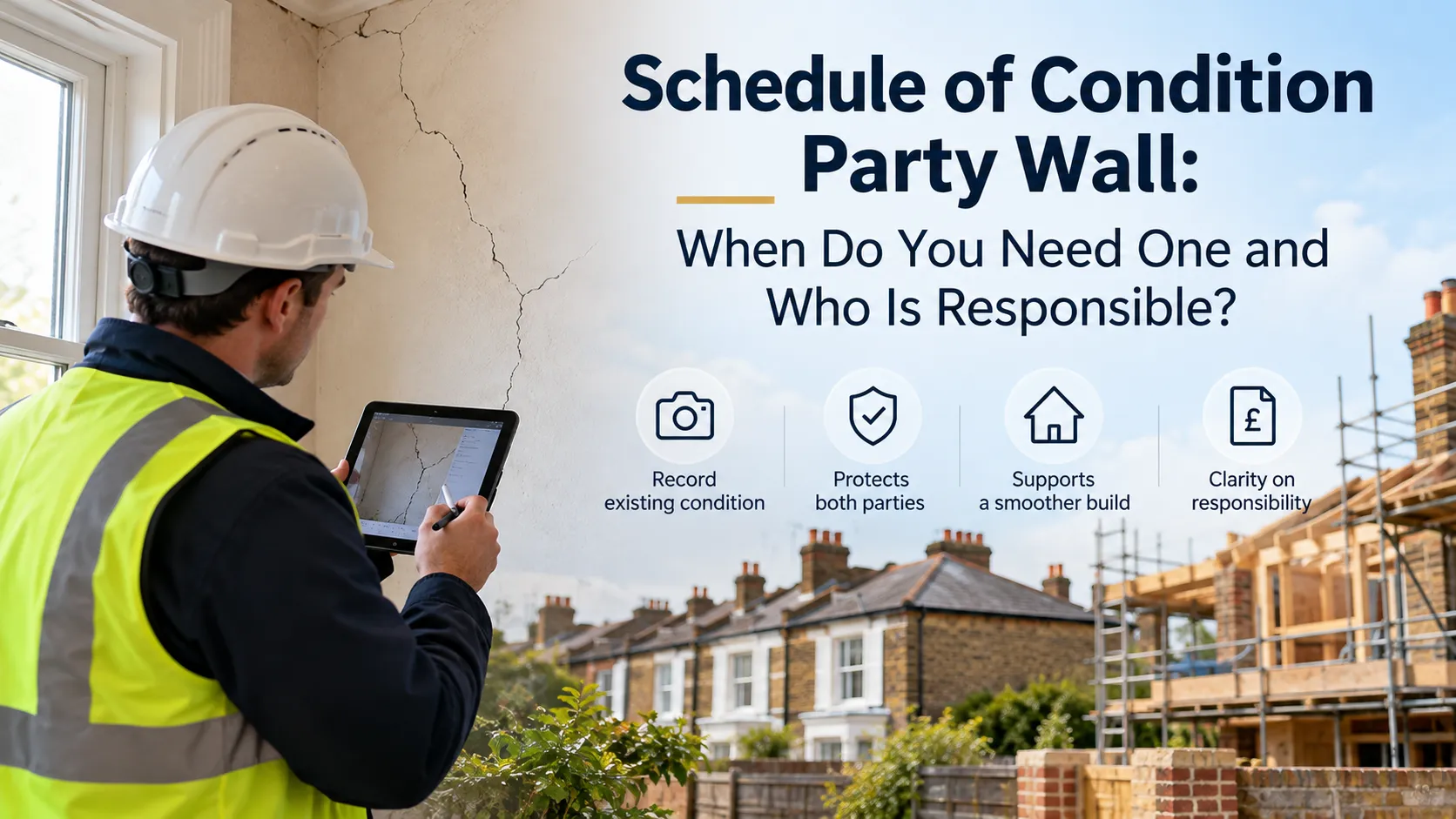
A Schedule of Condition provides a written and photographic record of a property's existing condition before nearby building work begins. It helps establish what was already there, making it easier to assess any damage reported during or after construction.
Although it is not a legal requirement under the Party Wall etc. Act 1996, it is widely recommended as a sensible precaution.
In this guide, we explain when a Schedule of Condition is appropriate, who is usually responsible for arranging and paying for it, and how it can help protect both parties.
What Is a Schedule of Condition Under the Party Wall Act?
A Schedule of Condition Party Wall report is an impartial record of the visible condition of relevant parts of a neighbouring property before construction begins.
It is typically prepared by a party wall surveyor and includes written observations and photographs documenting existing defects.
The report may cover cracks in plasterwork, ceiling damage, brickwork defects, signs of movement and other visible conditions that could become relevant during the building project.
Its primary purpose is to establish a reliable starting point against which the property's condition can be compared later.
Importantly, a Schedule of Condition does not automatically establish who is responsible for damage. Instead, it provides evidence that can assist surveyors when investigating whether construction work has caused or worsened a defect.
According to the UK Government's guidance on the Party Wall etc. Act 1996, a Schedule of Condition is not compulsory under the Act, but recording one is strongly advised.
GOV.UK
+1
When Do You Need a Schedule of Condition Party Wall Survey?
A Schedule of Condition is particularly valuable when proposed building works could affect an adjoining property.
The need for an inspection depends on the nature of the construction, the proximity of neighbouring structures and the potential risk of movement or damage.
Here are some common situations where a survey may be recommended.
1. Before a Loft Conversion
Loft conversions frequently involve structural alterations to existing walls and roof structures.
Where works affect a shared party wall, activities such as installing steel beams, forming beam pockets or altering masonry may create vibration or disturbance.
A Schedule of Condition can document existing cracks and finishes in the adjoining property before these works take place.
This helps distinguish pre-existing defects from changes that may be reported after construction.
2. Before a Rear or Side Extension
Extensions often require new foundations close to neighbouring buildings.
Depending on their depth and proximity, excavation works may fall within the provisions of the Party Wall etc. Act 1996.
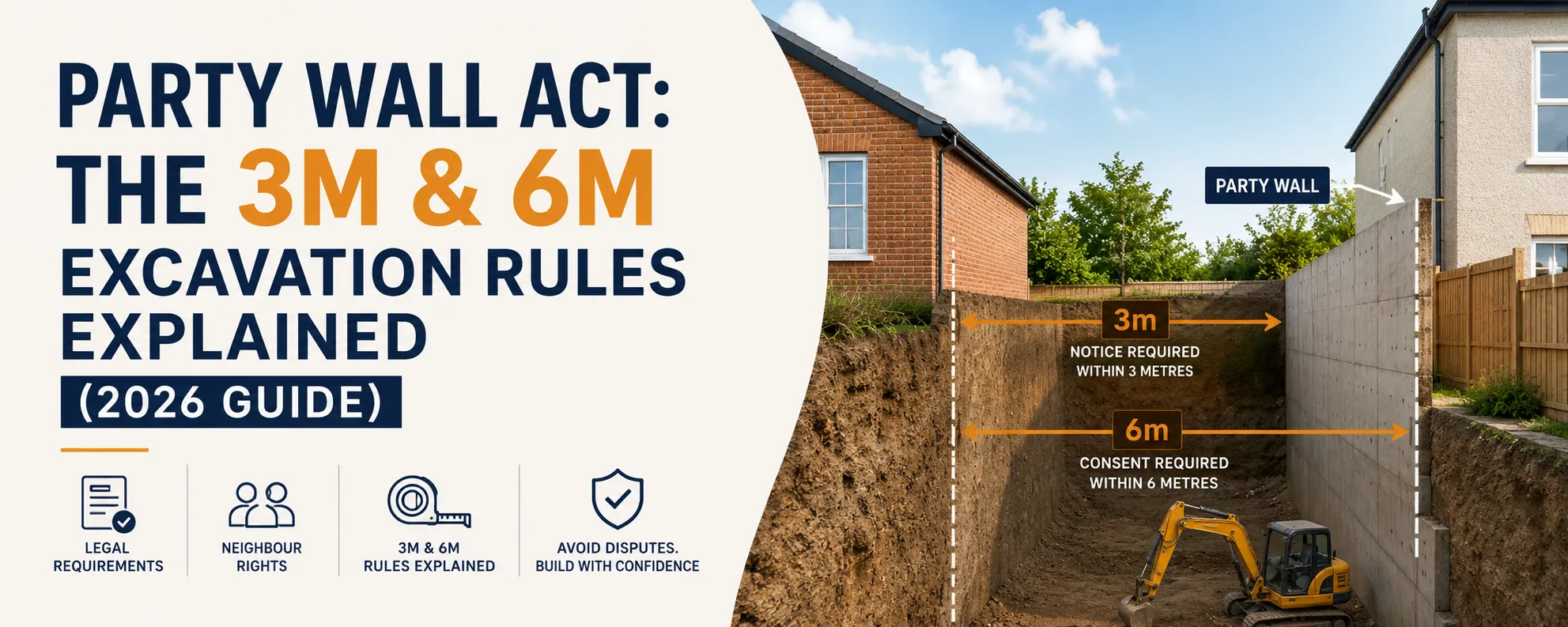
For example, excavation within three metres of a neighbouring structure may be notifiable where it extends below the bottom of that structure's foundations. Certain deeper excavations within six metres may also fall within the Act.
A Schedule of Condition can provide useful evidence of the neighbouring property's condition before excavation begins.
3. Before Basement Excavation
Basement construction can involve substantial excavation, underpinning and temporary structural support.
These activities may create a greater risk of movement or damage to nearby properties.
In such cases, a detailed Schedule of Condition is particularly important because it provides a baseline for assessing any subsequent changes.
Depending on the project, additional structural monitoring or engineering advice may also be appropriate.
4. Before Removing a Chimney Breast
Removing a chimney breast from a shared party wall can involve alterations to masonry and the installation of structural supports.
A Schedule of Condition can document the condition of adjoining walls, ceilings and nearby finishes before work starts.
This may be especially useful in older terraced or semi-detached properties where existing plaster cracks or historic repairs are already present.
Is a Schedule of Condition Legally Required?
No. A Schedule of Condition is not a statutory requirement under the Party Wall etc. Act 1996.
However, it is commonly prepared as part of the party wall process, particularly where surveyors are appointed to resolve a dispute and produce a Party Wall Award.
A Party Wall Award may include or refer to a Schedule of Condition as part of the documentation for the proposed works.
Without a reliable pre-construction record, disagreements about whether damage existed before building work began can become more difficult to resolve.
For this reason, arranging a Schedule of Condition is generally a practical precaution rather than simply an administrative exercise.
It is also important to understand that obtaining a Schedule of Condition does not replace the need to serve a Party Wall Notice where the Act requires one.
Who Arranges and Pays for a Party Wall Schedule of Condition?
In most typical residential party wall matters, the building owner proposing the works arranges for the relevant Schedule of Condition to be prepared and meets its reasonable cost.
However, responsibility for fees depends on the circumstances of the project and any applicable Party Wall Award.
The building owner is the person undertaking the proposed construction work, while the adjoining owner is the neighbouring owner whose property may be affected.
The appointed surveyor or surveyors usually determine whether a Schedule of Condition is appropriate and arrange the inspection.
Where both owners appoint the same agreed surveyor, that surveyor may undertake the inspection as part of the wider party wall process.
Where separate surveyors are appointed, the arrangements can be agreed between them.
For further guidance, explore the Schedule of Condition survey services offered by Party Walls Limited.
When Should a Schedule of Condition Be Carried Out?
The most appropriate time to prepare a Schedule of Condition is before any potentially damaging construction activity begins.
This ensures the report reflects the property's condition before it is exposed to the effects of the proposed works.
A typical sequence is:
- Review the proposed building works. Identify whether the project falls within the Party Wall etc. Act 1996.
- Serve the relevant Party Wall Notice. Give adjoining owners the statutory notice required for the proposed works.
- Resolve any dispute. If a dispute arises under the Act, the appointed surveyor or surveyors deal with the statutory process.
- Arrange the Schedule of Condition. Record the relevant neighbouring property's condition before works commence.
- Finalise the Party Wall Award, where required. The Award may incorporate or refer to the Schedule of Condition.
- Commence the authorised works. Ensure the applicable notice periods, agreements and Award requirements have been satisfied.
The precise order of some administrative steps can vary, but the essential principle remains the same: the condition record should be completed before the relevant construction starts.
What Happens If a Neighbour Refuses a Schedule of Condition Survey?
An adjoining owner may be reluctant to allow a surveyor into their property.
They may have concerns about privacy, disruption or the purpose of the inspection.
The first step is usually to explain what the inspection involves, why it has been requested and how the report may benefit both parties.
A Schedule of Condition is generally a visual inspection rather than an intrusive investigation.
If access is refused, the surveyor should consider the circumstances, including any applicable statutory access rights, and advise on the appropriate next steps.
The UK Government's explanatory guidance confirms that a Party Wall Award can be prepared without a Schedule of Condition where an adjoining owner does not wish one to be undertaken. However, the absence of a record may make later damage disputes harder to assess.
A refusal does not automatically prevent a Party Wall Award from being made, nor does it give unrestricted permission to enter a neighbour's property.
How Does a Schedule of Condition Help If Damage Occurs?
Consider a common situation involving two neighbouring terraced houses in London.
One homeowner is carrying out a rear extension involving foundation excavation. Before construction starts, a surveyor records an existing hairline crack above a doorway in the adjoining property.
Several weeks later, the adjoining owner notices that the crack appears wider.
The original Schedule of Condition provides a useful reference point.
The surveyor can compare the recorded condition with the current appearance, consider whether the crack has changed and investigate whether the construction works are likely to have contributed.
Without the original record, establishing the previous condition could be more difficult.
A Schedule of Condition therefore supports a fairer assessment, but it does not guarantee that every disagreement will be avoided or prove the cause of any damage on its own.
Schedule of Condition vs Party Wall Award: What Is the Difference?
Although these documents are often prepared as part of the same process, they serve different purposes.
| Schedule of Condition | Party Wall Award |
|---|---|
| Records the existing condition of a property | Resolves a dispute under the Party Wall etc. Act 1996 |
| Usually includes written notes and photographs | Sets out authorised works and relevant conditions |
| Provides evidence for future comparisons | Establishes rights and obligations under the Award |
| Not a statutory requirement in itself | Required to resolve a dispute through the Act's surveyor procedure |
| Focuses on the property's condition | Focuses on how the notifiable works may proceed |
A Schedule of Condition may accompany a Party Wall Award, but the two documents should not be confused.
You can learn more about the formal process through Party Wall Awards in London.
Can You Arrange a Schedule of Condition Without a Party Wall Award?
Yes. A Schedule of Condition can be arranged independently of a Party Wall Award.
For example, two neighbours may agree that a photographic condition record would be useful before building works begin, even where no statutory dispute has arisen.
An independent survey can also be considered for works that do not fall within the Party Wall etc. Act 1996 but may still affect a neighbouring property.
However, a privately arranged Schedule of Condition does not itself constitute a Party Wall Award or replace any statutory notice requirements.
How Much Does a Schedule of Condition Party Wall Survey Cost in London?
The cost depends on the property, the scope of inspection and the complexity of the proposed works.
Factors affecting the fee include property size, accessibility, the number of relevant rooms, the extent of existing defects and the level of documentation required.
As a general indication, Party Walls Limited's published guidance suggests approximately £200–£600 for a standard residential Schedule of Condition, with more complex properties potentially costing more. This is an indicative range rather than a guaranteed quotation.
In some cases, the inspection may form part of a wider party wall surveying fee rather than being charged separately.
For an accurate quotation, the surveyor should review the proposed works and relevant property details.
Why Choose Party Walls Limited for a Schedule of Condition Survey?
A well-prepared Schedule of Condition requires more than taking photographs.
It involves understanding the proposed building works, identifying relevant areas of the adjoining property and preparing a clear, impartial record that can be referred to if concerns arise.
At Party Walls Limited, we specialise in party wall matters for residential and commercial properties across London and the Home Counties.
Our services include Party Wall Notices, Party Wall Awards, Schedule of Condition inspections and advice on matters arising under the Party Wall etc. Act 1996.
Whether you are planning construction or have received a Party Wall Notice from your neighbour, our experienced surveyors can help you understand the process and determine whether a Schedule of Condition is appropriate.
Frequently Asked Questions About Schedule of Condition Party Wall Surveys
Is a Schedule of Condition compulsory for a party wall agreement?
No. The Party Wall etc. Act 1996 does not make a Schedule of Condition compulsory. However, it is commonly recommended to document the adjoining property's condition before building work begins.
Who pays for a Schedule of Condition survey?
The building owner proposing the works usually pays the reasonable cost in typical party wall matters. The precise responsibility depends on the circumstances and any relevant Party Wall Award.
Can building work start without a Schedule of Condition?
Potentially, yes. A Schedule of Condition is not itself a statutory prerequisite. However, the building owner must still comply with applicable Party Wall Act requirements, and proceeding without a condition record can make later damage disputes more difficult.
How long is a Schedule of Condition valid?
There is no fixed statutory expiry period. The report should accurately reflect the property's condition immediately before the relevant works. If significant time passes or the property's condition changes, an updated inspection may be advisable.
Can a neighbour refuse a Schedule of Condition?
An adjoining owner may decline a voluntary inspection. Any statutory access rights must be considered separately. An Award may still be prepared without a Schedule of Condition, depending on the circumstances.
Does a Schedule of Condition cover hidden structural defects?
No. It normally records visible and accessible conditions. It is not a substitute for a structural survey, concealed-defect investigation or specialist engineering assessment.
What happens if damage is found after building work?
The appointed surveyor or surveyors may compare the current condition with the original Schedule of Condition and consider the evidence to determine the appropriate next steps. The procedure depends on the nature of the damage and the applicable Party Wall Award.
Final Thoughts
A Schedule of Condition Party Wall survey is a straightforward but valuable precaution when construction work is planned near a neighbouring property.
It helps both building owners and adjoining owners understand the property's existing condition, provides evidence if concerns arise and can reduce uncertainty during the building process.
Although the survey is not legally compulsory, arranging one before relevant works begin is often a sensible investment in protecting property interests and maintaining good neighbour relationships.
If you are planning an extension, loft conversion, basement excavation or other work involving a party wall, obtaining professional advice early can help you understand your responsibilities and avoid unnecessary complications.
Need a Schedule of Condition Party Wall Survey in London?
Party Walls Limited can help you understand whether a survey is appropriate for your project and guide you through the relevant party wall procedures.
020 8877 0365























Sign in to leave a comment.