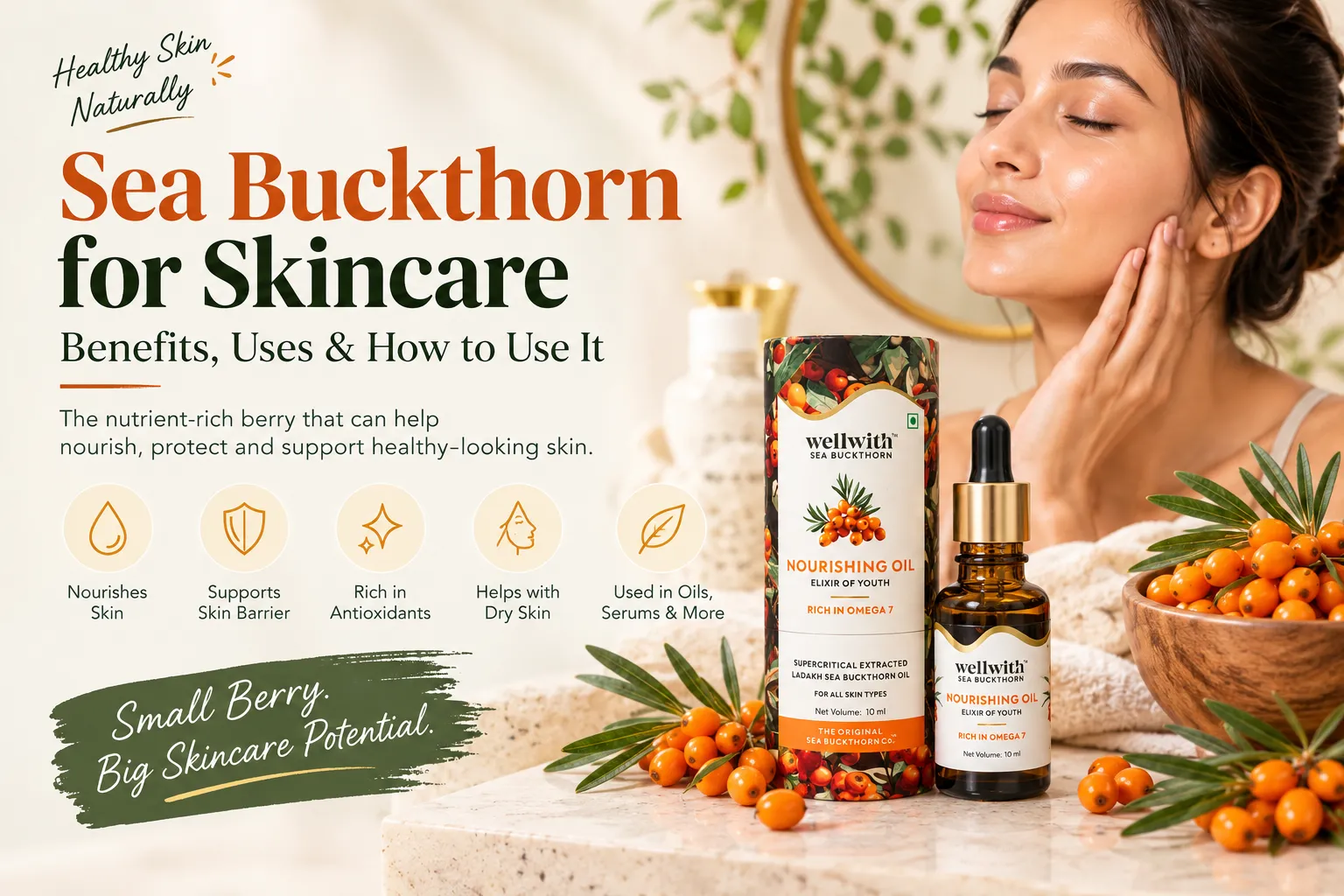

Sea buckthorn has become an increasingly popular ingredient in modern skincare, particularly in facial oils, moisturizers, serums, and nourishing treatments. The bright orange berry is valued not only for its distinctive appearance but also for its naturally occurring fatty acids, carotenoids, vitamins, and other plant compounds.
But is sea buckthorn actually useful for skin? And how should you use it in a skincare routine?
This guide explains the potential benefits of sea buckthorn for skincare, what makes sea buckthorn oil different, and how to choose and use a quality product.
What Is Sea Buckthorn?
Sea buckthorn (Hippophae rhamnoides) is a berry-producing plant found across parts of Europe and Asia, including Himalayan regions. Its small orange berries contain a combination of naturally occurring fatty acids, carotenoids, flavonoids, vitamins, and other bioactive compounds.
Sea buckthorn is used in several forms, including juice, dried berries, supplements, and oils. For skincare, however, sea buckthorn oil is particularly interesting because many of its fat-soluble compounds are concentrated in the oil.
Research has identified a range of fatty acids and other compounds in sea buckthorn oil, although its exact composition varies depending on whether the oil comes from the fruit pulp or seeds and how it is processed.
Why Is Sea Buckthorn Used in Skincare?
1. It Can Help Nourish the Skin
One of the main reasons sea buckthorn oil is used in skincare is its fatty-acid profile.
Sea buckthorn oil contains different fatty acids, including omega-3, omega-6, omega-7, and omega-9-related fatty acids. These lipids can help make skincare formulations feel nourishing and conditioning, particularly when used on dry or rough-feeling skin.
Importantly, the composition can differ significantly between seed and pulp oils. Therefore, checking which type of sea buckthorn oil a skincare product contains can be useful.
2. It May Support the Skin Barrier
A healthy skin barrier helps reduce excessive water loss and protects the skin from environmental stressors.
There is some human evidence specifically involving Hippophae rhamnoides. In one small study, a topical emulsion containing 5% sea buckthorn extract was associated with improved skin hydration and reduced transepidermal water loss compared with the base formulation after 84 days. However, the study involved only 13 healthy male participants, so larger studies are needed.
This makes sea buckthorn an interesting ingredient for skincare focused on hydration and barrier support, but it should not be presented as a treatment for skin disorders.
3. It Contains Antioxidant Compounds
Sea buckthorn contains naturally occurring carotenoids, tocopherols, flavonoids, and other antioxidant compounds.
Antioxidants are relevant to skincare because skin is constantly exposed to environmental factors such as UV radiation and pollution that can contribute to oxidative stress.
Laboratory research has found that sea buckthorn seed oil can influence oxidative-stress pathways in UV-exposed skin cells. However, laboratory findings should not be interpreted as proof that applying sea buckthorn oil can replace sunscreen or protect skin from sunburn.
Sunscreen remains essential for protecting skin from UV radiation.
4. It Can Be Useful for Dry or Stressed-Looking Skin
Because of its lipid content, sea buckthorn oil is often included in products designed to soften, condition, and nourish dry-feeling skin.
This makes it particularly suitable for routines where the goal is to improve the feeling of comfort and softness rather than simply adding water-based hydration.
For very dry skin, sea buckthorn oil can also be layered over a moisturizer. The moisturizer provides hydration, while the oil can help provide a more nourishing finish.
Is Sea Buckthorn Good for Acne-Prone Skin?
This is where expectations are important.
Sea buckthorn oil is not an established acne treatment, and having antioxidants or fatty acids does not automatically mean an oil will prevent breakouts.
If you have acne-prone or oily skin, consider the complete formulation rather than focusing only on the ingredient. A lightweight, well-formulated product may feel more comfortable than a heavy facial oil.
If you want to try a sea buckthorn nourishing oil, start with a small amount and patch test first. If you experience persistent irritation or breakouts, discontinue use and consider speaking with a dermatologist.
Sea Buckthorn for Different Skin Types
Dry Skin
Sea buckthorn oil can be a useful addition to a dry-skin routine because of its nourishing lipid profile. Apply a small amount after a moisturizer to help leave skin feeling softer.
Normal Skin
For normal skin, a few drops can be used as an occasional nourishing step, particularly when the skin feels dry or exposed to harsh weather.
Sensitive Skin
Sensitive skin requires more caution. Choose a simple formulation with minimal potential irritants and always patch test a new product.
Oily or Acne-Prone Skin
Instead of applying a large amount of oil, look for lightweight formulations containing sea buckthorn as one component. Introduce the product gradually and observe how your skin responds.
How to Use Sea Buckthorn Nourishing Oil in Your Skincare Routine
Using sea buckthorn oil does not need to make your routine complicated.
A simple routine could look like this:
Morning:
Cleanser → Moisturizer → Sunscreen
Evening:
Cleanser → Serum or moisturizer → 1–3 drops of sea buckthorn nourishing oil
You can also mix a small amount of oil with your moisturizer if you prefer a less concentrated application.
However, follow the directions provided with the specific product because concentration and formulation vary between products.
What Should You Look for in a Sea Buckthorn Skincare Product?
Not all sea buckthorn products are identical. When choosing one, look beyond the front label.
Check the Source
Look for information about where the sea buckthorn is sourced and whether the brand clearly identifies the ingredient and plant part used.
Understand the Formulation
Check whether the product contains seed oil, pulp oil, or another sea buckthorn extract. Also review the complete ingredient list, especially if your skin is sensitive.
Look for Quality Information
A transparent brand should provide useful information about ingredient sourcing, processing, formulation, and quality checks where applicable.
Don't Rely on “Natural” Alone
Natural ingredients can still cause irritation or sensitivity. Product quality depends on the
complete formulation, processing, storage, and suitability for your skin—not simply whether an ingredient is natural.
Sea Buckthorn Nourishing Oil: A Simple Skincare Option
For people looking to add a botanical oil to their routine, sea buckthorn nourishing oil can be an interesting option. Its combination of fatty acids and naturally occurring antioxidant compounds makes it suitable for formulations designed to nourish and condition the skin.
The key is to use it as part of a balanced routine rather than expecting one ingredient to solve every skincare concern.
Final Thoughts
The appeal of sea buckthorn for skincare comes from its unique combination of fatty acids, carotenoids, vitamins, and other plant compounds. Research suggests potential benefits for skin hydration and barrier function, while laboratory studies provide additional insight into its antioxidant and skin-related properties. However, the clinical evidence is still limited, and more high-quality human research is needed.
If you want to try sea buckthorn skincare, focus on quality sourcing, transparent ingredients, appropriate formulation, and how your own skin responds. Used alongside basics such as gentle cleansing, moisturizing, and daily sunscreen, it can be a useful botanical addition to a simple skincare routine.
FAQs
1 . Is sea buckthorn good for skin?
Sea buckthorn contains fatty acids and antioxidant compounds that may help nourish skin and support hydration and barrier function.
2. What does sea buckthorn oil do for the skin?
It can help condition and nourish the skin, particularly when it feels dry or stressed.
3. Can I use sea buckthorn oil on my face?
Yes, if the product is formulated for facial use. Start with a small amount and patch test first.
4. Is sea buckthorn oil good for acne-prone skin?
It is not an established acne treatment. If your skin is acne-prone, choose a lightweight formulation and introduce it gradually.
5. Can sea buckthorn oil replace sunscreen?
No. Sea buckthorn oil should not replace a broad-spectrum sunscreen.


























Sign in to leave a comment.