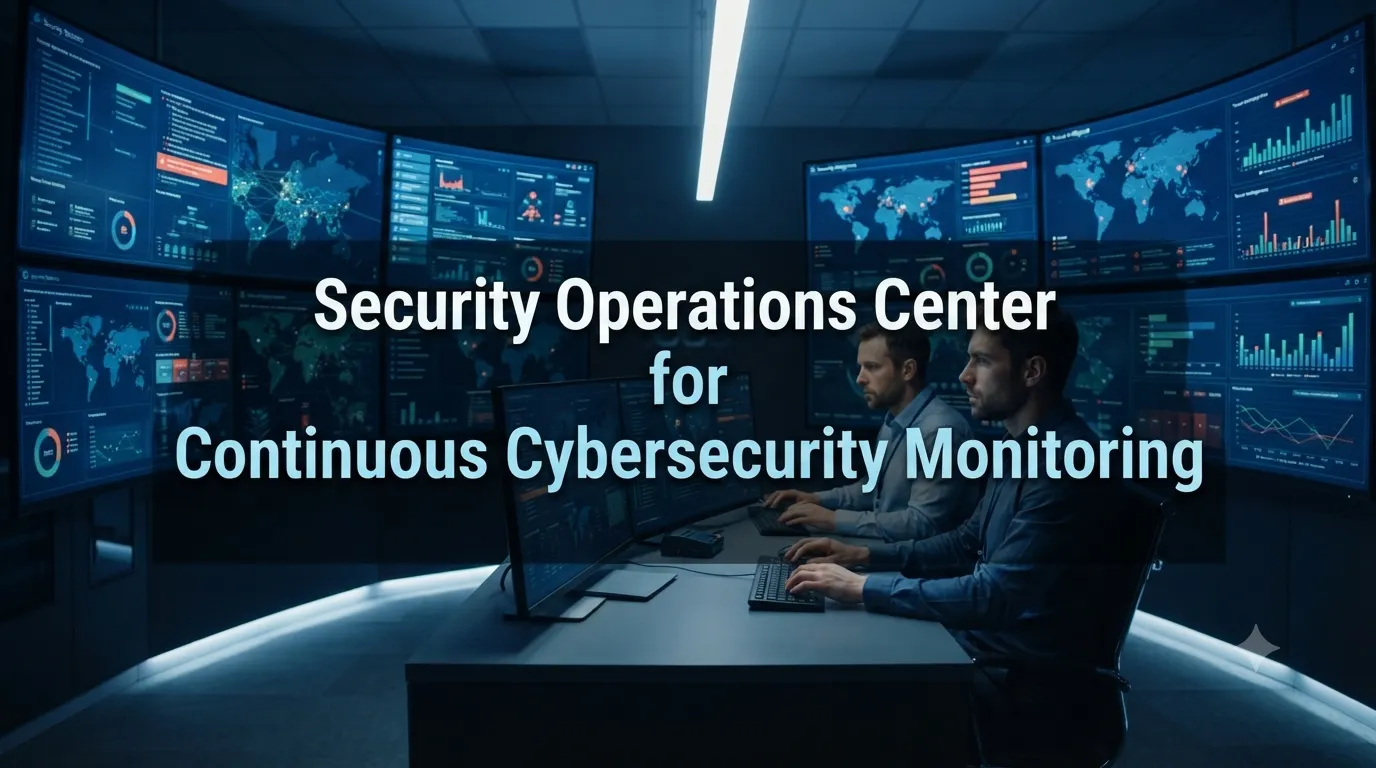

A strange login at 2:13 a.m. might not look like much at first. Maybe an employee is working late. Maybe they are traveling. Or maybe someone else has just entered the network using stolen credentials. This is where a security operations center becomes so valuable. Instead of waiting for an obvious breach, security teams watch systems, users, devices, and network activity around the clock and investigate signs that something feels off.
What Is a Security Operations Center?
A security operations center, commonly called a SOC, is a team and technology setup responsible for monitoring an organization's digital environment for cybersecurity threats.
People often picture a room filled with giant screens and analysts staring at alerts all night. Those rooms do exist, sure, but a SOC is really more about the people, processes, and security tools working together than the room itself.
A SOC monitors activity across an organization's IT environment. That can include computers, servers, cloud platforms, applications, firewalls, email systems, identity platforms, and other connected devices.
The goal is fairly straightforward: spot suspicious activity, investigate it, and respond before a small security event turns into a serious incident.
Why Continuous Cybersecurity Monitoring Matters
Cyberattacks don't follow office hours.
An attacker does not think, “It's Friday evening, I'll come back Monday.” If an organization only checks security logs during business hours, there can be a large window where unusual activity goes unnoticed.
Continuous cybersecurity monitoring gives security teams visibility throughout the day and night. Automated tools collect events from different systems while analysts review alerts that may require human judgment.
Imagine an employee account suddenly signing in from one country and then another location shortly afterward. That could be harmless. Travel happens. VPNs exist. Still, it deserves a closer look.
Now imagine that same account downloading hundreds of files and attempting to access systems it has never used before.
That combination starts looking much more interesting.
How SOC Monitoring Works
A modern SOC usually pulls security information from many places rather than watching one system in isolation.
Common data sources include:
- Firewall and network logs
- Endpoint security software
- Cloud services
- Email security platforms
- Authentication systems
- Identity and access management tools
- Servers and databases
- Web applications
- Security sensors
- Vulnerability management platforms
Security information and event management, or SIEM, software is often used to collect and organize this information.
Without some kind of central system, analysts could end up jumping between dozens of dashboards. Nobody wants that at 3 a.m.
A SIEM can connect related events and generate alerts based on rules, patterns, and other detection methods. Analysts then investigate the alerts and decide whether further action is needed.
What Does a SOC Analyst Do?
SOC analysts are the human side of cybersecurity monitoring.
Their work can include reviewing alerts, checking logs, investigating suspicious behavior, researching indicators of compromise, and helping with incident response.
A typical alert might say that malware was detected on a laptop. That sounds serious, but the alert alone does not tell the whole story.
An analyst may check:
- What file triggered the alert?
- Where did it come from?
- Which user opened it?
- Did the file communicate with an external server?
- Did other computers show similar activity?
- Were any credentials used afterward?
- Has the device accessed sensitive information?
The answers help the team understand what actually happened.
Sometimes the alert turns out to be harmless. Other times, several small clues line up and reveal something much bigger.
SOC Incident Detection and Response
Threat detection is only one part of security operations. A SOC also plays an important role in incident response.
Suppose an endpoint begins communicating with a suspicious external address. The security platform raises an alert. An analyst reviews the event and finds that the device also downloaded an unfamiliar executable.
The team may isolate the affected device from the network, investigate the file, check for similar activity elsewhere, and begin removing the threat.
Speed matters here.
The longer an attacker remains inside an environment, the more opportunities they may have to steal information, move between systems, or disrupt operations.
A security operations center can help organizations move from “something strange happened” to “we know what happened and we're taking action.”
Security Operations Center Services
Organizations can build their own SOC, outsource monitoring, or use a combination of internal staff and an external security provider.
SOC services may include:
- 24/7 security monitoring
- Threat detection
- Security alert investigation
- Incident response
- Endpoint monitoring
- Network monitoring
- Log management
- SIEM monitoring
- Threat intelligence
- Vulnerability monitoring
- Security reporting
- Digital investigation support
Managed SOC services can be useful for companies that don't have enough internal security staff to maintain round-the-clock monitoring.
That does not mean every alert gets treated as a crisis. Good security monitoring also involves filtering noise and giving analysts enough context to focus on events that actually deserve attention.
SOC and Threat Intelligence
Threat intelligence gives security teams additional information about known or emerging threats.
An IP address, domain, file hash, or malware signature found during an investigation may match information from external threat intelligence sources.
That extra context can help analysts determine whether an event is connected to known malicious infrastructure or a previously identified campaign.
Still, threat intelligence is not magic. A suspicious indicator needs context. An address appearing in a threat feed does not automatically prove that every connection to it represents an active attack.
Good analysts ask questions. Lots of them.
Benefits of 24/7 Security Monitoring
Continuous monitoring can help organizations spot unusual behavior earlier, investigate incidents faster, and maintain better visibility across their technology environment.
It can also help with security compliance requirements where logging, monitoring, alerting, or incident records are expected.
Another practical benefit is consistency. A security team does not have to depend entirely on someone noticing an unusual event during a busy workday.
There is also a simple peace-of-mind factor. Knowing that security activity is being watched outside normal office hours matters, particularly for companies that operate online around the clock.
Building an Effective SOC
A SOC needs more than expensive security software.
People need clear procedures for handling alerts. Detection rules need regular review. Logs need to be available and useful. Employees need to know who should be contacted during a suspected incident.
The organization also needs to understand what it is actually trying to protect.
A small business with a few cloud applications will have different monitoring needs from a hospital, bank, manufacturer, or large software company.
Starting with the most important systems usually makes sense. From there, monitoring can expand as the environment grows.
And yes, there will be false alarms. There always are. The goal is not to create a world where every notification is terrifying. It is to give security teams enough useful information to recognize genuine threats and act before damage spreads.
Cybersecurity monitoring is a bit like having someone regularly check the locks, windows, cameras, and doors of a building instead of waiting for a broken window to tell you there was a problem.
The technology keeps changing, too. New attack methods appear, cloud environments grow, employees work from different places, and more business systems become connected.
A capable SOC gives organizations a place to keep watch through all of that noise. Not perfectly. No security setup can promise that. But with continuous monitoring, skilled analysts, useful security data, and clear response procedures, suspicious activity has a much better chance of being noticed while there is still time to do something about it.
























Sign in to leave a comment.