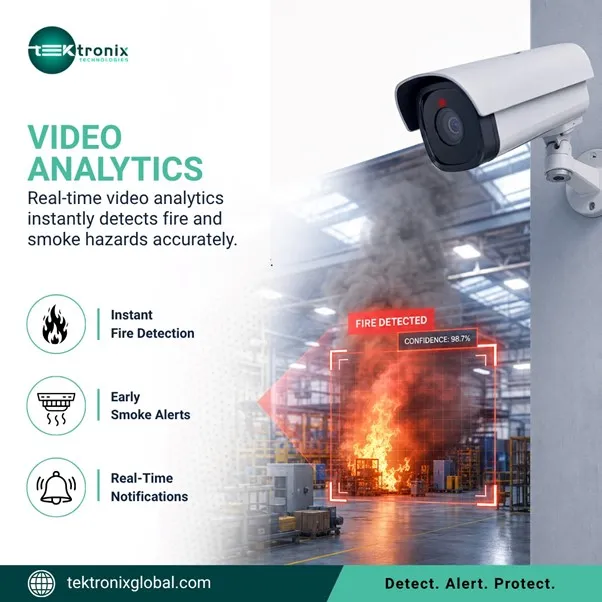

A point-type smoke detector can only respond once combustion particles physically drift up to touch it, and in the large, open, or heavily ventilated spaces that define much of the UAE's industrial and infrastructure landscape, that drift can take minutes rather than seconds. Video Analytics for fire and smoke detection closes that gap by watching a space visually rather than waiting for smoke to arrive at a sensor — spotting flame flicker and a developing smoke plume from tens of metres away, often before a conventional detector even begins to register a change.

UAE facilities — from oil and gas processing plants and high-bay logistics warehouses to high-rise towers and data centres — face a fire detection challenge shaped by exactly the conditions where traditional sensors struggle most: extreme ceiling heights, strong ventilation, open-sided structures, and outdoor exposure. Local fire codes require detection systems matched to the specific geometry and hazard profile of each space, and camera-based detection has become the practical way to meet that requirement in environments where point detectors simply cannot provide adequate coverage.
Why Traditional Fire Detection Falls Short in UAE Environments
Conventional point-type smoke and heat detectors are designed for enclosed spaces with modest ceiling heights, where combustion products accumulate rapidly at sensor level. They perform poorly, or not at all, in the large-volume spaces that dominate UAE industrial and infrastructure environments: aircraft hangars where ceiling heights exceed thirty metres and high air velocity dilutes combustion particles before they reach a sensor; open-sided logistics sheds where natural ventilation prevents product accumulation; outdoor refineries and petrochemical areas where wind dispersal renders point-detector thresholds largely irrelevant; and road tunnels where detection geometry demands a fundamentally different approach altogether.
In these environments, which represent a significant share of the UAE's highest-consequence fire risk locations, AI-Powered Video Analytics provides a detection capability that conventional systems cannot. Camera-based detection analyses the visual characteristics of fire and smoke as they develop — the distinctive pixel-level patterns of flame flicker, smoke plume expansion, and colour temperature shift — at detection distances of fifty metres or more, across open areas that no realistic quantity of point detectors could adequately cover.
Smart Video Analytics: From Passive Recording to Active Hazard Recognition
Older CCTV networks simply record footage for someone to review after the fact. Smart Video Analytics flips that model, running continuous computer-vision analysis on every camera feed so the system itself recognises a hazard signature in real time rather than waiting for a person to notice it on a monitor wall.
A complete Video Analytics Solution for fire safety combines this recognition layer with the physical camera network, the analytics processing hardware, and the integration links to a facility's existing fire alarm and building management infrastructure — the software alone is only useful once it is genuinely wired into the systems that need to act on what it sees.
At the core of that stack sits the Video Analytics Software, which runs the detection algorithms frame by frame, and the broader Video Analytics System architecture that manages camera health, processing load distribution across a large multi-camera site, and the alerting pipeline that turns a detection event into an action a human or another system can respond to.
Core Capabilities of AI-Based Video Analytics Fire Detection
Real-Time Hazard Detection: The Metric That Matters Most
Real-Time Hazard Detection is the primary performance measure for any fire detection system: the elapsed time between ignition or smoke generation and confirmed alarm. Local civil defence technical standards specify detection latency requirements that vary by occupancy type and hazard classification, and camera-based systems can achieve confirmed detection of visible flame in well under fifteen seconds from ignition onset under standard conditions — meeting or exceeding the detection time requirements for the large-volume facility types where video analytics is specified as a primary or supplementary detection layer.
Detection algorithms behind AI-Based Video Analytics analyse each camera frame for the simultaneous presence of multiple fire and smoke signatures — the irregular, high-frequency flicker of open flame, the characteristic colour spectrum of combustion, the upward-expanding dynamics of a smoke plume, and the scene illumination changes a developing fire produces nearby. Requiring several signatures to align before raising an alarm is the foundational mechanism behind reliable detection without excessive nuisance triggers.
Instant Alerts and Notifications: Closing the Gap Between Detection and Response
A detection event is only useful if it reaches the right person or system immediately. Instant Alerts and Notifications push a confirmed detection to the facility's security operations centre, the fire safety manager's mobile device, and — where interface protocols are agreed in advance — to the relevant civil defence dispatch system, all within seconds of the initial alarm condition being confirmed.
Automated Emergency Response Across Connected Building Systems
Beyond notification, a confirmed detection can trigger a coordinated action sequence without waiting for a human operator: activating the relevant zone on the fire alarm control panel, releasing turnstiles and magnetically held fire doors to free-passage mode for safe egress, activating smoke exhaust and pressurisation systems through the building management platform, and broadcasting evacuation guidance over the public address system — all within the same few seconds that the alert reaches security staff.
Reduced False Alarms Through Scene-Specific Calibration
The multi-signature confirmation approach is supplemented by calibration that accounts for the visual phenomena most commonly responsible for nuisance triggers in UAE conditions. Steam from cooling towers and air handling units is distinguished from genuine smoke through its white colour, condensation behaviour, and consistent origin point. Reflections from glass-façade buildings that create fire-like colour patterns during sunrise and sunset are excluded through scene masking applied to known reflection zones, and vehicle headlights or welding arcs in industrial settings are discriminated from flame signatures through motion pattern and spectral analysis.
Detailed Incident Reporting for Regulators and Insurers
Every detection event generates a structured evidence package: a timestamped video clip spanning the pre-alarm and post-detection period, a detection confidence log showing how signatures accumulated leading up to the alarm, a zone map identifying the camera and location of the hazard, and a full response action log documenting which automated systems activated and when. This record satisfies the documentation expectations of civil defence investigation procedures and the evidence requirements of fire insurance underwriters, providing a complete account of how an incident developed and how the facility's systems responded.
Beyond Fire: Real-Time Object Detection and Left Object Detection on the Same Camera Network
The same camera infrastructure and processing platform used for fire detection typically supports a broader set of safety and security functions at no additional hardware cost. Real-Time Object Detection identifies people, vehicles, and equipment moving through a monitored area, supporting perimeter intrusion alerts, restricted-zone monitoring, and occupancy counting from the same video feeds already analysing for smoke and flame.
A related capability, left object detection, flags an item left unattended in a monitored area for longer than a configured threshold — useful in transport hubs, lobbies, and public-facing facilities where an abandoned bag or package needs to be identified quickly rather than discovered by chance during a routine patrol.
UAE Sector Applications for Fire and Smoke Detection Analytics
Oil, gas, and petrochemical facilities rely on camera-based flame detection at outdoor processing areas and loading platforms, where open-air conditions make conventional point sensors impractical. Detection at distances of fifty to one hundred metres provides early warning during the pre-ignition phase when hydrocarbons are accumulating but combustion has not yet established — arguably the most operationally valuable detection window for process fire prevention.
Logistics and warehousing facilities with high-bay storage present a distinct challenge, since ceiling heights well above conventional detector range and racked storage geometry create smoke stratification patterns at intermediate levels that ceiling-mounted point detectors cannot reliably catch. Cameras mounted at mid-height and roof level provide aisle-level coverage that closes this gap.
Transport infrastructure — road tunnels, transit station platforms, and airport terminal zones — requires fire and smoke detection that integrates directly with tunnel ventilation control, operations management centres, and emergency response teams, since a fire event in these spaces demands an immediate, coordinated system response rather than a standalone alarm.
Data centres and critical infrastructure sites use high-sensitivity analytics capable of detecting the earliest visible pre-combustion smoke from overheating electronic components, often visible as a faint haze at sub-perceptible concentrations, enabling targeted suppression and workload migration before a full suppression discharge causes unnecessary downtime for operational server infrastructure.
Video Analytics UAE: National Coverage Across All Seven Emirates
Deploying video analytics UAE-wide requires coordination with the relevant civil defence authority in each emirate to ensure integration specifications, commissioning test procedures, and documentation meet local regulatory approval requirements — industrial facility projects in Abu Dhabi, logistics and transport infrastructure in Dubai and Sharjah, and government and healthcare facilities across the northern emirates all follow this same approval pathway.
Video Analytics Dubai: Logistics, Tunnels, and Data Centres
Dubai fire detection analytics projects span logistics facility deployments, tunnel fire detection analytics on motorway infrastructure, data centre fire monitoring, and industrial facility fire detection. Dubai Civil Defence technical circular requirements govern fire detection system design and commissioning for all Dubai facilities, making established coordination with that authority a practical necessity for any project where technical approval is a pre-condition of system activation.
AI-Powered Video Analytics UAE: Abu Dhabi Industrial and Airport Deployments
Abu Dhabi engagements applying AI-powered video analytics UAE-wide include outdoor process area flame detection at major industrial facilities, port logistics terminal fire monitoring, government data centre fire analytics, and airport ground support equipment area fire detection. Abu Dhabi Civil Defence's inspection and licensing requirements govern fire detection system specifications for all Abu Dhabi facilities, and design, installation, and commissioning phases are coordinated closely with that authority to secure the approval required before a system can form part of a facility's licensed fire safety programme.
AI Video Analysis UAE: A Single Camera Network, Multiple Safety Functions
Facilities increasingly expect AI video analysis UAE-wide to deliver more than a single-purpose fire detection layer — the same camera network and processing platform can simultaneously cover perimeter security, occupancy analytics, and left-object detection, giving facility operators a broader safety and security capability from one integrated investment rather than several disconnected systems.
Why UAE Fire Safety Managers Choose Tektronix
Tektronix LLC holds active SIRA licensure and maintains certified integration partnerships with Axis Communications, Hikvision, Genetec Security Center, Milestone XProtect, and Dahua — the platforms whose AI analytics engines power its fire and smoke detection deployments. With more than 500 surveillance and analytics installations across the UAE and GCC spanning industrial, critical infrastructure, transport, and government environments, the engineering team carries formal training in analytics platform configuration, fire and smoke detection algorithm calibration, building management and fire alarm panel integration, and civil defence technical approval documentation preparation.
Target false-alarm performance is documented in the project specification and formally validated during site acceptance testing before handover to a client's fire safety team, ensuring the deployed system performs to its commissioned standard from day one rather than requiring extended tuning after go-live.
Conclusion
Camera-based fire and smoke detection has become the most effective option for the large-volume, high-consequence environments that define UAE fire risk across industrial, logistics, transport, and critical infrastructure sectors. Built on analytics engines that identify fire and smoke signatures in seconds, triggering automated response sequences across integrated building and safety systems, cutting nuisance alarms through scene-specific calibration, and generating incident records that satisfy civil defence and insurance documentation requirements, a well-implemented video analytics platform protects both lives and assets in a way conventional point detectors were never designed to across the environments where UAE fire risk is highest.
FAQs
1. How does video analytics detect fire faster than conventional smoke detectors in large UAE spaces?
Video analytics detects fire and smoke through direct visual analysis of camera feeds, identifying flame flicker, smoke plume expansion, and scene illumination changes as they develop in real time at distances of up to one hundred metres. Conventional point detectors require combustion products to physically reach the sensor, a process that can take several minutes in high-bay or open-sided spaces where air movement disperses smoke before it reaches a ceiling-mounted unit.
2. How does real-time hazard detection integrate with existing fire alarm systems?
Detection events are transmitted to the connected fire alarm control panel via a standard relay or network interface, activating the panel's zone alarm in the same way as a conventional detector input and triggering suppression activation and evacuation alarms in line with local fire code requirements. Where the local civil defence authority has approved video analytics as a detection layer, the system is registered in the facility's approved fire protection documentation as a listed detection device.
3. What causes false alarms in fire detection video analytics, and how are they minimised?
The most common nuisance triggers are steam from cooling towers, sunrise or sunset reflections off glass façades, and bright light sources like headlights or welding arcs. Each is addressed through a specific calibration technique — spectral and trajectory analysis for steam, scene masking for reflections, and motion or spectral discrimination for bright light sources — validated during site acceptance testing before handover.
4. Can automated emergency response release turnstiles and fire doors during a confirmed detection?
Yes — automated response workflows can include relay outputs to turnstile controllers and magnetic door hold-open devices, releasing barriers to free-passage mode within seconds of a confirmed detection event, in line with emergency egress requirements. All release events are logged with a timestamp and trigger source for post-incident review.
5. What does the incident report from a video analytics fire detection system include for insurance purposes?
A typical incident report includes a timestamped pre-alarm and post-detection video clip, a detection confidence log showing how signatures built up before the alarm, a facility zone map showing the hazard's location, and a complete automated response action log. This package satisfies most property insurers' evidence requirements for documented detection timing and emergency response sequencing, which conventional fire alarm systems and manual incident reports typically cannot reconstruct in the same level of detail.
For more information contact us on:
Tektronix Technology Systems Dubai-Head Office
+971 50 814 4086
+971 55 232 2390
Office No.1E1 | Hamarain Center 132 Abu Baker Al Siddique Rd – Deira – Dubai P.O. Box 85955

























Sign in to leave a comment.