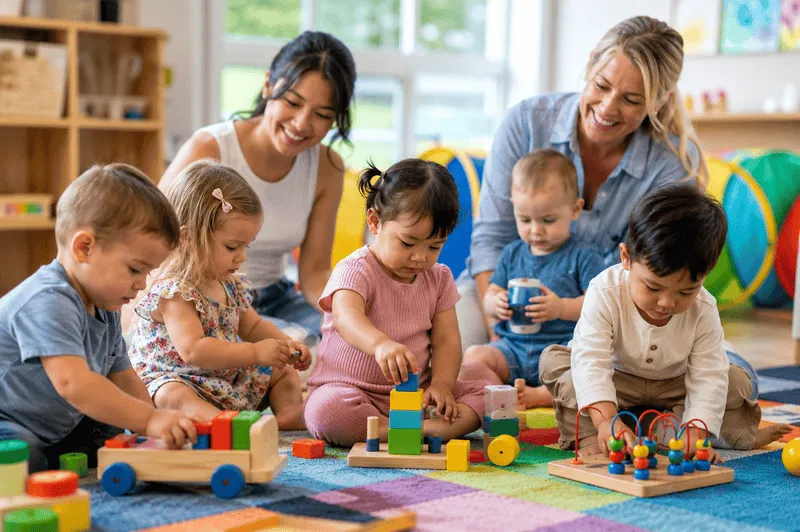

Babies and toddlers spend much of their early lives discovering how the world feels, sounds, looks and moves. A textured toy becomes something to squeeze and investigate. Music invites movement. Crawling towards an interesting object involves coordination, balance and determination. For parents exploring sensory classes Ryde, these everyday forms of discovery help explain why sensory play is closely connected with early childhood experiences.
Young children do not separate learning into neat subjects. Movement, communication, touch, listening and social interaction often happen together. A toddler following a song may be listening to rhythm while copying an action, watching other people and moving their body at the same time.
Structured sensory activities may provide additional opportunities for children to explore these experiences in an age-appropriate environment. They also give parents and carers ideas that may be adapted for ordinary play at home without needing complicated equipment or elaborate activities.
Sensory Play Begins With Everyday Experiences
The word sensory can make an activity sound more technical than it needs to be.
In reality, sensory experiences are happening throughout a child's day. Feeling water during bath time, touching grass outside, listening to a familiar voice or watching a brightly coloured object move all provide information about the surrounding environment.
Young children gradually learn to respond to this information through repeated experiences.
A baby reaching towards a toy is doing more than simply trying to grab something interesting. They are judging distance, coordinating vision with movement and adjusting their body to complete the action.
As children become more mobile, these experiences become increasingly complex. Crawling across different surfaces, climbing onto low equipment or moving to music may involve several areas of development at once.
Parents looking at sensory development classes for toddlers may therefore encounter activities that combine movement, sound, touch and interaction rather than treating each sense as an entirely separate skill.
Movement Gives Children Information About Their Bodies
Movement is an important part of early childhood because children are continually learning where their bodies are in relation to the space around them.
Rolling, crawling, reaching, balancing and eventually walking all involve repeated coordination between the brain and body. These skills develop gradually rather than appearing perfectly formed.
A child might attempt the same movement many times before it becomes comfortable.
Sensory classes Ryde may incorporate movement experiences that give children opportunities to practise body awareness in different ways. Depending on age and developmental stage, this might involve reaching for objects, navigating suitable equipment or participating in guided movement activities.
The purpose is not to rush children towards the next physical milestone. Development varies between individuals, and activities should remain appropriate to the child's current abilities.
Providing varied opportunities for movement simply gives children more ways to explore what their bodies can do.
Touch Encourages Investigation and Discovery
Toddlers are often irresistibly drawn towards interesting textures.
Something smooth, rough, soft, cool or slightly sticky may hold their attention because it provides unfamiliar information. Touch helps children investigate objects in a direct way that words alone cannot reproduce.
Simple materials can create rich experiences.
Fabric, paper, water and appropriately selected natural materials all feel different. As children handle them, they may squeeze, pat, grasp, release or compare them.
These actions also involve hand and finger control.
Sensory exploration therefore does not need to involve highly specialised resources. The value often comes from giving children safe opportunities to investigate materials while an adult remains nearby and responsive.
Any objects or materials used with babies and toddlers should, of course, be suitable for their age and developmental stage, particularly because young children frequently explore objects with their mouths.
Music Brings Listening and Movement Together
Music is naturally engaging for many young children.
A change in rhythm may prompt a baby to become alert, while a familiar song might encourage a toddler to clap or attempt an action they have seen before.
Songs also introduce repetition.
Hearing the same words and movements over time may help children become familiar with patterns. Eventually, they may begin anticipating what comes next.
Group activities that include songs may add another dimension because children can observe adults and other children responding to the same music.
Parents researching early learning programs in Ryde may find that music is incorporated alongside movement and play rather than being treated as an isolated activity.
At home, familiar songs can also become useful parts of daily routines, whether during play, packing away or quieter moments.
Repetition Has an Important Place in Early Learning
Adults often become bored when an activity is repeated too many times. Young children may have a very different response.
A toddler might want the same book read repeatedly or ask for the same song again immediately after it finishes. They may drop an object over and over simply to observe what happens.
Repetition gives children opportunities to become familiar with an experience.
The first time they encounter a new activity, much of their attention may be devoted to understanding what is happening. After several attempts, they may begin participating more confidently or noticing details they initially missed.
This is useful for parents to remember when attending sensory classes Ryde. A familiar activity is not necessarily wasted time. Repeating an experience may give the child an opportunity to engage with it differently.
Sensory Activities May Encourage Language Interaction
Long before children speak in complete sentences, communication is already developing.
Babies use sounds, gestures, facial expressions and eye contact. Toddlers gradually add words and begin using them to communicate wants, observations and ideas.
Shared sensory play creates natural opportunities for adults to introduce language.
A parent might describe an object as soft, notice that a ball has rolled away or talk about the sound made by an instrument. The child does not need to repeat every word for the interaction to have value.
Language becomes connected with an experience that is happening in front of them.
Adults may also respond to the child's attempts at communication. If a toddler points towards an object, the parent can acknowledge the gesture and add relevant words.
These short exchanges are part of the broader communication environment surrounding early development.
Group Classes Introduce a Social Environment
Babies and toddlers do not need to play cooperatively in the same way older children might, but being around other people still provides social experiences.
A young child may watch another toddler use a piece of equipment, notice a baby making a sound or observe adults participating in a song.
These interactions provide exposure to different voices, movements and behaviours.
Some children are immediately curious in group environments. Others prefer to observe for a while before becoming involved.
Both responses can be normal.
Parents attending sensory classes Ryde do not necessarily need to expect their child to participate enthusiastically in every activity from the first session. Watching is also a form of engagement, particularly when an experience is unfamiliar.
As the environment becomes more predictable, some children may gradually become more comfortable joining activities.
Parents Are Part of the Learning Experience
Early childhood classes are not simply something that happens between an instructor and a child.
Parents and carers often play an active role by helping children participate, providing reassurance and responding to their cues. This shared involvement may also give adults a closer view of what captures their child's attention.
A parent might notice that their toddler particularly enjoys music or repeatedly returns to an activity involving climbing. Another child may be more interested in tactile materials or quiet observation.
These preferences may provide inspiration for play outside the class.
Families exploring GymbaROO’s sensory classes may therefore see the experience as an opportunity for both child participation and parent involvement.
The ideas encountered during a session do not need to remain in the class environment. Many concepts may inspire simple variations at home.
Activities Should Reflect Developmental Stages
There can be considerable developmental difference between a young baby and an active toddler.
Even two children of the same age may have different physical abilities, interests and levels of confidence.
Sensory experiences are most useful when they recognise these differences rather than expecting every child to complete the same task in exactly the same manner.
A baby who is not yet mobile may explore primarily through looking, listening, reaching and supported movement. A toddler may want to climb, carry objects and move constantly around the space.
Neither approach is inherently better.
Parents sometimes feel pressure when they notice another child reaching a milestone earlier. Early development, however, is individual. Questions or concerns about a child's development are best discussed with an appropriate healthcare professional rather than resolved through comparison with other children in a class.
Sensory Play Does Not Need to Create a Mess
Online images sometimes make sensory play look like it requires enormous trays of colourful materials spread across an entire room.
It does not.
Sensory experiences may be remarkably simple. Listening to music, walking barefoot across an appropriate surface, playing with water under supervision or exploring safe household textures may all encourage sensory investigation.
For parents, this can be reassuring.
There is no need to recreate every class activity at home or purchase large amounts of specialist equipment. The goal is not to fill every moment with structured developmental tasks.
Ordinary life already contains many learning opportunities.
A child helping to wash vegetables, for example, may experience temperature, texture, water and language while simply participating in a family routine.
Outdoor Play Provides Rich Sensory Experiences
Outdoor environments naturally contain variation.
The temperature changes. Leaves move. Birds make sounds. Surfaces feel different underfoot, and light shifts throughout the day.
For young children, these ordinary outdoor experiences can be fascinating.
A toddler may stop repeatedly during a walk because they have noticed a leaf, stone or insect that an adult would otherwise pass without thinking. Allowing some time for this curiosity gives the child an opportunity to observe and investigate.
Outdoor movement may also provide different physical challenges from indoor play.
Suitable climbing, walking across varied surfaces and moving through open space all encourage children to adjust their bodies in response to the environment.
The activity does not need to have a formal learning objective to be valuable.
Quiet Experiences Matter Alongside Active Play
Sensory learning is not always energetic.
Young children also experience periods when they prefer quieter activities. Looking through a book, listening to gentle music or exploring a small object with a parent can provide meaningful engagement without constant movement.
This balance is worth recognising.
Some children become absorbed in busy environments, while others may need periods with less stimulation. Parents often become familiar with their child's cues and may notice when they need a change of pace.
A well-rounded approach to sensory play leaves room for active movement and quieter exploration rather than assuming more stimulation is always better.
The child's response remains an important guide.
Play at Home Can Continue the Experience
One useful aspect of attending sensory classes Ryde is the possibility of taking simple ideas into everyday family life.
A song learned during a session may become part of the morning routine. A movement activity might inspire a safe variation at home. Parents may also become more aware of the learning happening during ordinary play.
There is no need to turn the household into a classroom.
In fact, young children often learn best when experiences feel natural and enjoyable. Following a child's curiosity, talking about what they are doing and allowing enough time for repeated exploration may be more useful than creating a tightly scheduled series of activities.
Parents already provide many sensory experiences simply by interacting with their children throughout the day.
Early Learning Is Built From Small Experiences
Child development can sometimes feel like a race towards major milestones. Rolling, crawling, walking and talking are easy to notice, so they naturally receive plenty of attention.
Much of development, however, happens through smaller experiences that are less obvious.
A child reaches slightly further than yesterday. They recognise the beginning of a familiar song. They explore a new texture without hesitation or watch another child before trying an activity themselves.
These moments gradually accumulate.
Sensory classes Ryde may provide an environment where babies and toddlers encounter movement, music, touch and social interaction in ways suited to early learning. Just as importantly, parents may gain ideas for recognising similar opportunities during ordinary routines.
There is no requirement for childhood learning to feel formal or complicated. For babies and toddlers, some of the richest experiences begin with something as simple as moving, listening, touching, watching and having a trusted adult nearby to share the discovery.
























Sign in to leave a comment.