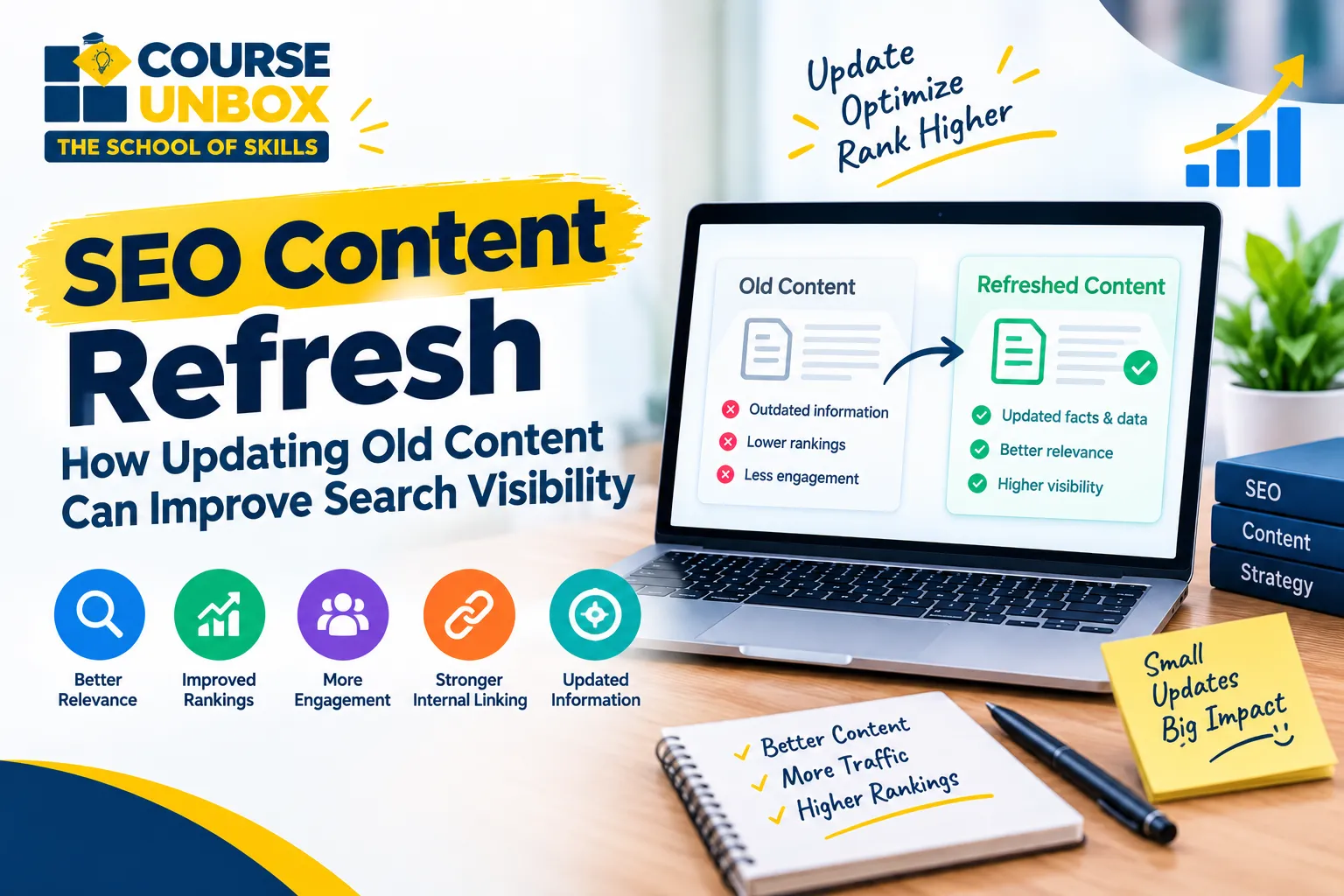

SEO is not always about creating new content. Sometimes, the content already published on a website has useful information but gradually loses visibility because it becomes outdated, incomplete, or less relevant to current search behavior. Content refreshing is the process of reviewing and updating existing webpages so they remain useful, accurate, and aligned with what users are searching for.
For businesses and website owners, updating older content can be an important part of a long-term SEO strategy. Instead of constantly creating new pages, improving existing content can help maintain its relevance and usefulness.
Why Is Content Refresh Important for SEO?
Search engines aim to provide users with relevant and helpful information. An article that was useful a few years ago may not provide the same value today. Statistics can change, tools may receive updates, links can become outdated, and search intent can evolve.
Refreshing old content gives businesses an opportunity to improve existing pages rather than starting from scratch. Older pages may already have backlinks, search impressions, rankings, and organic traffic, making them worth reviewing before creating a completely new page.
A content refresh can also improve the visitor experience by making information more current, clear, and useful.
How to Identify Content That Needs an Update
Not every old article needs a complete rewrite. Start by identifying pages that have experienced declining organic traffic, lower rankings, outdated information, or reduced engagement.
Google Search Console can help identify pages and search queries that receive impressions but generate fewer clicks. Comparing current performance with previous periods can reveal content that may need improvement.
You should also check whether the page still matches the search intent behind its main topic. If users are looking for updated information but your article focuses on older practices, the page may need a substantial refresh.
What Should You Update?
A useful content refresh can involve several improvements. Start by checking facts, statistics, examples, screenshots, references, and external links. Outdated information should be updated, while broken links should be replaced or removed.
Review the page structure as well. Make sure headings clearly explain the topics covered and that the content flows logically from one section to another.
You can also improve the introduction, add missing information, answer related questions, and remove sections that no longer provide meaningful value.
Keyword optimization should also be reviewed, but it should be done naturally. Instead of repeatedly inserting the same keyword, focus on covering the topic comprehensively with relevant terminology and related concepts.
Improve Content Based on Search Intent
Search intent is one of the most important factors to consider when refreshing an article.
For example, someone searching “how to improve technical SEO” is likely looking for practical information rather than only a basic definition. If an older article only explains what technical SEO means, adding actionable steps, examples, and relevant considerations could make the page more useful.
Before updating content, review what information users are currently looking for and make sure the page addresses those needs clearly.
Don't Update Content Just for the Sake of SEO
A content refresh should focus on improving the page for users first. Simply changing the publication date or adding a few keywords does not automatically make an article better.
Before making changes, understand what information has become outdated and what users need today. The objective should be to make the page more accurate, useful, readable, and comprehensive.
It is also important to avoid adding unnecessary sections just to make an article longer. Quality and relevance are more important than word count.
Content Refresh and Internal Linking
Refreshing older content is also a good opportunity to improve internal linking.
As a website grows, new articles and service pages are often published after older content. Older articles may not link to these newer pages, creating missed opportunities for users to discover related information.
Adding relevant internal links can help visitors move between related topics while creating a clearer content structure for the website.
For example, an SEO article about content optimization could naturally link to pages covering keyword research, technical SEO, on-page SEO, local SEO, and SEO analytics.
How Often Should You Refresh Old Content?
There is no single schedule that works for every website. Content should be reviewed based on its topic, industry, and how quickly the information changes.
Topics involving tools, technology, statistics, digital marketing trends, or frequently changing information may require more frequent reviews. Evergreen topics may only need updates when important information changes or performance begins to decline.
Regularly reviewing important pages can help businesses identify problems before they have a significant impact on search visibility.
Content Refresh as Part of Modern SEO
Content refreshing should be treated as an ongoing part of SEO rather than a one-time activity. Businesses can create a workflow where important pages are reviewed periodically, performance is monitored, and updates are made when necessary.
At Course Unbox, practical SEO training covers areas such as keyword research, on-page SEO, technical SEO, content optimization, local SEO, and performance tracking. Understanding these areas can help learners evaluate existing content and identify practical opportunities for improvement.
Conclusion
Updating old content is an important part of maintaining a strong SEO strategy. While publishing new articles can help a website target additional topics, existing pages should not be ignored.
A well-planned content refresh can improve the accuracy, relevance, structure, and usefulness of older webpages. When combined with keyword research, internal linking, technical SEO, and regular performance analysis, content refreshing can become a valuable part of long-term search optimization.
The goal is simple: keep useful content useful, relevant, and aligned with what people are searching for today.
Frequently Asked Questions (FAQ)
1. What is a content refresh in SEO?
A content refresh is the process of reviewing and updating an existing webpage to improve its accuracy, relevance, structure, and usefulness for current users.
2. Does updating old content improve SEO?
Updating content can help maintain or improve its relevance, particularly when information has become outdated or the page no longer fully satisfies search intent. However, an update does not guarantee higher rankings.
3. How do I know which content needs to be refreshed?
Look for pages with declining traffic, lower rankings, outdated information, falling click-through rates, broken links, or content that no longer matches current search intent.
4. Should I change the publication date when updating an article?
The date should reflect the actual publishing or meaningful update process according to the website's editorial practices. Changing a date alone does not make content more valuable.
5. How often should SEO content be updated?
There is no universal schedule. Fast-changing topics may need frequent reviews, while evergreen content can be reviewed when its information, performance, or search intent changes.
6. Can content refreshing replace creating new content?
No. Both approaches can serve different purposes. New content helps cover new topics, while content refreshing keeps existing pages accurate and useful.
7. Should keywords be added when refreshing old content?
Keywords can be reviewed and updated where relevant, but they should be incorporated naturally. The main focus should remain on search intent, topical relevance, and user value.

























Sign in to leave a comment.