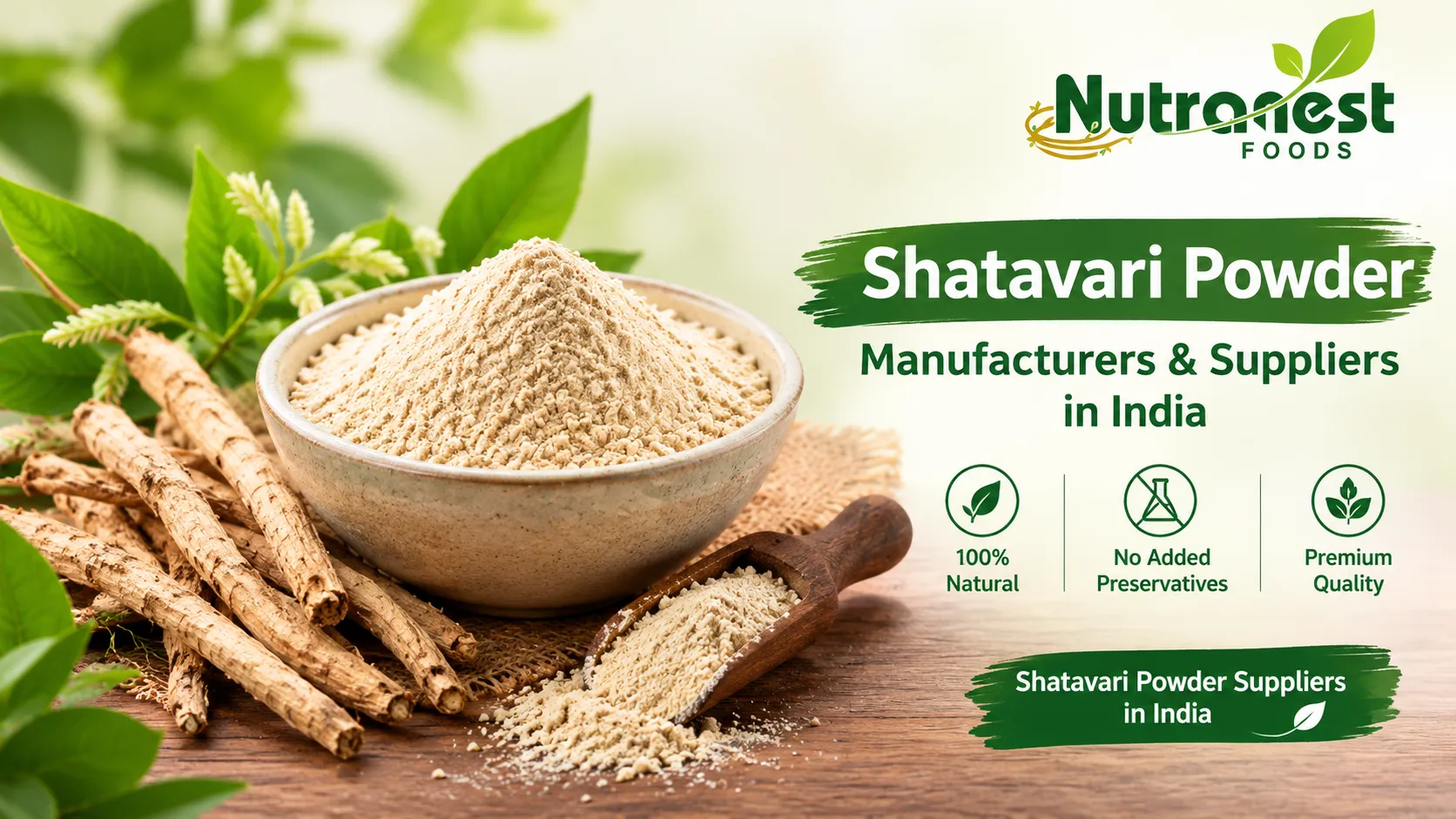

A buyer in Rotterdam once asked us for Shatavari Powder with a saponin content he'd copied off a competitor's spec sheet without checking if it matched the actual root batch he was sourcing from. That's the problem with Shatavari Powder procurement right now. Everyone quotes a number. Few can explain where it comes from. If you're sourcing Shatavari Powder for a nutraceutical line, a herbal formulation, or private-label export, the gap between "manufacturer" and "trader repackaging someone else's stock" decides whether your shipment clears quality control or gets flagged at the port.
The Spec Detail Most Buyers Skip
Shatavari Powder isn't one product. It varies by root source (wild-harvested versus cultivated), drying method, and particle size and each of these changes shelf life, solubility, and active compound retention.
Root Source and Saponin Range
Wild Asparagus racemosus root, still harvested in parts of Madhya Pradesh and the Western Ghats, tends to carry a saponin content between 8% and 12%, depending on soil and harvest season. Cultivated root, more common now due to overharvesting restrictions, runs slightly lower but is far more consistent batch to batch which matters more to a formulator than a marginally higher peak number.
Mesh Size and Drying
Standard commercial grade sits at 80–100 mesh. Buyers formulating capsules often want 120 mesh for better encapsulation flow. Shade-dried root retains more of the steroidal saponins than sun-dried; heat-dried at high temperature is faster but strips volatile compounds that matter in Ayurvedic formulations specifically.
The detail most buyers skip: asking whether the powder was tested for saponin content after drying, not just on the raw root before processing. Numbers on a pre-processing certificate mean nothing once the root has been through a dryer.
What a Lapsed Certificate Actually Costs You
Here's how to evaluate a Shatavari Powder Supplier without getting talked into a decision you'll regret in month four.
- Certification currency. Ask for the FSSAI license and organic certificate with expiry dates visible, not a PDF from two renewal cycles ago. A bad answer sounds like "we're renewing it, should be through soon" — that means it's already lapsed.
- Batch-specific COA, not a template. A bad answer is a Certificate of Analysis that looks identical across three different order dates. Real batch testing produces slightly different numbers each time.
- Traceability to source region. A bad answer is "we source from across India" with no further detail. That's a trader's answer, not a manufacturer's.
- Microbial and heavy metal testing on every batch, not annually. A bad answer treats this as a formality: "we test periodically." Periodically isn't a policy.
- Willingness to share a defect protocol before you ask. A supplier who says "we'll handle defects case by case" doesn't have a policy. That's a negotiation you'll lose after the shipment lands.
Benefits of Sourcing Shatavari Powder From a Direct Manufacturer
Working with a manufacturer rather than a repackaging trader changes your risk exposure in ways that don't show up until something goes wrong.
- Fewer intermediary markups on bulk orders, which protects margin on volumes above 500 kg.
- Direct accountability on COA accuracy, since the lab testing and the shipping party are the same entity.
- Faster resolution on quality disputes, because there's no second party to route the complaint through.
- Custom mesh size and packaging on request, without a trader negotiating that on your behalf.
- Consistent lead times during peak Ayurvedic demand seasons, when traders often get squeezed out of allocation first.
- Direct visibility into harvest-to-processing timelines, which matters if your end buyer asks for traceability documentation.
Availability Across India and Export Markets
We manufacture and dispatch Shatavari Powder out of Surat, Gujarat, with direct rail and port access to Mundra and Nhava Sheva for container-load export. That location isn't incidental Gujarat sits close to both the Ayurvedic processing belt in central India and the export infrastructure that moves bulk herbal powder to the Middle East, Southeast Asia, and Europe without a second inland transfer.
Domestically, we supply wholesalers and brand owners across Maharashtra, Delhi NCR, and South India, typically within 5–7 working days of order confirmation for in-stock grades. For custom mesh sizes or non-standard packaging, factor in an additional 10–12 days for processing.
About Us
We've been processing Ayurvedic and herbal powders out of Surat since 2013, and Shatavari root is one of the more finicky materials we handle moisture content swings more than people expect between harvest seasons, and we've had to reject entire lots from new farm partners over the years when the root arrived under-dried. We switched to a two-stage drying process in 2019 after a European buyer flagged clumping in a humid-climate shipment; it added cost, but we haven't had a repeat complaint since. That's the kind of adjustment you only make after a buyer tells you something went wrong on their end, not yours.
If you're ready to move forward, send us your required mesh size, order quantity, and destination port. We respond to bulk inquiries within 24 hours on working days. Minimum order quantity starts at 25 kg for domestic buyers and 100 kg for export orders. Reach out to Nutranestfood directly through our website contact form or email — we'll send a current COA and pricing sheet before you commit to anything.
Conclusion
Shatavari Powder sourcing comes down to one question most buyers only ask after a bad shipment: can your supplier prove what's actually in the bag, batch by batch? Manufacturers who test after drying, not before, and who can name their harvest regions without hesitation, are the ones worth building a long-term supply relationship with. The next shipment you approve should be the one you don't have to think twice about.
FAQs
1. What is the typical saponin content in commercial-grade Shatavari Powder?
It usually falls between 6% and 12%, depending on whether the root is wild-harvested or cultivated. Anyone quoting a flat number without a batch-specific COA is rounding for convenience, not reporting a test result.
2. Do Shatavari Powder manufacturers in India offer organic certification?
Some do, but not universally — organic certification depends on whether the sourcing farms are certified, not just the processing facility. Ask to see the certificate tied to the specific batch, not a general company-level document.
3. How long does Shatavari Powder stay stable after packaging?
Properly dried and packaged powder holds for 18–24 months, but moisture ingress during transit or storage can cut that significantly. We can't guarantee shelf life past 24 months even under ideal storage — that's simply where the compound stability curve starts to drop.
4. Is Shatavari Powder tested for heavy metals and microbial contamination?
It should be, on every batch — not annually. If a supplier can't produce a recent microbial test alongside the saponin COA, that's a gap worth pushing on before you place a large order.























Sign in to leave a comment.