
Strategic Horizons: Navigating the Shooting Market Landscape in 2026 and Beyond
The global shooting market stands at a pivotal intersection of tradition, technology, and regulatory evolution. As we move through 2026, enterprise leaders across firearms manufacturing, range operations, and training simulation must look beyond quarterly fluctuations to understand the structural forces shaping revenue trajectories through 2032. The newly released Shooting Market research report by PW Consulting delivers a comprehensive, data-driven foundation for strategic planning, offering clarity amid complexity.
Historical momentum tells a consistent story of steady expansion. Between 2020 and 2025, the market navigated supply chain realignments, shifting recreational demand, and evolving compliance frameworks. Revenue progression across this period reflects an industry that has consistently adapted while maintaining upward momentum. Looking ahead, the forecast period from 2026 to 2032 projects sustained growth, anchored by a compound annual growth rate that underscores durable demand drivers across both recreational and professional applications.
For decision-makers, this trajectory is more than a statistical projection—it is a planning parameter. Capital allocation, product portfolio adjustments, geographic expansion, and partnership strategies all require a calibrated understanding of where the market is headed, not merely where it has been. This report is engineered to provide that calibration.
Market Structure and Growth Fundamentals
The shooting market encompasses a diverse ecosystem of equipment, infrastructure, and services. Demand is shaped by recreational participation, competitive sports, training requirements, and commercial range operations. Understanding how these segments interact—and where value is concentrated—requires granular analysis that goes beyond top-line figures.
Revenue composition across equipment categories reveals distinct consumption patterns. Air rifles and air pistols represent significant portions of the market, each serving different user profiles, ranging from casual recreational shooters to dedicated training programs and competitive participants. Infrastructure and range systems further extend the ecosystem, encompassing fixed and moving target solutions, safety-compliant facility design, and virtual simulation platforms that bridge physical training with digital precision.
Application-driven demand further diversifies the market. Game and clay shooting, hunting, and competitive sports each present unique purchasing cycles, seasonal fluctuations, and equipment preferences. Operators and manufacturers that align their offerings with these application-specific behaviors gain a measurable advantage in capturing sustained demand rather than reacting to it.
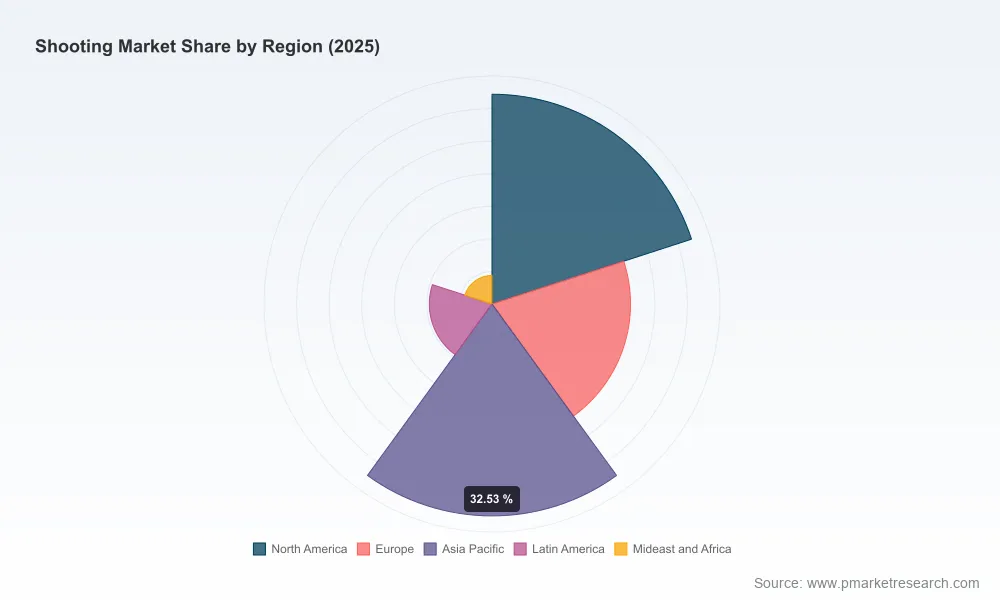
Regional dynamics add another layer of strategic complexity. Market activity spans North America, Europe, Asia Pacific, Latin America, and the Middle East and Africa, with each geography exhibiting distinct regulatory environments, cultural participation trends, and infrastructure maturity levels. For companies evaluating distribution partnerships, facility investments, or product localization, understanding these regional variations is essential to mitigating risk and maximizing return.
The report provides a detailed breakdown of these structural components, allowing leadership teams to identify which segments and geographies align with their strategic objectives. Rather than presenting aggregate numbers in isolation, the analysis connects market sizing to actionable context—helping executives translate growth figures into portfolio decisions.
Competitive Landscape and Strategic Positioning
The shooting market is characterized by a fragmented yet increasingly sophisticated competitive environment. Market concentration metrics indicate that leading players hold a meaningful but not dominant share, leaving substantial room for differentiation through technology, service integration, and specialized expertise.
Several core companies define the current competitive landscape. Action Target, headquartered in Santa Clarita, California, provides end-to-end design, build, and support solutions for commercial and tactical shooting ranges, including fixed targets, moving targets, and virtual simulators. Their continued investment in range technology underscores the industry's shift toward integrated, smart infrastructure. Range USA, Inc. similarly develops and supplies range systems and equipment, focusing on target solutions and infrastructure that support operational efficiency for facility operators.
Simulation and training represent a rapidly evolving frontier. Cubic Corporation offers training and simulation solutions for shooting ranges and tactical facilities using virtual simulators, reflecting broader demand for scalable, repeatable, and data-rich training environments. On the equipment manufacturing side, Beretta USA manufactures firearms and shooting sports equipment, including air rifles and pistols for training and recreation, while Kel-Tec CNC Industries produces compact firearms and shooting sports accessories for range use and self-defense training. Air Arms Limited and Weihrauch, based in the United Kingdom and Germany respectively, manufacture precision air rifles and pistols designed for target shooting, training applications, and recreational use.
Beyond commercial players, industry associations such as the National Shooting Sports Foundation play a vital role by providing directories, certification frameworks, and resources for manufacturers and operators, helping standardize practices and support compliance across the ecosystem.
Recent activity highlights the pace of innovation. In January 2026, Action Target showcased next-generation SmartRange AXIS technology, shotgun ranges, and expanded range solutions at SHOT Show 2026, signaling continued investment in advanced range systems and anniversary-driven brand momentum. Such developments illustrate how competitive differentiation increasingly depends on technology integration, operational reliability, and customer-facing innovation.
The report's competitive analysis goes beyond company profiles. It examines strategic positioning, technology roadmaps, partnership opportunities, and areas where new entrants or established players can capture share through service enhancements, product specialization, or geographic expansion. Leadership teams can use this analysis to benchmark their own positioning and identify where the market's trajectory creates openings for strategic moves.
Regulatory and Operational Dynamics
No strategic assessment of the shooting market is complete without a clear understanding of the regulatory and operational environment. Compliance requirements continue to shape product design, distribution pathways, facility operations, and export practices. As of 2026, the National Shooting Sports Foundation's Industry Reference Guide documents ongoing compliance requirements for firearms and range equipment under federal regulations, establishing a baseline for operational readiness.
Export controls have also become a critical consideration. The Bureau of Industry and Security has implemented updates to export controls for firearms and shooting equipment, with enforcement continuing into 2026. These controls affect how manufacturers and distributors plan international expansion, manage supply chains, and structure cross-border partnerships. Additionally, Federal Register revisions to firearms license requirements, issued in April 2024 and actively applied throughout 2026, introduce further compliance obligations that operators and manufacturers must integrate into their licensing, reporting, and operational workflows.
Operational costs represent another strategic factor. Sector analysis indicates elevated operational costs for shooting ranges due to specialized training staff and facility maintenance in 2026. At the same time, range operators face infrastructure investment requirements for safety compliance and target systems as outlined in NSSF guidelines. These cost pressures do not merely affect margins; they influence facility design decisions, staffing models, technology adoption, and the feasibility of expansion plans.
By embedding these regulatory and operational realities into its market analysis, the report enables executives to evaluate opportunities with a realistic understanding of compliance burdens, cost structures, and risk factors. This context is particularly valuable for organizations assessing new market entry, facility development, or product lines that must satisfy evolving standards.
How the Report Enables Actionable Strategy
Strategic intelligence is only valuable when it connects to decision-making. The Shooting Market report is structured to support a range of enterprise applications, from long-range forecasting to near-term operational planning. Its contents are designed to give leadership teams the clarity required to act with confidence.
- Comprehensive market sizing and forecast modeling covering historical performance and projected growth through 2032, enabling scenario planning and investment prioritization.
- Segment-level analysis across equipment types and application categories, helping companies align product development and marketing resources with the most relevant demand drivers.
- Regional assessment frameworks that illuminate where infrastructure, regulatory conditions, and participation trends create favorable conditions for expansion or partnership.
- Competitive profiling of core companies, including strategic focus areas, technology initiatives, and market positioning, providing a reference point for benchmarking and opportunity mapping.
- Regulatory and operational context that integrates compliance requirements, cost dynamics, and infrastructure considerations into market interpretation, ensuring forecasts are grounded in operational reality.
- Recent industry developments, including trade show innovations and product launches, that signal where technology and service expectations are heading.
The report is intended for executives, strategy teams, investors, and operational leaders who require more than high-level summaries. It delivers the depth needed to support capital allocation, geographic planning, product roadmap decisions, and competitive response strategies. At the same time, it is structured to serve as a gateway: the full report includes detailed segmentation data, regional breakdowns, and granular forecast tables that allow organizations to build customized models aligned with their specific objectives.
The Strategic Imperative for 2026 Decision-Making
In a market shaped by steady growth, evolving technology, and an active regulatory landscape, the cost of operating without precise intelligence is rising. Organizations that rely on fragmented information risk misreading demand patterns, underestimating compliance burdens, or overlooking competitive shifts that can alter share dynamics. Conversely, those that ground their planning in robust, up-to-date market research are better positioned to allocate resources efficiently, enter new segments with confidence, and adapt to changing conditions without sacrificing momentum.
The forecast period through 2032 offers a long enough horizon to justify investment in infrastructure, product innovation, and strategic partnerships, while also requiring close attention to the near-term realities of 2026. Labor costs, safety compliance, license requirements, and export controls all influence how growth translates into operational execution. The Shooting Market report integrates these factors into a unified analytical framework, giving decision-makers a clearer view of both opportunity and constraint.
For companies operating in equipment manufacturing, range services, simulation and training, or related supply chain roles, this research provides a foundation for strategic clarity. It supports questions that matter most to enterprise leadership: Where is demand concentrated? Which segments offer the strongest alignment with existing capabilities? How do regulatory and operational conditions shape feasible growth paths? And where does the competitive landscape leave room for differentiation?
Camera Host Market
Access the Full Intelligence
This article provides a strategic overview of the market's direction, competitive dynamics, and operational context. However, the complete analytical value lies in the full report, where detailed segmentation data, regional breakdowns, forecast tables, and company-level intelligence are presented in a structured format designed for direct application.
Leaders seeking to translate market momentum into concrete strategy can use the full report to build internal models, support investment discussions, and align cross-functional teams around a shared understanding of the landscape. The macro trends described here point clearly toward sustained growth and increasing strategic complexity, but the specific numbers, regional sensitivities, and segment-level opportunities are best evaluated in the complete research environment.
Shooting Market
As the shooting market continues its trajectory through 2026 and beyond, informed strategy will separate organizations that merely respond from those that actively shape their position. PW Consulting's Shooting Market report is built to support that distinction, offering the depth, context, and forward-looking analysis required for decisive action in a market where precision in planning is as important as precision in practice.
For detailed analysis of this topic, please visit the official page: Shooting Market
Lacy Lee
Senior Marketing Manager
[email protected]
PW Consulting: www.pmarketresearch.com























Sign in to leave a comment.