
When I first started looking into Sodium Lauryl Ether Sulfate (SLES) for a detergent production project, I thought the decision would be simple. Just pick the cheaper one, right? Turns out, that's exactly the wrong way to think about it.
Here's what I wish someone had told me earlier.
They're the Same Chemical, Just Different Water Content
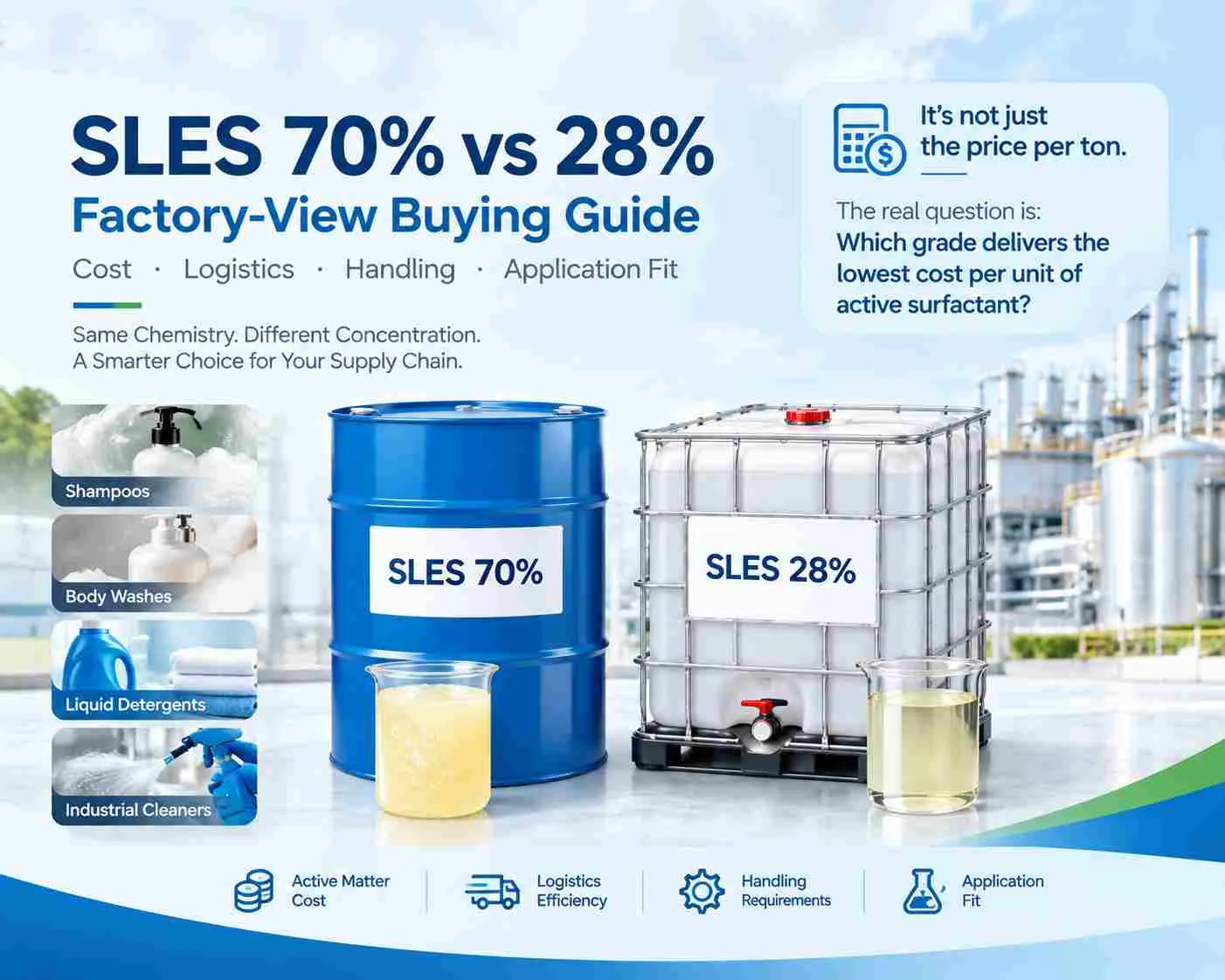
SLES 70% and SLES 28% are chemically identical. The only difference is how much water is mixed in. SLES 70% is a thick paste with about 70% active surfactant. SLES 28% is a pourable liquid with about 28% active surfactant. When you adjust both to the same active level in your formula, they perform the same way.
So why does the choice matter so much? Because you're not really buying surfactant. You're buying water, packaging, freight, and storage space. And that changes everything.
The Price Tag Is Misleading
A supplier might quote SLES 28% at $900 per ton and SLES 70% at $1,800 per ton. At first glance, the 28% grade looks like a bargain. But here's the catch. A ton of SLES 70% gives you about 700 kg of active ingredient. A ton of SLES 28% gives you only about 280 kg. When you calculate the cost per kilogram of active matter, the 70% grade usually comes out ahead — sometimes by 20% or more.
I learned this the hard way. The lower invoice price doesn't always mean lower total cost.
The Logistics Reality Check
If you're importing SLES from overseas, this is where things get really interesting. SLES 70% packs 2.5 times more active ingredient per kilogram than the 28% grade. When you ship 28%, you're paying ocean freight on a product that's mostly water.
For international shipping, 70% is almost always the preferred grade. The savings per ton of active surfactant can be significant, especially when you're moving full container loads. Of course, the exact numbers depend on your packaging format, container loading, and shipping terms, but the principle holds.
But There's a Catch — Equipment
Here's where SLES 28% fights back. That thick 70% paste doesn't just pour itself into your mixing tank. You need high-shear mixing equipment to dilute it properly.
Two rules I picked up along the way. First, always add the concentrate to water, never water to the concentrate. Second, don't go above about 27% concentration during dilution, or you'll end up with a gel that's almost impossible to work with. Keeping the process temperature between 25 and 35°C also helps manage viscosity.
If your factory doesn't have that kind of setup, SLES 28% becomes the practical choice. It pours, it mixes with standard agitation, and it's ready to go. No dilution step, no heating, no specialized equipment.
So Which One Should You Choose?
It really comes down to your operation. If you're running a large factory with proper dilution equipment, SLES 70% usually gives you the best economics — lower cost per active kilogram and better logistics efficiency. If you don't have that equipment, SLES 28% is the smarter choice despite the higher active cost.
For smaller producers or anyone running multiple small-batch formulations, the 28% grade often wins on simplicity. Faster changeovers, less cleaning downtime, and no capital investment in mixing equipment.
And if you're exporting over long distances, the 70% grade almost always makes more financial sense because you're not paying to ship water around the world.
A Quick Note on Thickening
I've seen claims that SLES 70% gives better thickening power in final products. From what I've learned, thickening really depends on the salt curve and your overall formulation system, not just the incoming concentration. Always test your specific formula before committing to a grade.
The Bottom Line
SLES 70% and 28% are the same chemistry. The 70% grade wins on cost per active kilogram and logistics efficiency, but it demands the right equipment and process knowledge. The 28% grade wins on simplicity and convenience, but you pay a premium for the water you ship and store.
Neither is universally better. The right choice depends entirely on your factory's capabilities and your supply chain cost structure.
If you want to dig deeper into the technical details or get a current quote, HOO CHEMTEC (https://www.hoochemtec.com/) is a direct SLES manufacturer offering both export-grade 70% and ready-to-use 28% grades. Their SLES product page (https://www.hoochemtec.com/surfactant/sodium-lauryl-ether-sulphate-sles/) has full specifications and selection guidance.
Disclaimer: Price examples are illustrative only. Actual prices vary by market conditions, volume, and region. Handling recommendations are general guidance — always consult your equipment manufacturer and safety data sheet (SDS) for specific operating procedures.



























Sign in to leave a comment.