


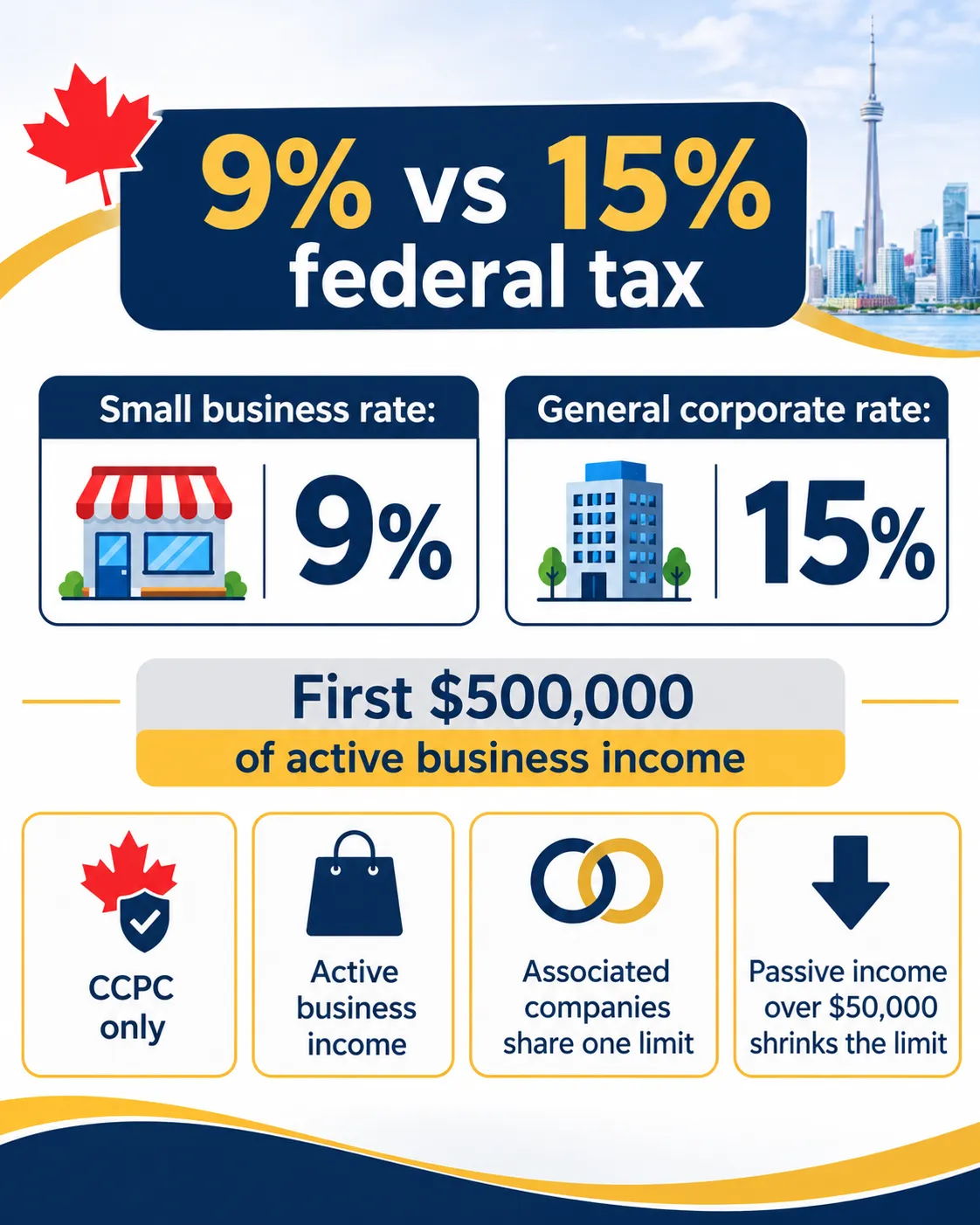
Most Canadian corporations pay 15% federal tax on their profits. Some pay 9%. The gap isn’t luck, and it isn’t clever accounting either. It’s the small business deduction, and on $500,000 of profit it’s worth tens of thousands of dollars a year.
Here’s the catch. The small business deduction in Canada doesn’t switch on just because you incorporated. Your company has to be a particular kind of corporation, earning a particular kind of income, and staying under limits that shrink more easily than most owners expect.
Miss one of those and the rate you budgeted for isn’t the rate on your notice of assessment.
This guide covers who qualifies, how the $500,000 limit works, what the 2026 rates look like and how the claim gets made. If you’d rather talk it through with a person, our corporate tax services team handles exactly this.
What Is the Small Business Deduction (SBD) in Canada?
Despite the name, the small business deduction isn’t a deduction from your income. It’s a reduction in the federal tax rate your corporation pays. Instead of 15% on its profit, a qualifying corporation pays 9% on the first $500,000 of active business income it earns each year. Provinces then add their own rate on top, which we’ll get to.
The rule itself lives in section 125 of the Income Tax Act. In mechanical terms, the deduction equals 19% of the smallest of three numbers: your active business income from Canada, your taxable income, and your business limit. That 19% is what takes the federal rate down to 9%. You’ll rarely calculate it by hand, but it explains why the benefit stops when any one of those three runs out.
It’s worth separating this from ordinary business expenses. Expenses such as rent, wages, software and advertising reduce your income before tax is worked out. The small business deduction reduces the rate applied to what’s left. They work together: you deduct your expenses first, and the lower rate then applies to the smaller profit.
Small Business Tax Rate in Canada for 2026: Federal and Provincial
The federal small business tax rate is 9%. The general federal corporate rate is 15%. That’s the starting point, and it’s the same in every province.
What changes is the provincial layer. Each province sets its own small business rate and its own general rate, so there’s no single Canada-wide small business tax rate. Combined rates for 2026 range from about 9% in Manitoba, which charges no provincial small business tax, to roughly 11% to 12% in most of the country.
Several provinces moved their rates or limits in 2026, which is why you’ll see older articles quoting numbers that no longer match.
One practical wrinkle: if your fiscal year straddles the date a province changed its rate, you don’t pick one or the other. The rate is blended, based on how many days of your year fell before and after the change. Your accountant’s software handles this, but it’s why last year’s effective rate can look odd next to this year’s.
Who Qualifies for the Small Business Deduction? CCPC Eligibility
Three questions decide it: is the corporation a CCPC, is the income active business income, and is there any business limit left?
The Canadian-Controlled Private Corporation (CCPC) requirement
Only a Canadian-controlled private corporation can claim the deduction. In plain terms, that’s a private corporation resident in Canada that isn’t controlled, directly or indirectly, by non-residents or by public corporations, alone or in combination. A company owned by a Canadian resident who runs it is the textbook case.
The edges are where trouble starts. A corporation that’s majority-owned by a non-resident shareholder, or one that a public company controls, generally isn’t a CCPC even if it operates entirely in Canada. If you’ve brought in investors or are about to, check the control question before the share issuance, not after.
Active business income vs passive investment income
The lower rate applies to active business income earned in Canada. That means profit from actually running a business: selling products, providing services, doing the work. It doesn’t cover investment income such as interest, rent from a passive property, or dividends. That income is taxed differently, and it can drag down the amount of active income that qualifies, which we cover below.
Two categories deserve a flag. A specified investment business is one whose main purpose is earning income from property. Rental companies usually fall here unless they employ more than five full-time people. A personal services business is where an individual who would be an employee, if not for the corporation, bills through a corporation instead. The CRA treats that income as ineligible for the small business deduction.
Do sole proprietors and partnerships qualify?
No. The deduction belongs to corporations. We explain what unincorporated owners can claim instead in a section further down.
Understanding the $500,000 Small Business Deduction Limit
The business limit is the annual cap on how much active income gets the 9% rate. Federally it’s $500,000. Income above it is taxed at the 15% general rate. A corporation earning $700,000 of active income pays the small business rate on the first $500,000 and the general rate on the remaining $200,000.
That sounds simple. Two things make it less so.
Associated corporations and sharing the business limit
If you own more than one company, don’t assume each gets its own $500,000. Corporations that are controlled by the same person or group, or are otherwise connected under the associated-corporation rules, have to share a single limit. Owners sometimes set up a second or third company hoping to multiply the benefit, and the rules are written to prevent exactly that.
Associated corporations divide the limit by filing an agreement with their T2 returns. If they don’t file it after the CRA asks, the limit for the group can fall to zero. That’s a painful outcome for a missing form.
How passive investment income can reduce the limit
This is the rule that surprises people most. If your corporation, together with any associated corporations, earns more than $50,000 of adjusted aggregate investment income in a year, the business limit starts shrinking. It drops by $5 for every $1 of passive income above $50,000, and it’s gone completely at $150,000.
Picture a consulting company that’s been leaving profit in the corporation for years and investing it. Eventually the interest and dividends are large enough that the company loses part of its low rate on its actual consulting income. Corporations with very large taxable capital, between $10 million and $50 million, also lose the deduction gradually, though that’s rarely an issue for owner-managed businesses.
Tax Benefits of the Small Business Deduction: A Simple Example
Numbers make this concrete. Take Alberta in 2026, where the combined small business rate is 11% (9% federal plus 2% provincial) and the general combined rate is 23% (15% federal plus 8% provincial). These are illustrative figures to show scale.
| Active business income | Tax with small business deduction (11%) | Tax at general rate (23%) | Difference |
| $300,000 | $33,000 | $69,000 | $36,000 |
| $500,000 | $55,000 | $115,000 | $60,000 |
That $60,000 difference stays in the company, where it can pay down debt, buy equipment, build a cash cushion or be invested. It’s also the main reason the deduction is better understood as a tax deferral tool than a permanent saving. Money you take out of the corporation as salary or dividends gets taxed again in your hands. The benefit is largest when profit stays in the business.
That’s why the decision about how much to pay yourself, and when, matters as much as qualifying in the first place. It fits naturally into year-round tax planning, rather than a December scramble.
Small Business Deduction vs General Corporate Tax Rate
| Small business rate | General corporate rate | |
| Federal rate | 9% | 15% |
| Who can use it | CCPCs only | Any corporation |
| Income covered | First $500,000 of active business income | Everything else, including income above the limit |
| Reduced by | Passive income over $50,000, associated corporations, very large taxable capital | Not applicable |
Income ends up at the general rate for three reasons. The corporation isn’t a CCPC, the income is above the business limit, or the limit has been reduced by passive income or associated corporations. If your tax bill looks higher than expected, those three are where to look first.
How to Claim the Small Business Deduction on Your T2 Return
You claim the deduction on your corporation’s T2 return. Nobody grants it in advance, and nothing happens automatically. Tax software can apply the lower rate if the right boxes are checked, but you still have to meet the conditions.
The schedules you’ll see most often are Schedule 7, which calculates aggregate investment income and active business income and feeds the passive income reduction, and Schedule 23, the agreement among associated CCPCs to divide the business limit. Your accountant will confirm which others apply, and the CRA’s current forms are the final word.
Timelines matter too. The T2 return is generally due six months after your fiscal year-end. Tax owing is due earlier, usually two months after year-end, or three months for many CCPCs that claim the deduction.
Late payments attract interest even when the return is filed on time.
Keep your financial statements, a breakdown of active versus investment income, shareholder and ownership records, and anything showing associated companies. Our tax documents checklist is a good starting point for what to gather.
Small Business Deduction for Sole Proprietors and the Self-Employed
If you run a business without incorporating, you won’t get the small business deduction. Sole proprietors and partners report business profit on their personal returns and pay personal tax rates, which rise with income and, for the highest earners in some provinces, top out above 50%.
What you can claim instead is business expenses, plus a share of home and vehicle costs where they apply. Those reduce your profit directly. If your income is growing and you’re wondering whether incorporating makes sense, the answer depends on how much you need to spend personally versus leave in the business. Our self-employed tax filing team can walk through the numbers for your situation.
Provincial Small Business Tax Rates: Ontario, Quebec, Alberta and BC
The provincial piece moves more often than the federal one. Here’s where several provinces stand for 2026.
| Province | Provincial small business rate | Combined with federal 9% | Provincial income limit |
| Alberta | 2% | 11% | $500,000 |
| British Columbia | 2% | 11% | $500,000 |
| Manitoba | 0% | 9% | $500,000 |
| Ontario (from July 1, 2026) | 2.2% | 11.2% | $600,000 |
| Quebec (tax years beginning after April 29, 2026) | 2.2% | 11.2% | $500,000 |
Ontario lowered its small business rate from 3.2% to 2.2% on July 1, 2026 and raised its provincial limit to $600,000. The federal limit stays at $500,000, so income between $500,000 and $600,000 gets Ontario’s small business rate but the federal general rate. See the Ontario corporate income tax page for the official rule.
Quebec cut its rate from 3.2% to 2.2% for tax years beginning after April 29, 2026. Alberta and BC have been steady at 2%, and Manitoba charges nothing at the provincial level.
A few other provinces, including Saskatchewan and Prince Edward Island, apply the provincial small business rate to a limit above $500,000. Always check your own province’s current rate before you forecast, since this area has changed more than once in a single year.
Small Business Tax Planning: How to Protect Your Deduction
Qualifying this year doesn’t guarantee qualifying next year. A few habits protect the benefit.
Watch the passive income that builds up inside the corporation. If retained profit is generating more than $50,000 of investment income, talk to your accountant about the reduction before the year ends. Sometimes the answer is changing where the money is invested. Sometimes it’s paying it out. Sometimes it’s accepting the cost.
Review any plan to add a second company. Associated corporation rules can undo the point of it, and the paperwork has to be done properly if you do go ahead.
Think about salary and dividends together, not in isolation. How you pay yourself affects your personal tax, your RRSP room and your corporation’s taxable income all at once. And review your ownership before bringing in outside investors, since a change in control can end CCPC status.
Common Mistakes When Claiming the Small Business Deduction
The most frequent mistake is assuming a corporation qualifies automatically. A company owned by non-residents, or one that’s really an incorporated employee, may not.
Second comes forgetting that associated corporations share a single limit. Each filing its own return as if it had the full amount is how reassessments happen.
Then there’s missing the passive income reduction. It’s calculated from the prior year’s numbers, so a good year for investments can quietly cost you next year’s rate.
Some owners also mix up the small business deduction with business expenses and expect both to apply to the same dollar in the same way. And poor records can sink a legitimate claim. If the CRA asks and you can’t show your income split or ownership structure, you’re arguing without evidence.
If you want a broader list of slip-ups to avoid, we cover them in our guide to common tax mistakes in Canada.
Frequently Asked Questions About the Small Business Deduction in Canada
What is the small business deduction in Canada?
It’s a lower federal corporate tax rate for qualifying Canadian-controlled private corporations. Instead of 15%, you pay 9% on the first $500,000 of active business income each year.
Who qualifies for the small business deduction?
A CCPC earning active business income in Canada, with business limit still available. Non-resident-controlled companies, personal services businesses and most passive investment companies don’t qualify.
What is the small business tax rate in Canada in 2026?
Federally it’s 9%. Add your province’s small business rate and the combined number is roughly 9% to 12%, depending on where you operate. Ontario and Quebec both changed theirs in 2026.
Is the small business deduction automatic?
No. You claim it on your T2 return, and you need to meet the conditions. Software may apply it for you, but if your facts don’t support the claim, the CRA can change it.
What is the $500,000 small business limit?
It’s the most active business income that can be taxed at the small business rate in a year. Associated corporations share one limit, and it can shrink if passive income is high.
Do sole proprietors get the small business deduction?
No, because it’s a corporate tax rate. Sole proprietors deduct business expenses against profit and pay personal tax on what remains.
Can associated corporations each claim the full limit?
No. They share one $500,000 limit and divide it by agreement. If they don’t file the agreement when the CRA asks, the group’s limit can drop to nothing.
How does passive income affect the small business deduction?
Once investment income across the group passes $50,000, the limit drops by $5 for each extra dollar. At $150,000, you’ve lost the whole thing.
What happens if my corporation earns more than $500,000?
The first $500,000 gets the small business rate. Everything above it is taxed at the general rate, which is 15% federally plus your province’s general rate.
How do I claim the small business deduction on my T2 return?
Your accountant or software completes the corporation’s T2 and supporting schedules, such as Schedule 7 and, for associated companies, Schedule 23. You need your financial statements and ownership records in order first.
Get Your Corporate Taxes Done Right
The small business deduction can save a corporation tens of thousands of dollars a year, but only if it’s claimed correctly and the limit is protected. Missing a form or a threshold can cost far more than the fee for getting advice up front.
Tax-Wala provides tax and accounting support for Canadian small business owners. If you want a second opinion on your corporate return, or you’d rather have it handled for you, book a consultation

























Sign in to leave a comment.