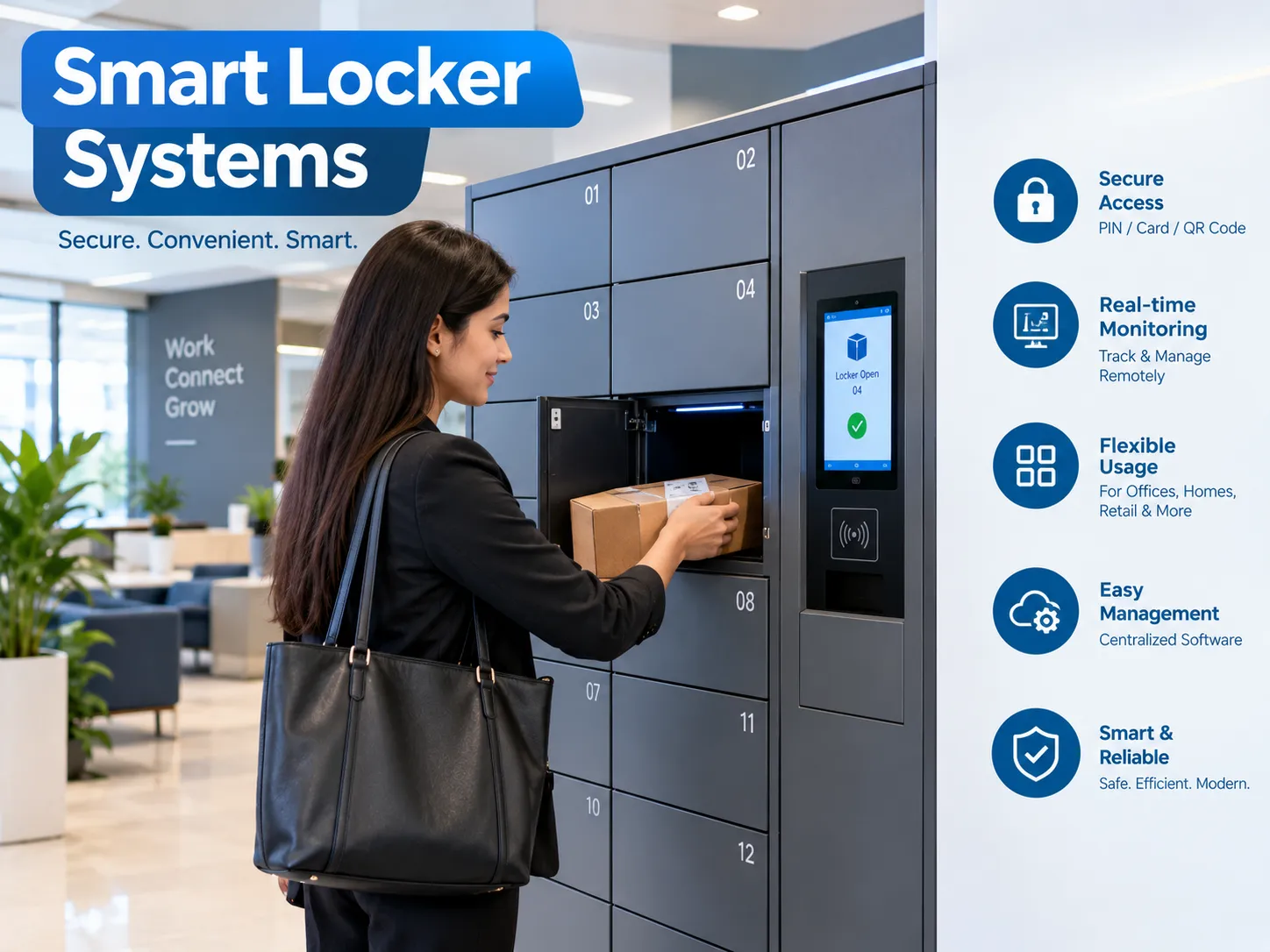

As businesses become more digital, secure storage is becoming an important part of modern workplaces, hotels, residential buildings, schools, hospitals, gyms, and commercial facilities. Traditional lockers that use physical keys or simple combination locks can create problems such as lost keys, forgotten passwords, difficult access management, and limited visibility. A Smart Locker System provides a modern solution by combining secure lockers with digital technology, electronic access, monitoring, and management software.

A Smart Locker System allows organisations to manage lockers electronically and provide users with secure, convenient access. Depending on the system, users can open lockers using PIN codes, RFID cards, QR codes, mobile applications, biometrics, or Face Recognition Locker Access. Administrators can manage locker assignments, monitor usage, control access permissions, and review activity through connected software.
For businesses in Saudi Arabia, particularly in Riyadh, smart lockers can support modern security and facility management requirements. From employee storage and hotel guest services to parcel delivery and high-security environments, an Electronic Locker System can make storage more convenient, organised, and secure.
What Is a Smart Locker System?
A Smart Locker System is an electronically controlled locker solution that uses digital technology to manage access, locker allocation, security, and usage information. Unlike traditional lockers that depend mainly on physical keys, smart lockers use electronic locking mechanisms and software to control who can access each compartment.
A smart locker can be connected to a central management platform known as Locker Management Software. Through this software, administrators can create users, assign lockers, change access permissions, monitor locker activity, and generate reports.
Different access technologies can be used depending on the requirements of the facility. These may include PIN codes, RFID cards, QR codes, mobile credentials, fingerprints, and facial recognition. With Face Recognition Locker Access, an authorised user can access a locker using facial verification instead of a physical key or card.
Smart lockers can also provide an audit trail. The system can record events such as locker opening, closing, access attempts, and user activity. This can help businesses improve accountability and manage locker usage more efficiently.
Types of Smart Locker Systems
Smart lockers are available in different configurations because organisations use lockers for different purposes. A corporate office may need lockers for employees, while a hotel may require secure storage for guests. E-commerce companies may need delivery lockers, and industrial facilities may require highly secure electronic lockers.
Locker Management Software
Locker Management Software is the digital platform used to control and manage smart lockers. It provides administrators with a central interface where they can manage users, lockers, access permissions, and activity records.
Instead of manually assigning keys, an administrator can digitally assign a locker to an employee or user. When the employee leaves the organisation or no longer needs the locker, access can be removed through the software.
Locker Management Software can also help organisations monitor locker availability. Administrators can see which lockers are occupied, available, assigned, or temporarily reserved. This can be particularly useful for large facilities with hundreds or thousands of lockers.
Integration with employee management systems, access control systems, mobile applications, or other business platforms can further improve the efficiency of locker operations.
Delivery Locker
A delivery locker is designed for receiving and storing parcels securely. It can be used by residential communities, offices, universities, shopping centres, hotels, and other locations where people regularly receive deliveries.
Instead of a delivery person leaving a package at a reception desk or outside a building, the parcel can be placed inside an assigned locker. The recipient can then receive a notification and access the locker using a secure code, QR code, mobile application, or another authorised method.
Delivery lockers can reduce the workload for reception and security teams while providing users with a convenient way to collect parcels. They can also reduce the risk of packages being misplaced or left unattended.
Smart Locker for Hotels
A Smart Locker for Hotels can be used in different areas of hotel operations. Hotels can provide smart lockers for luggage storage, employee belongings, guest services, spa facilities, gyms, and other applications.
For example, a hotel guest who arrives before check-in time may need a secure place to store luggage. A smart locker can provide controlled storage without requiring staff to manually manage every item.
Hotels can also use smart lockers for employee storage. Hotel staff can receive individually assigned lockers that are managed electronically. This can make locker allocation easier when employees work in shifts or when staff numbers change frequently.
A smart locker can also support a more modern guest experience by providing convenient, technology-based access.
Smart Locker System KSA
A Smart Locker System KSA solution is designed to meet the operational and security requirements of businesses and organisations in Saudi Arabia. It can be deployed in corporate offices, hotels, hospitals, schools, universities, residential communities, factories, warehouses, gyms, and other facilities.
Businesses in Saudi Arabia can choose locker systems based on their specific access requirements. Some environments may need RFID or PIN access, while high-security facilities may consider biometric authentication or Face Recognition Locker Access.
When selecting a Smart Locker System KSA, organisations should also consider software security, data protection, integration capabilities, local technical support, and long-term maintenance.
Benefits of a Smart Locker System
One of the main benefits of a Smart Locker System is improved security. Electronic access allows organisations to control who can open a locker and when they can access it. If an employee loses an RFID card or leaves the organisation, access can be changed or removed without replacing physical locks.
Convenience is another important benefit. Users do not need to carry traditional keys that can be lost or damaged. Depending on the system, they can use a PIN, RFID card, QR code, smartphone, fingerprint, or face recognition to access their locker.
Smart lockers can also reduce administrative work. With traditional lockers, administrators may need to maintain physical keys and manually track assignments. A digital management platform can simplify locker allocation and provide a central view of locker usage.
Another benefit is better accountability. Electronic systems can create records of access activity, allowing authorised administrators to understand when lockers were accessed and by whom.
Smart lockers can also save time. In busy workplaces, hotels, gyms, and residential facilities, users can access their assigned storage without waiting for reception staff.
For parcel delivery, smart lockers can provide secure self-service collection. For businesses, this can reduce pressure on reception and improve the overall delivery process.
Importance of Smart Locker Systems for Businesses in KSA and Riyadh
Saudi Arabia is investing heavily in digital transformation, smart infrastructure, hospitality, logistics, and technology-driven services. Businesses in Riyadh and other major cities increasingly require systems that improve efficiency while supporting modern security requirements.
A Smart Locker System can be useful in corporate offices where employees need secure personal storage. It can also support hotels, residential communities, universities, hospitals, fitness centres, logistics facilities, and commercial buildings.
Riyadh's growing business environment means that many organisations manage large numbers of employees, visitors, contractors, guests, and deliveries. Traditional locker systems can become difficult to manage as facilities expand.
An Electronic Locker System provides a scalable approach. New users can be added, access permissions can be updated, and lockers can be reassigned through software. This can be particularly useful for organisations with multiple departments, locations, or employee shifts.
Businesses should also consider personal data protection when using smart locker technologies, especially when biometric authentication or facial recognition is involved. Saudi Arabia's Personal Data Protection Law establishes requirements concerning the processing of personal data, making data governance an important consideration when deploying systems that collect or process user information.
For this reason, businesses should evaluate not only the physical security of the lockers but also the security of the software, user credentials, biometric information where applicable, and connected systems.
Features to Look for in a Smart Locker System
When selecting a Smart Locker System, organisations should first consider the access method. A flexible system may support RFID cards, PINs, QR codes, mobile access, biometrics, or facial recognition. The appropriate method depends on the facility's security requirements and user experience.
Face Recognition Locker Access can be useful in environments where organisations want a contactless authentication method. Facial recognition should be implemented with appropriate security, privacy, consent, and data-handling controls based on the applicable requirements.
Centralised Locker Management Software is another important feature. Administrators should be able to create and manage users, assign lockers, modify permissions, view locker status, and monitor activity from a central dashboard.
Real-time monitoring can help administrators understand which lockers are occupied or available. A good system should also provide activity logs and reports so authorised staff can review access events when necessary.
Integration is also important. Businesses may want to connect the locker system with access control, employee management, visitor management, hotel systems, mobile applications, or other software.
Scalability should also be considered. A solution suitable for a small office may not be suitable for a large corporate campus or hotel chain. Businesses should choose a system that can expand as their requirements grow.
Hardware quality is equally important. A Visitor Management Device is different from a locker device, but the same principle applies: organisations should choose reliable hardware designed for continuous use and appropriate environmental conditions.
Why Choose a Professional Smart Locker Provider?
Selecting a professional provider can make a major difference in the success of a smart locker project. A smart locker is not simply a metal cabinet with an electronic lock. It is a combination of hardware, software, access control, networking, security, and user management.
A professional provider can assess the facility and recommend the appropriate locker configuration, authentication technology, software, and integration options. The provider can also support installation, system configuration, testing, user training, and maintenance.
Professional support becomes particularly important for large installations. If hundreds of lockers are deployed across an office, hotel, university, or residential community, organisations need reliable technical support and a clear maintenance process.
Businesses in Saudi Arabia should also consider the provider's local presence and ability to provide after-sales support. Fast technical assistance can help reduce downtime and ensure that employees, guests, and customers continue to have access to their lockers.
The provider should also explain how user data is protected, where data is stored, how access permissions are managed, and what security controls are available. This is particularly important when systems use biometric or facial recognition technologies.
Conclusion
A Smart Locker System provides a modern way to manage secure storage in offices, hotels, residential buildings, schools, hospitals, gyms, logistics facilities, and other organisations. By combining electronic locks, digital authentication, and Locker Management Software, businesses can improve security, convenience, accountability, and operational efficiency.
From employee lockers and hotel luggage storage to delivery lockers and advanced Face Recognition Locker Access, smart locker technology can be adapted to different business requirements.
For organisations in Riyadh and across Saudi Arabia, selecting the right Smart Locker System KSA requires careful consideration of security, access technology, software capabilities, integration, scalability, data protection, hardware quality, and technical support.
A professional provider can help businesses select, install, integrate, and maintain the right Electronic Locker System according to their specific operational requirements.
Upgrade to Smarter and More Secure Locker Management
Ready to modernise your facility with a reliable Smart Locker System? Contact a professional smart locker provider today to discuss your requirements and discover a solution designed for your business in Riyadh or anywhere in Saudi Arabia. Request a product demonstration and explore options such as Locker Management Software, delivery lockers, hotel smart lockers, electronic access, and Face Recognition Locker Access to create a safer and more convenient storage experience.
Frequently Asked Questions
1. What is a Smart Locker System?
A Smart Locker System is an electronically controlled locker solution that uses digital technology to manage locker access, users, permissions, and activity. Users can access lockers through methods such as PINs, RFID cards, QR codes, mobile credentials, biometrics, or facial recognition, depending on the system.
2. What is an Electronic Locker System?
An Electronic Locker System uses electronic locking mechanisms instead of traditional physical keys. It can connect to management software and provide controlled access, user management, activity records, and other digital features.
3. How does Face Recognition Locker Access work?
Face Recognition Locker Access uses facial recognition technology to verify an authorised user before allowing access to a locker. The system compares the user's face with an enrolled facial profile according to the system's authentication process. Organisations using facial recognition should carefully consider applicable privacy, security, and personal data requirements.
4. Can Smart Locker Systems be used in hotels?
Yes. A Smart Locker for Hotels can be used for guest luggage, employee storage, gyms, spas, staff areas, and other applications. Smart lockers can provide controlled self-service access and reduce the amount of manual locker management required from hotel staff.
5. What should businesses look for in a Smart Locker System KSA?
Businesses should consider access methods, Locker Management Software, security controls, activity monitoring, reporting, integration capabilities, scalability, hardware quality, data protection, installation, maintenance, and local technical support. The right solution should match the organisation's security requirements, facility size, user volume, and future expansion plans.























Sign in to leave a comment.