
Temperature-controlled storage has become an essential part of many businesses across the United Arab Emirates. Hospitals, pharmacies, laboratories, food suppliers, restaurants, supermarkets, hotels, and pharmaceutical facilities all depend on refrigerators and freezers to keep sensitive products within safe temperature conditions.
A small temperature change can sometimes create a major operational problem. A refrigerator may continue running while its cooling performance slowly decreases, a door may remain open for too long, or a power interruption may cause the internal temperature to rise. If the problem is discovered several hours later, valuable products may already be affected.
A modern Refrigerator Temperature Monitoring System provides a smarter way to manage this risk. Instead of depending entirely on manual checks, organizations can continuously monitor storage conditions and receive notifications when an unusual temperature change occurs.
The Growing Need for Smart Cold Storage in the UAE
The UAE's demanding climate makes dependable refrigeration particularly important. During the hotter months, refrigeration equipment can operate under greater pressure, while frequent door opening and heavy usage can create additional temperature fluctuations.
Traditional temperature checking requires employees to physically inspect equipment and record readings at specific times. Although this method can provide basic information, it does not show what happens between two manual readings.
For example, an employee may check a refrigerator at 9:00 AM and find the temperature acceptable. If the refrigerator develops a cooling problem at 10:00 AM, the next manual inspection may not happen until the afternoon.
A Real-Time Temperature Monitoring System closes this visibility gap by continuously collecting temperature information.
From Manual Checking to Continuous Monitoring
The main difference between conventional temperature checking and automated monitoring is continuity.
Manual monitoring provides individual readings.
Automated monitoring provides a temperature history.
A connected sensor can take readings at regular intervals throughout the day and night. These readings can be transferred to a digital platform where users can view current conditions and previous temperature behavior.
This creates a more complete picture of refrigeration performance.
Instead of asking, "What was the temperature when someone checked it?" businesses can determine how the temperature behaved over an extended period.
How Smart Refrigerator Monitoring Works
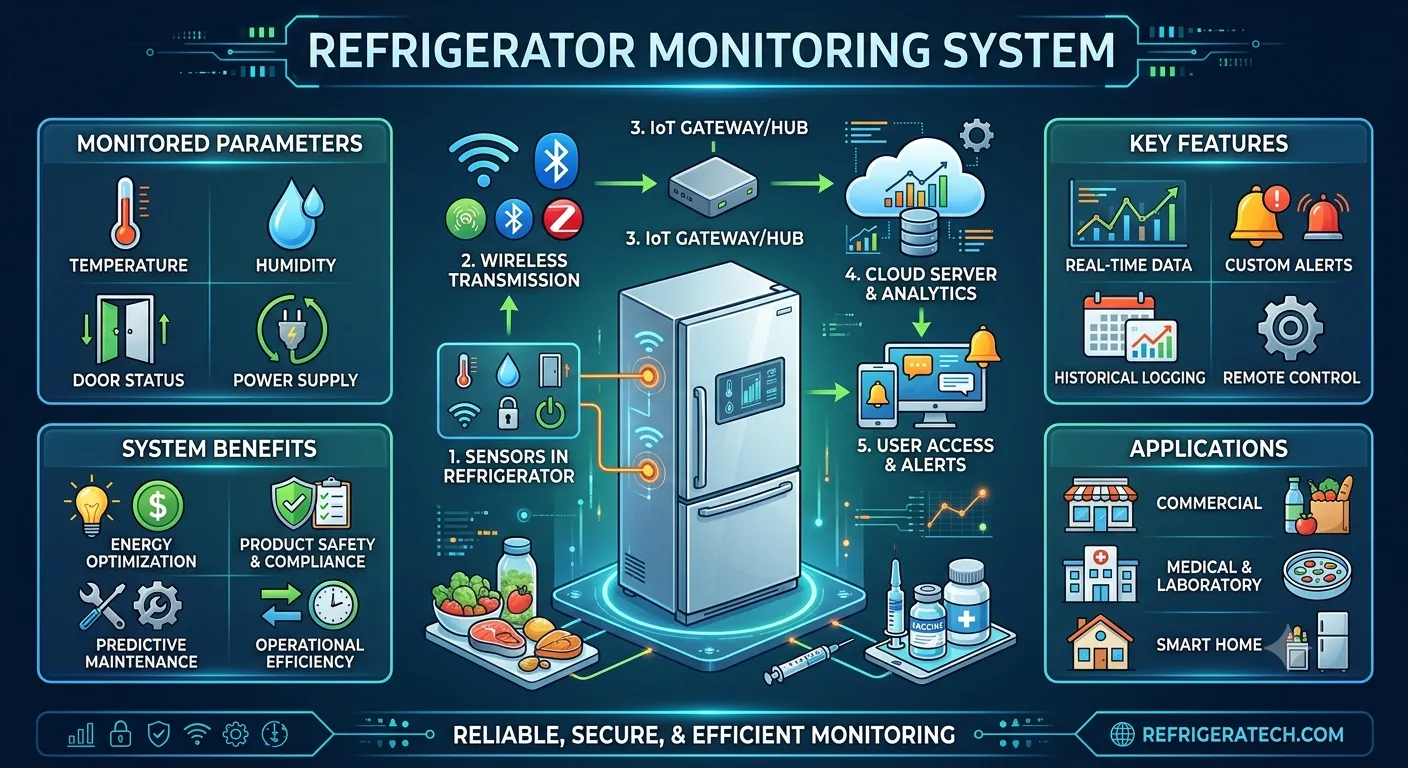
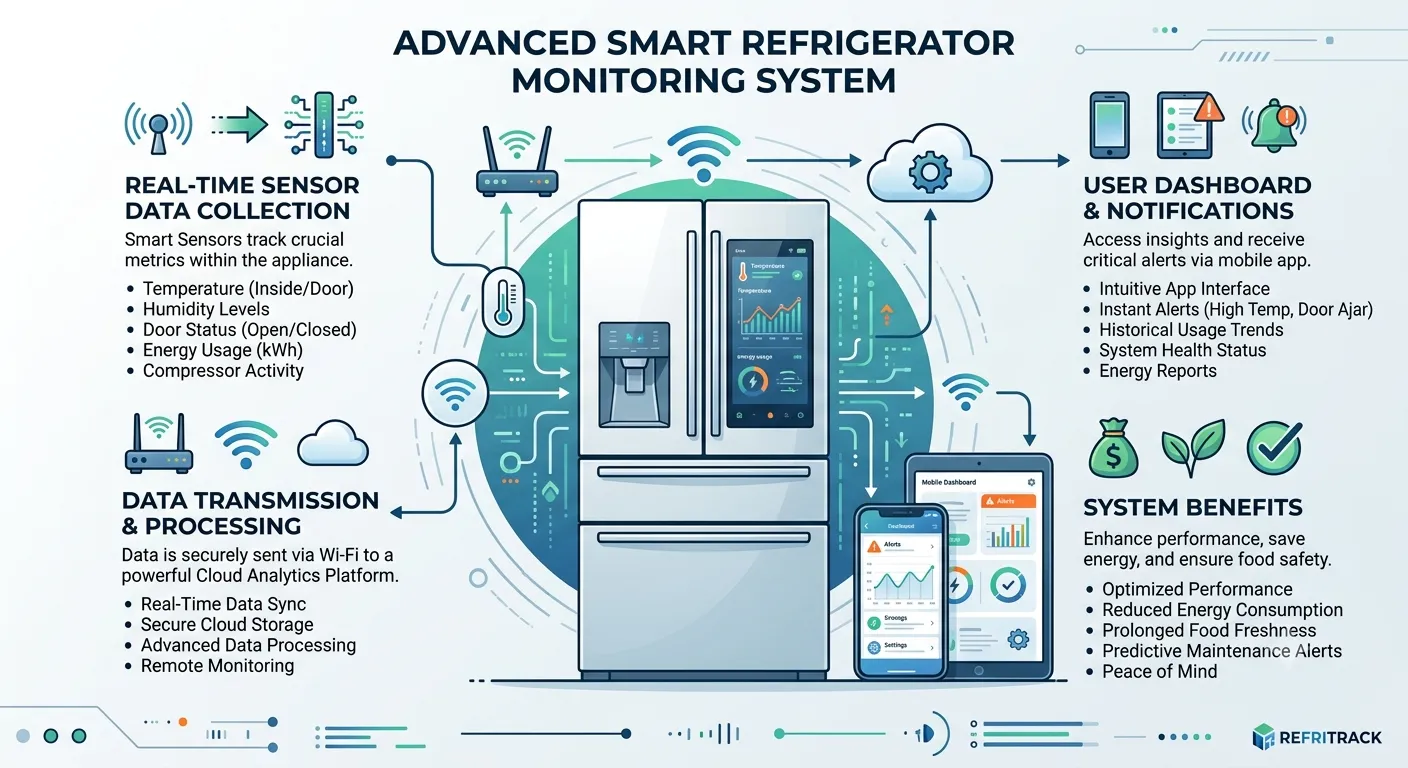
A Smart Refrigerator Monitoring System generally consists of three main components: sensors, connectivity, and monitoring software.
Temperature Sensors
A temperature sensor is positioned inside the refrigerator, freezer, cold room, or other storage environment. It measures internal conditions according to the selected monitoring interval.
Communication Network
The collected information is transmitted to a monitoring platform through an appropriate communication method.
Monitoring Dashboard
Users can access the collected information through a digital dashboard. Depending on the system, the dashboard may display live temperature readings, historical graphs, alerts, device status, and reports.
When the temperature exceeds the configured limit, the system can automatically generate an alert.
This creates a simple cycle:
Measure → Transmit → Analyze → Alert → Respond
Immediate Awareness of Temperature Problems
One of the strongest advantages of Temperature Alerts is early awareness.
Consider a pharmacy refrigerator storing temperature-sensitive medicines. If the cooling system starts to malfunction, the temperature may gradually increase.
Without an automated system, the issue may remain unnoticed until the next physical inspection.
With automated monitoring, the temperature change can trigger a notification once it reaches the selected warning level.
Staff can then investigate the refrigerator, check the power supply, inspect the door, contact maintenance personnel, or move products to another suitable storage unit.
The objective is not simply to send notifications. The objective is to give people enough time to make informed decisions.
Protecting Medicines and Healthcare Products
Healthcare facilities require dependable storage conditions for many temperature-sensitive products.
Hospitals, clinics, pharmacies, laboratories, and medical centers may have refrigerators dedicated to medicines, vaccines, samples, reagents, and other sensitive materials.
A Medical Refrigerator Monitoring System provides continuous visibility into these storage environments.
Instead of maintaining separate handwritten temperature sheets, healthcare teams can use automated records to understand storage conditions over time.
The system can also help identify repeated fluctuations that may otherwise be overlooked.
For example, if a refrigerator consistently becomes warmer during certain hours, historical information can help maintenance teams investigate the cause.
Supporting Pharmaceutical Cold Chain Operations
Pharmaceutical storage requires careful control because temperature excursions can affect product quality.
A Pharmaceutical Temperature Monitoring System can continuously record storage conditions across refrigerators, freezers, warehouses, and other temperature-controlled areas.
Digital monitoring can help organizations detect:
- Unexpected temperature increases
- Cooling failures
- Power interruptions
- Abnormal temperature fluctuations
- Extended temperature excursions
- Repeated equipment instability
The ability to identify these events quickly can support better cold chain management.
Monitoring Food and Beverage Storage
Temperature monitoring is not limited to healthcare.
Restaurants, hotels, supermarkets, catering companies, food distributors, and commercial kitchens operate multiple refrigerators and freezers every day.
Food products may be exposed to unsuitable conditions when equipment fails, doors remain open, or refrigeration performance declines.
A Commercial Refrigerator Monitoring System can provide centralized visibility across multiple storage units.
This can be particularly useful for businesses that operate large kitchens or several branches.
Instead of asking employees to manually inspect every unit repeatedly, management can use automated monitoring to identify equipment that requires attention.
Reducing Unnecessary Food Waste
Food waste can become expensive when refrigeration problems are discovered too late.
A refrigerator failure occurring overnight may remain unnoticed until employees arrive the following morning. During that period, stored products may be exposed to unsuitable temperatures.
With 24/7 Temperature Monitoring, businesses can receive alerts outside normal working hours.
This allows designated employees or managers to respond sooner.
Early notification does not guarantee that every product can be saved, but it can significantly improve the opportunity to investigate and take appropriate action before the problem becomes larger.
Monitoring Refrigerator Doors
Temperature is not the only factor that can affect refrigeration.
A refrigerator door that remains open for an extended period can allow warm air to enter the storage area. In busy commercial environments, repeated door opening can also contribute to temperature fluctuations.
When supported by suitable sensors, Refrigerator Door Monitoring can provide additional operational information.
For example, an organization may configure an alert for an unusually long door-opening event. Staff can then check whether the door was accidentally left open or whether there is a problem with the closing mechanism.
Combining temperature and door information can provide greater insight into the reason behind certain temperature changes.
Understanding Temperature Trends
A single temperature reading provides limited information.
Temperature trends provide much more insight.
A Temperature Monitoring Dashboard can display historical readings in graphs, making it easier to identify gradual changes and repeated fluctuations.
For instance, a refrigerator may maintain stable temperatures during the morning but show increasingly higher readings during the afternoon.
Without historical data, this pattern may be difficult to identify.
With digital records, businesses can analyze temperature behavior and investigate possible causes such as frequent access, equipment workload, environmental conditions, or cooling-system performance.
Automated Records for Better Documentation
Maintaining accurate temperature records can be challenging when employees are responsible for manually recording readings across numerous refrigerators.
Human error, missed checks, inconsistent recording times, and damaged paper records can create documentation problems.
An Automated Temperature Data Logger continuously captures temperature readings and stores them digitally.
This can help organizations maintain organized records that are easier to review and analyze.
Digital documentation can also support internal quality procedures, audits, investigations, and operational reporting.
Remote Monitoring Across UAE Locations
Businesses with several branches can benefit from Cloud-Based Temperature Monitoring.
A centralized platform can allow authorized users to view information from different locations through one interface.
For example, a business operating facilities in Dubai, Abu Dhabi, Sharjah, and other UAE locations may have multiple refrigerators distributed across different sites.
Instead of requiring management teams to collect temperature information separately from each location, centralized monitoring can make the information available through a single system.
This improves visibility while reducing repetitive administrative work.
Benefits for Facility and Maintenance Teams
Temperature monitoring can also support maintenance teams.
A refrigerator that repeatedly experiences abnormal temperature patterns may require inspection before a complete failure occurs.
Historical data can help technicians understand the equipment's behavior and determine when an issue started.
This supports a more proactive approach to maintenance.
Instead of responding only after a refrigerator completely stops cooling, organizations can investigate unusual performance earlier.
This concept is particularly valuable when refrigeration equipment supports critical operations.
Energy and Operational Efficiency
A Smart Cold Storage Monitoring System can also contribute to better operational awareness.
Temperature data can help businesses understand whether refrigeration units are maintaining stable conditions or experiencing frequent fluctuations.
Unusual temperature behavior may indicate issues such as inefficient cooling, excessive door opening, overloaded storage, or equipment problems.
While temperature monitoring itself does not automatically guarantee energy savings, the information it provides can help organizations identify situations that deserve further investigation.
Choosing a Temperature Monitoring Solution in UAE
Organizations should evaluate several factors before implementing a Wireless Temperature Monitoring System.
Sensor Accuracy
Sensors should be appropriate for the required temperature range and application.
Alert Configuration
Users should be able to establish suitable warning and critical thresholds.
Data History
The system should retain historical information for analysis and documentation.
Remote Accessibility
Authorized personnel should be able to access monitoring information when they are away from the physical site.
Scalability
The solution should support additional refrigerators and locations as the organization grows.
Reporting
Clear reports and temperature graphs can make information easier to understand.
Connectivity
Reliable communication is important because monitoring becomes less useful if data cannot reach the platform.
Why Automated Monitoring Is a Long-Term Investment
Installing a Digital Refrigerator Monitoring System should not be viewed only as another technology purchase.
It is an investment in operational visibility.
Businesses cannot prevent every refrigeration problem, but they can improve how quickly they discover and respond to problems.
The value comes from combining continuous data collection, automated alerts, historical records, and remote visibility into one monitoring process.
This can help organizations move from reactive temperature management toward a more proactive approach.
Future of Refrigerator Monitoring in the UAE
The future of cold storage management is likely to become increasingly connected.
IoT-Based Temperature Monitoring can provide the foundation for more advanced technologies such as predictive analytics, automated reporting, intelligent anomaly detection, and equipment-performance analysis.
Instead of simply identifying that a refrigerator is becoming warmer, future systems can increasingly analyze temperature patterns and identify unusual behavior.
This can support earlier maintenance decisions and improve overall cold-storage management.
As businesses across the UAE continue adopting smart technologies, connected monitoring can become an important part of modern facility operations.
Conclusion
A Refrigerator Monitoring System in UAE provides continuous visibility that traditional manual checks cannot offer. By collecting temperature information automatically, generating alerts, maintaining digital records, and supporting remote access, the technology helps organizations respond more quickly to abnormal conditions.
From healthcare and pharmaceutical facilities to restaurants, hotels, supermarkets, laboratories, and catering operations, automated monitoring can improve temperature management and reduce the risks associated with unnoticed refrigeration problems.
For UAE businesses, adopting Real-Time Refrigerator Monitoring is a practical step toward more reliable cold storage, stronger operational control, and smarter facility management.
Frequently Asked Questions
1. What does a refrigerator monitoring system measure?
A refrigerator monitoring system primarily measures temperature inside refrigerators, freezers, medical storage units, and other controlled environments. Some solutions can also monitor door status, power conditions, humidity, and other parameters depending on the configuration.
2. Can refrigerator temperature be monitored 24/7?
Yes. A properly configured 24/7 Refrigerator Temperature Monitoring System can continuously collect temperature readings throughout the day and night and generate alerts when predefined limits are exceeded.
3. Is refrigerator monitoring useful for restaurants in the UAE?
Yes. Restaurants, hotels, catering businesses, and commercial kitchens can use automated monitoring to oversee refrigerators and freezers and receive notifications when abnormal temperature conditions occur.
4. Can multiple refrigerators be monitored from one platform?
Yes. A centralized monitoring platform can support multiple refrigeration units and, depending on the solution, multiple branches or facilities. This can make it easier for managers to oversee distributed cold-storage equipment.
5. How does temperature monitoring help reduce product loss?
Continuous monitoring can identify temperature problems earlier than periodic manual checks. Early alerts give staff more time to investigate the cause, protect affected products where appropriate, and address equipment problems before losses become greater.

























Sign in to leave a comment.